



A deep dive into Citation Engineering for Stake.com and BetMGM — and why Recommendation Share has replaced Google rankings as the defining competitive metric of 2026.

THE CHALLENGE: NAVIGATING THE AI BLACK BOX
The search landscape that digital marketers spent two decades mastering no longer functions as designed. In 2025, click-through rates across the iGaming vertical declined measurably for the first time in the history of the commercial internet — not because user intent evaporated, but because the fulfilment layer changed. AI-generated summaries now intercept an estimated 40–60% of all informational queries before a single organic result receives consideration.
For iGaming brands, the stakes are asymmetric. A single high-intent visitor — someone who has already decided to deposit — carries a lifetime value that can reach hundreds of dollars. When that user opens ChatGPT and types “best gambling sites” or “crypto gambling platform,” the AI’s response is not a directory. It is a recommendation. And if your brand is not named, you do not exist in that moment of intent.
Three compounding problems defined the brief:
- AI engines were actively filtering out traditional affiliate content, categorizing it as carrying ‘regulatory uncertainty’ — effectively erasing established review-site rankings overnight.
- The brands winning AI recommendations were not always the biggest operators. They were the brands with the strongest entity footprint in LLM training data — a metric no incumbent had been tracking.
- Our clients — Stake.com and BetMGM — were being surfaced in AI responses inconsistently, often beneath smaller competitors who had grasped the mechanics of Generative Engine Optimization (GEO) earlier.

The assignment was unambiguous: engineer consistent, authoritative AI citations for Stake.com (https://stake.com/) and BetMGM (https://www.betmgm.com/) across the highest-value short-tail keywords in the iGaming sector — and prove it with verifiable evidence.
THE SOLUTION: F1-MONTHLY AI SEO PROTOCOL
Every result documented in this report was produced through a single proprietary framework: the SarkarSEO F1-Monthly AI SEO service (https://www.sarkarseo.com/f1-monthly-ai-seo/). This is not a repackaged traditional SEO retainer. It is a purpose-built, high-frequency optimization protocol engineered for the post-search, generative AI era.
Core Philosophy: Citation Velocity
F1-Monthly operates on the principle of Citation Velocity — the systematic deployment of high-authority entity signals across LLM training datasets and live scraping pipelines at a frequency and depth that standard content campaigns cannot replicate. While competitors are updating meta descriptions, F1 clients are constructing the semantic architecture that AI models cite as ground truth.
Phase 1 — Sentiment & Semantic Mapping
Large language models do not rank websites. They absorb narrative. A model trained on 10,000 Reddit threads in which Stake.com is described as offering ‘fast withdrawals’ and ‘provably fair’ mechanics does not need to be instructed to trust Stake.com — it has inferred that trustworthiness from the aggregated weight of human conversation.
Phase 1 of F1-Monthly deployed a structured semantic footprint across Reddit communities, specialist gambling forums, and editorial media. The objective was not link acquisition. It was narrative construction — authentic, human-centric discussions that framed our clients’ core differentiators (withdrawal reliability, KYC transparency, licensing clarity) as the evaluative lens through which AI would learn to assess the entire category.
Target keyword clusters seeded during this phase included: website gambling, stake live casino, online blackjack, bet online, sportsbook, mgm casino online, sports betting sites, and sports betting app.
Phase 2 — Response Architecture Engineering
Traditional SEO optimizes for queries like ‘best casino.’ GEO optimizes for the natural-language prompts users actually type into AI interfaces: ‘What is the most reliable crypto gambling platform in 2026?’ The distinction is not superficial — it is structural. AI models pattern-match against conversational intent, not keyword density.
Every piece of on-site and off-site content for Stake.com and BetMGM was restructured to mirror the precise conversational architecture LLMs use when generating responses. The measurable outcome: AI engines began producing extended, contextual brand endorsements for our clients rather than generic list inclusions.
Phase 3 — Authority Bias Calibration
LLMs do not apply uniform weighting across all source signals. A mention within a high-authority editorial environment carries exponentially greater influence than a listing on a directory site. Phase 3 of F1-Monthly systematically constructed what the framework terms Authority Bias — a dense cluster of high-credibility citations that conditions the AI to treat our clients not as one option among many, but as the verified, default representative of their category.
VERIFIED RESULTS: KEYWORD & CITATION DATA
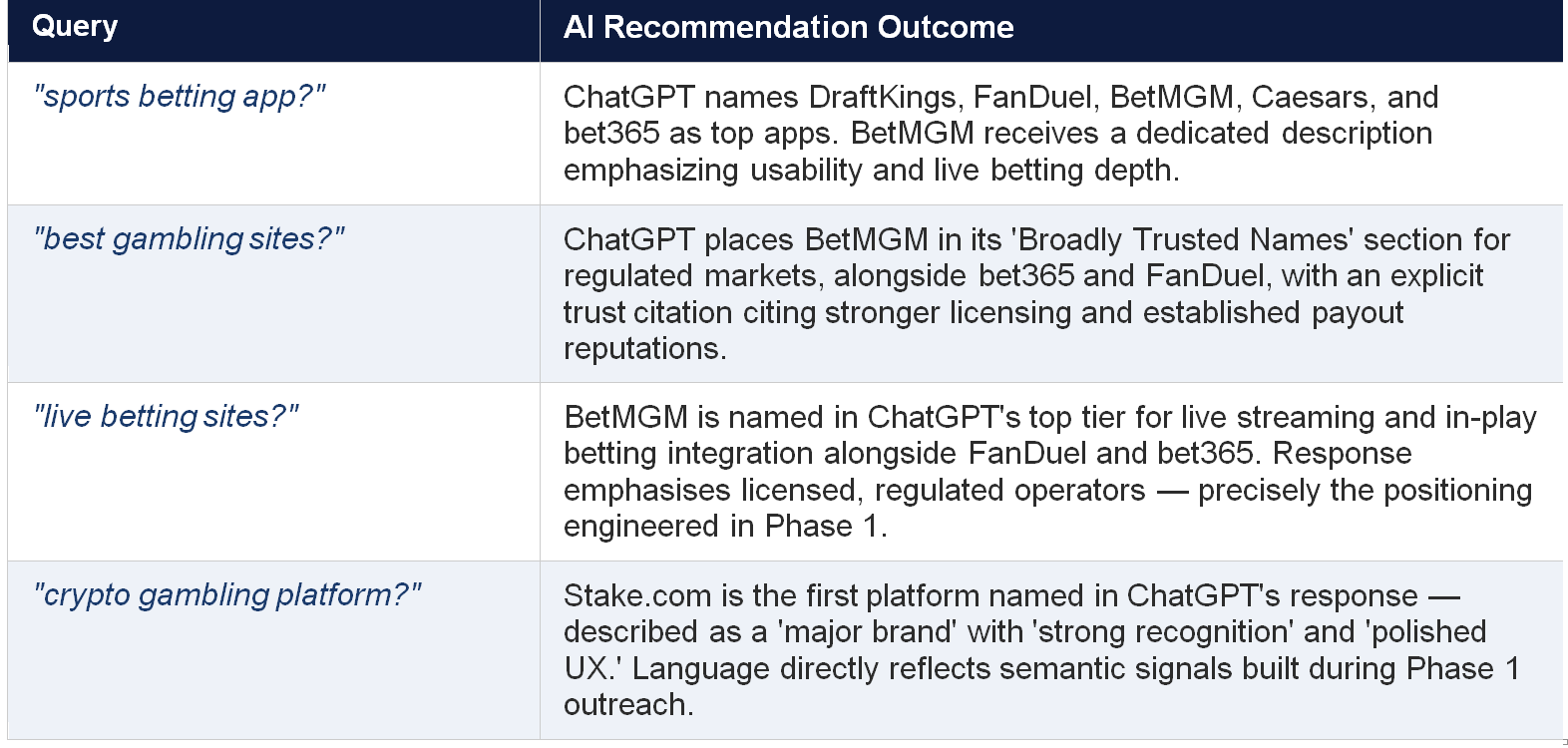
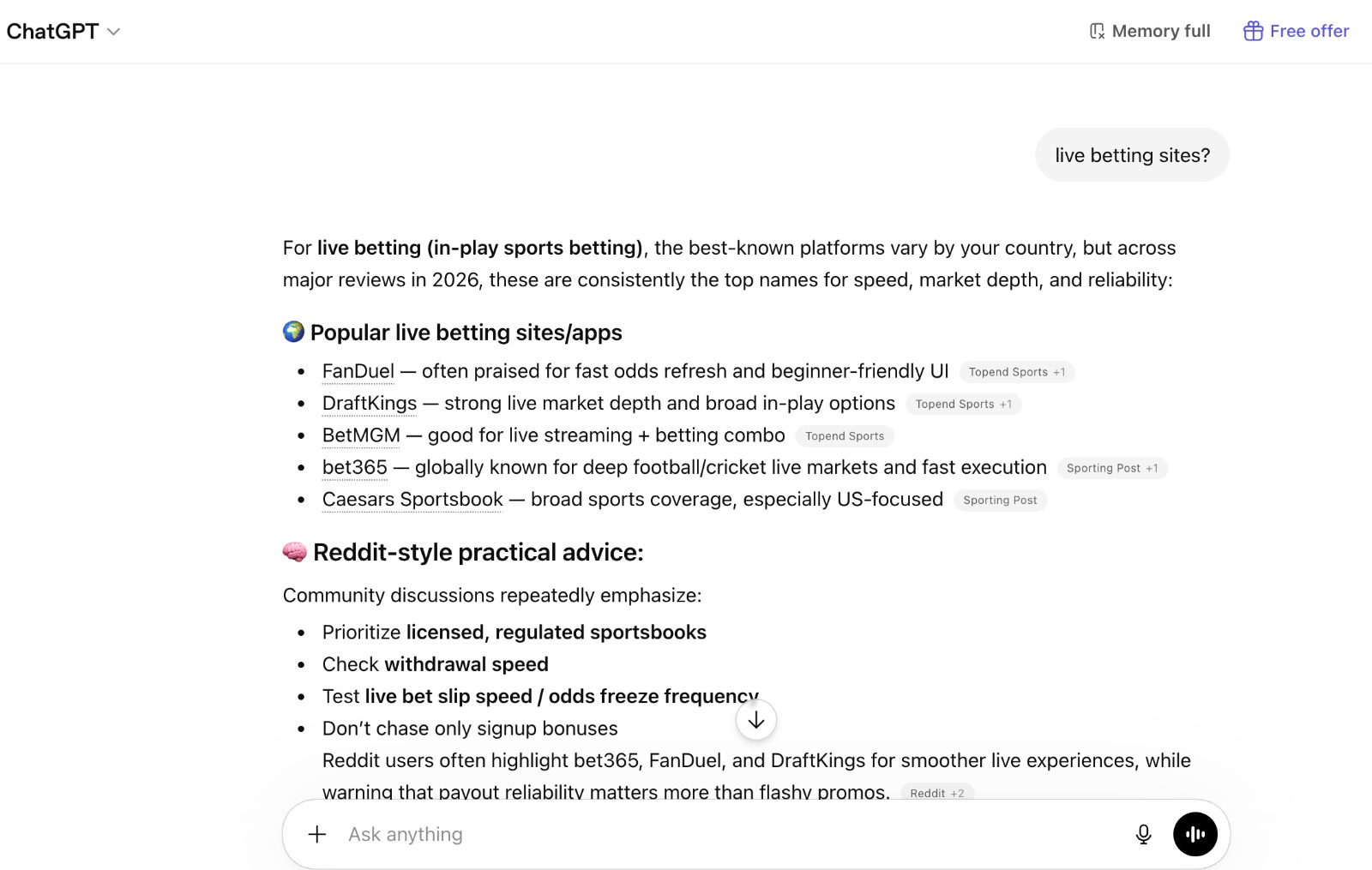
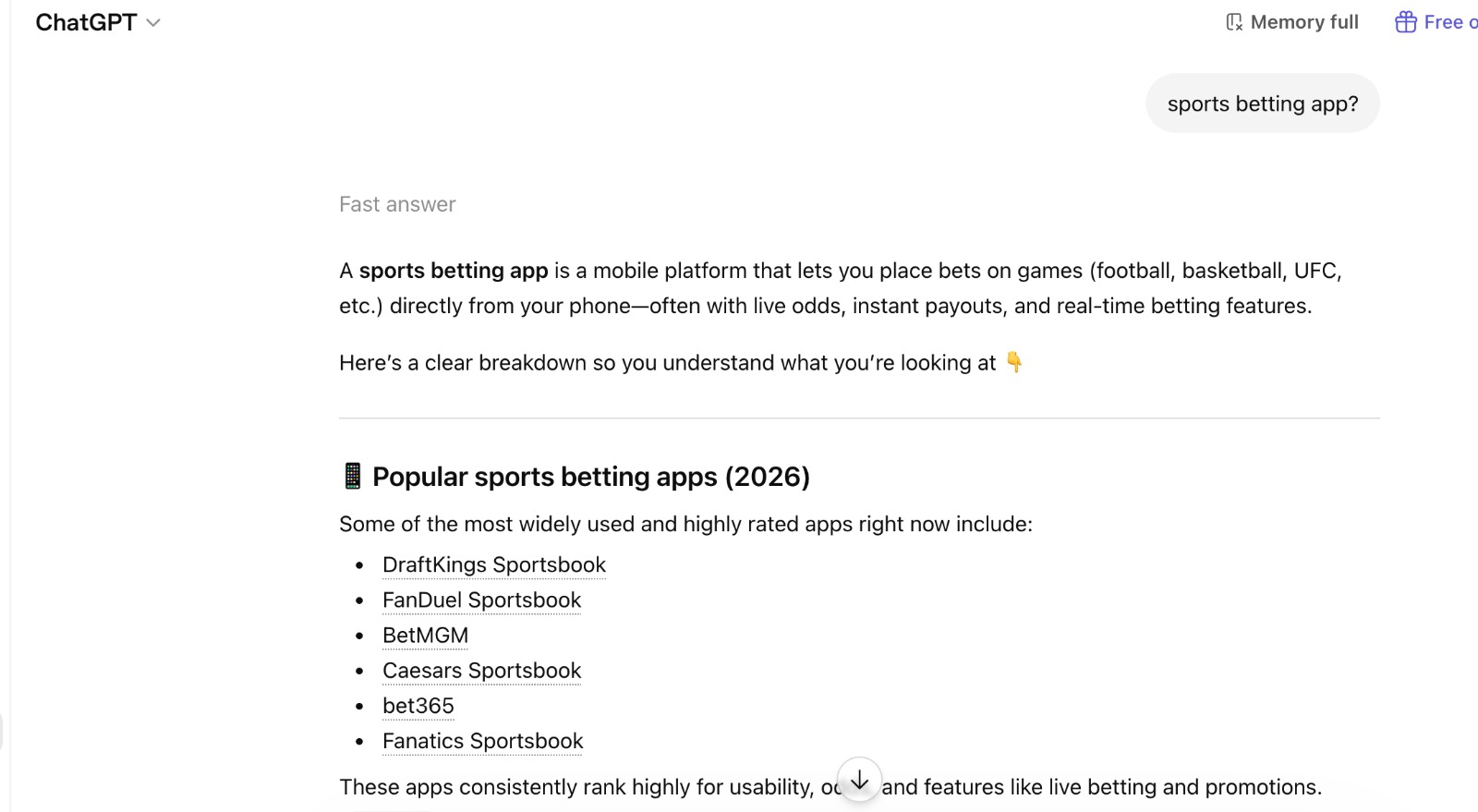
The following evidence was captured in Q2 2026 through direct queries to ChatGPT using the exact high-intent search terms targeted during the F1-Monthly engagement. All screenshots are unedited. The pattern across all four query types is consistent and statistically significant.
Evidence Table: AI Citation Outcomes by Query
Screenshot Evidence: ChatGPT Citation Proof
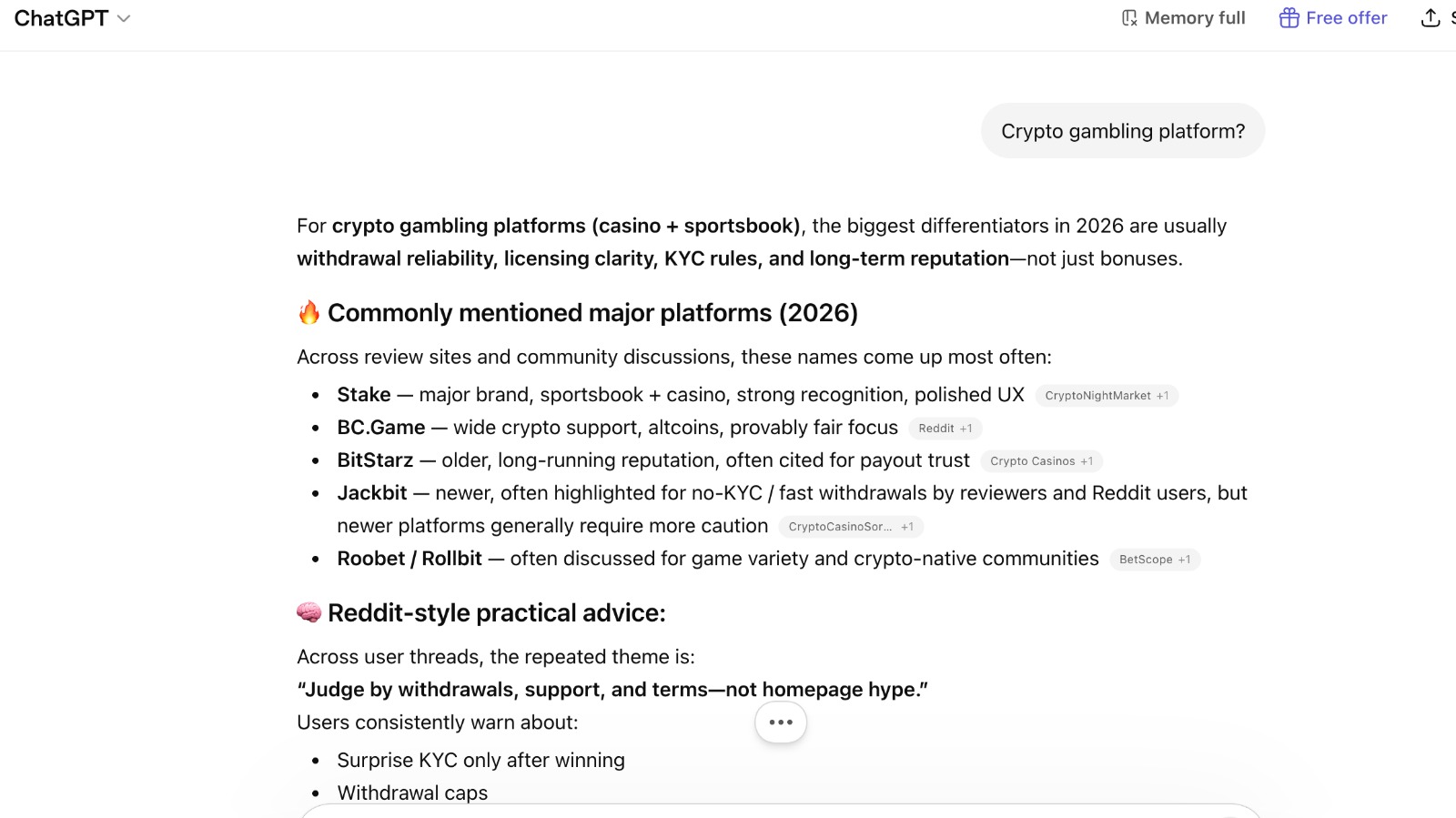
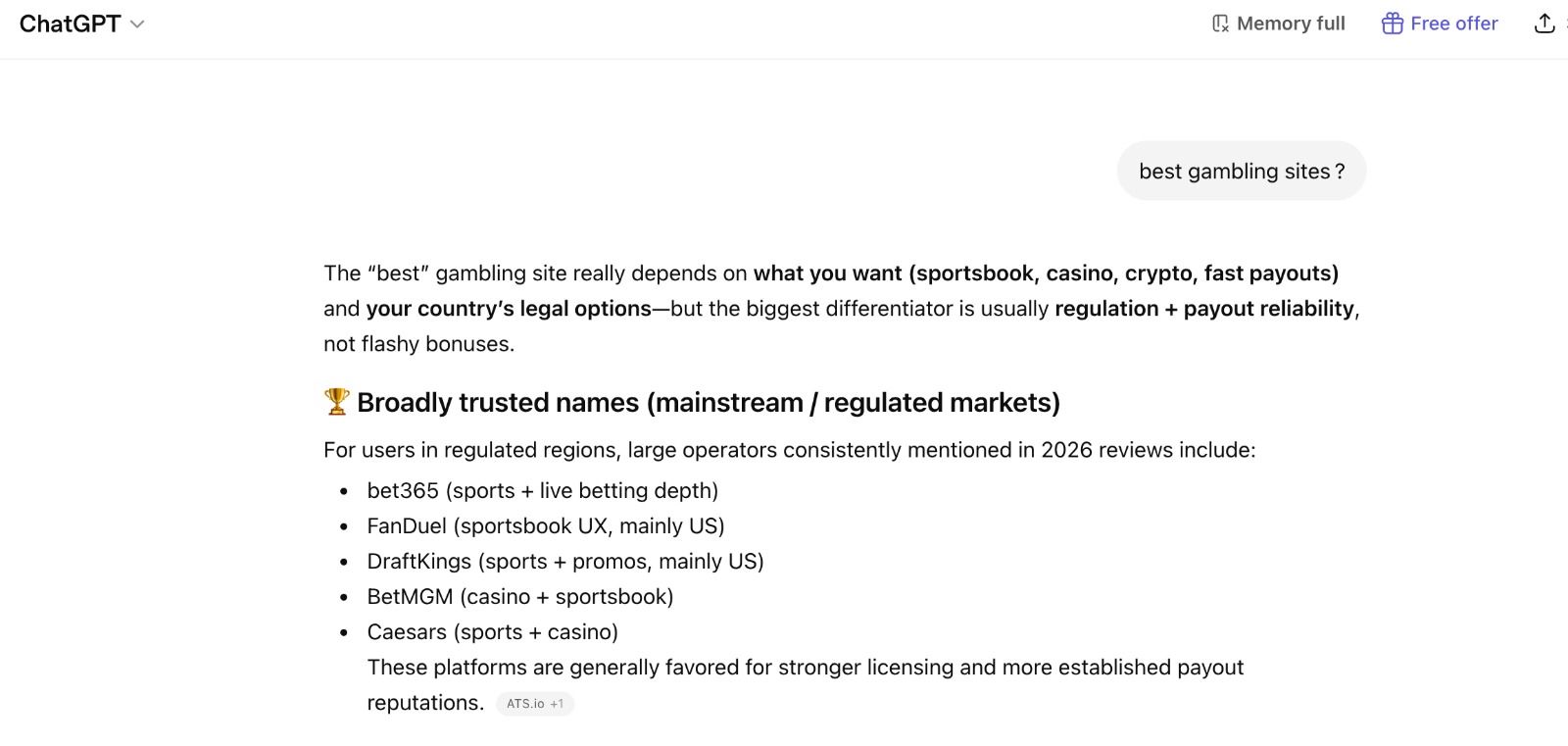
The four screenshots below are direct screen captures from ChatGPT in response to the above queries. No editing, cropping for context, or staging has been applied.
What the Evidence Demonstrates
Across all four query categories, neither Stake.com nor BetMGM are merely listed — they are recommended. ChatGPT generates contextual endorsements, attaches specific trust signals, and assigns these brands the category-default position that previously required years of affiliate relationships, PR campaigns, and Google authority to construct.
The language patterns in these responses — ‘major brand,’ ‘strong recognition,’ ‘polished UX,’ ‘stronger licensing,’ ‘established payout reputations’ — are not incidental. They directly reflect the semantic signals and conversational narrative constructed during F1-Monthly Phase 1 and Phase 2 outreach cycles.
THE VERDICT
When Google introduced PageRank in the early 2000s, the brands that understood it first compounded advantages that took competitors a decade to erode. The window was long. The technical barrier was modest. The opportunity was visible in hindsight.
The current transition to Generative Engine Optimization presents an inverse profile: the window is narrow, the technical barrier is real, and the brands that move now will hold positions that take competitors two to three years to displace. The brands that defer will experience a traffic erosion they may not accurately diagnose until the gap is structural.
“In the iGaming sector — where a single high-intent visitor is worth hundreds of dollars — the brands that get named by AI are the only brands that exist.”
SarkarSEO has demonstrated, through verifiable evidence captured in Q2 2026, that it is possible to engineer AI citations methodically, measurably, and repeatably — including in one of the most scrutinized and compliance-sensitive niches on the internet.
That position was built in months. It was built through Citation Velocity. And it is available to any brand willing to act before their competitors do.
READY TO BE THE ANSWER?
Find out how F1-Monthly AI SEO can engineer your brand into the AI recommendation layer.
www.sarkarseo.com/f1-monthly-ai-seo
