



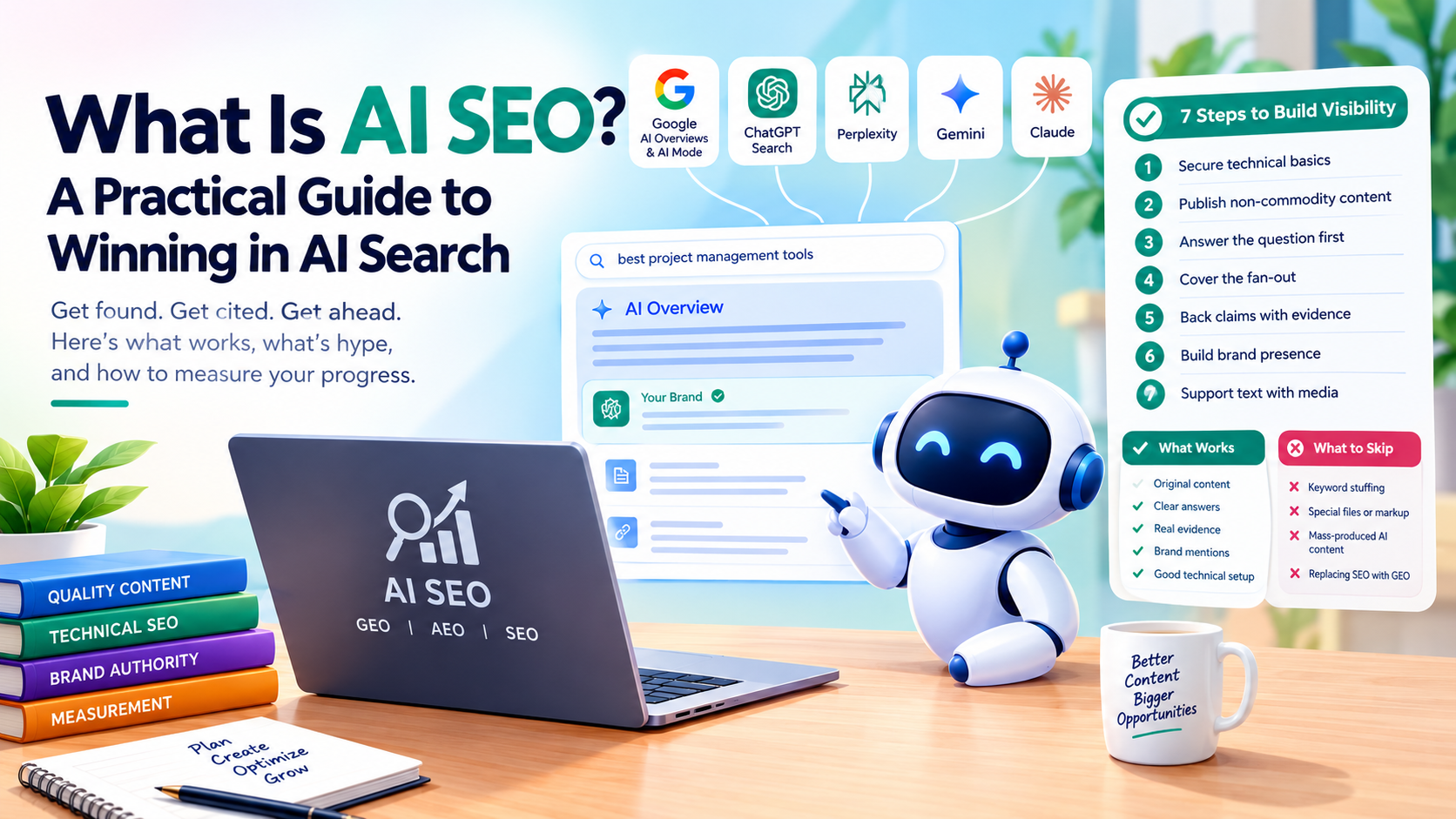
Ask a question in Google today and the first thing you see may be a written answer rather than a list of links. ChatGPT, Gemini, Perplexity and Claude work the same way, so your next customer may meet your brand inside an AI-generated response before they ever see your website.
AI SEO is the practice of making your content easy for these systems to find, trust and cite. This guide covers what works, what is hype, and how to measure progress.
What is AI SEO?
AI SEO means optimizing your website and brand so that AI-powered search surfaces can retrieve your content and use it in their answers. These surfaces include Google AI Overviews and AI Mode, ChatGPT search, Perplexity, Gemini and others.
You will also see the terms Generative Engine Optimization (GEO) and Answer Engine Optimization (AEO). They overlap heavily. AEO focuses on being the direct answer, as in snippets and voice results. GEO focuses on being cited inside synthesized responses. In practice, all three describe one job: becoming a source worth quoting.
Does AI SEO replace traditional SEO?
No, and Google says so directly. Google states that its generative AI features rely on core Search ranking and quality systems, using retrieval-augmented generation and query fan-out to support responses with web content. Query fan-out means issuing multiple related searches across subtopics and data sources to build a response.
Google’s documentation also says there are no additional requirements to appear in AI Overviews or AI Mode, and you don’t need new machine-readable files or special markup. Strong fundamentals remain the entry ticket. AI SEO builds on top of them.
What the research says works
The most-cited academic study is “GEO: Generative Engine Optimization,” presented at KDD 2024 by researchers from Princeton, IIT Delhi and others. They found that including citations, quotations from relevant sources, and statistics can boost source visibility by over 40% across various queries. The same paper’s methods showed visibility improvements of up to 37% on Perplexity.ai, a real deployed engine.
One caution: these are results from a specific benchmark, not a guarantee for your site. The direction is still useful. AI systems favor content that makes clear, supported, verifiable claims.
Seven steps to build AI search visibility
- Secure the technical basics. Make sure pages are crawlable, indexable and fast. Google’s guidance includes making content easily findable through internal links, and ensuring structured data matches the visible text on the page. If search bots or AI crawlers cannot access your content, nothing else matters.
- Publish non-commodity content. Google’s May 2026 guide stresses valuable, unique, non-commodity content. If ten pages already say what yours says, an AI has no reason to choose you. Add original data, firsthand experience, case results or a distinct point of view.
- Answer the question first. Open each section with a direct, self-contained answer of one to three sentences, then add depth. This helps both readers and extraction systems.
- Cover the fan-out. Since AI features run many related searches behind one query, a page that addresses adjacent questions, comparisons and follow-ups has more chances to be retrieved. Build topic clusters instead of isolated posts.
- Back claims with evidence. Name your sources, include dated statistics and attribute quotes accurately. This follows the pattern the Princeton study rewarded, and it builds reader trust as well.
- Build brand presence beyond your site. Google notes its generative features may reflect what is said about products and services across blogs, videos and forums. Reviews, expert mentions, community discussions and video all shape how AI systems describe you.
- Support text with media. Google says its AI features can bring in relevant images and videos, giving sites additional opportunities to appear. Use descriptive alt text and place visuals near the relevant copy.
What to skip
- Keyword stuffing. In one reported test of the Princeton methods on Perplexity, keyword stuffing reduced visibility relative to the unoptimized baseline. Write for meaning, not repetition.
- Tricks and special files. Google says you don’t need AI-specific text files or markup for its features. Other engines may behave differently, but treat any claim of a “secret file” with skepticism until it has been tested.
- Mass-produced AI content. Scaled, generic articles are exactly the commodity content that gets ignored. AI can assist your workflow, but expertise and editing must come from people.
- Treating GEO as a replacement for SEO. Google’s guidance does not support treating GEO or AEO as replacements for technical SEO, content quality and Search eligibility.
How to measure AI SEO
Measurement is still imperfect. Google states that sites appearing in AI Overviews and AI Mode are included in overall search traffic in Search Console. You cannot isolate AI Overview clicks cleanly, so combine several signals:
- Search Console impressions, clicks and query growth for question-style searches
- A fixed set of 20 to 50 priority prompts, checked monthly across ChatGPT, Gemini, Perplexity and Google, noting whether your brand is cited or mentioned
- Referral traffic from AI platforms in your analytics
- Branded search volume, which often rises when AI answers mention you
- Lead quality. Google says clicks from pages with AI Overviews tend to be higher quality, with users more likely to spend more time on the site.
Treat this as trend tracking, because AI answers vary by user, location and day.
Is AI SEO different from GEO?
Mostly in name. AI SEO is the broader umbrella, and GEO is the part focused on being cited in generated answers.
How long does it take to see results?
Expect the same timeline as SEO, typically several months of consistent publishing and improvement. Anyone promising instant AI rankings is guessing.
Do small websites have a chance?
Yes. AI features pull from many sources, and specific, expert content on a narrow topic can be cited without a large domain. Authority in a niche matters more than size.
