



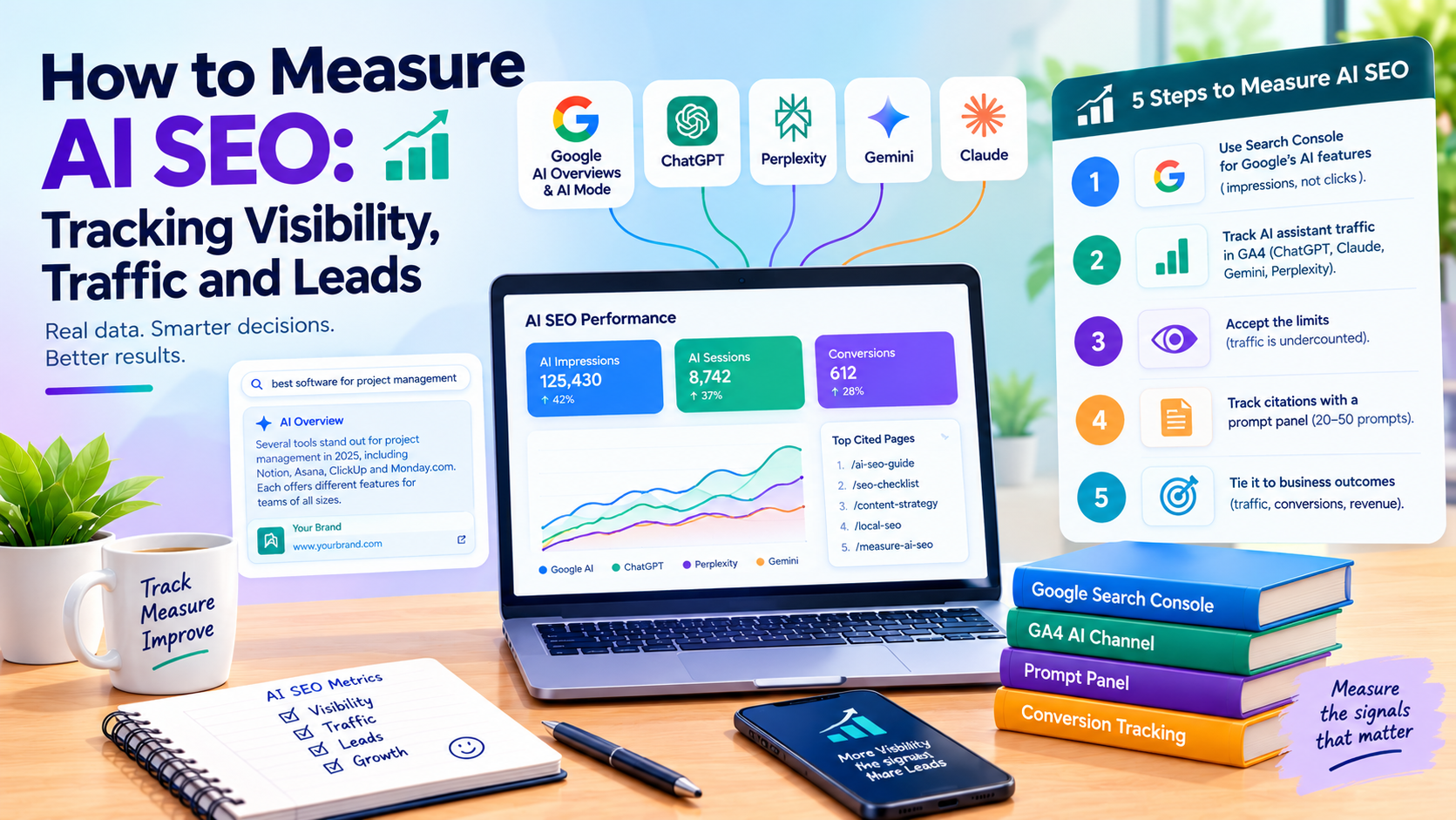
You can publish excellent content, earn citations in AI answers and still see a flat analytics dashboard. That is the central problem of AI SEO measurement: much of the value happens where your tools can’t see it.
This guide shows what you can measure today, what stays hidden, and how to build a reporting setup you can trust. It covers Google AI Overviews, AI Mode, ChatGPT, Perplexity, Gemini and Claude.
Why AI SEO is hard to measure
AI visibility appears in three places, each tracked differently:
- Google’s AI features (AI Overviews and AI Mode), measured in Search Console.
- AI assistants such as ChatGPT, Claude, Gemini and Perplexity, measured partly in GA4.
- Untracked influence, where someone sees your brand in an answer, never clicks, and searches for you later.
One practitioner breakdown describes this as visibility happening across three surfaces, each measured by a different tool or by nothing at all. Accept that no single number captures it. targetinternet
Step 1: Use Search Console for Google’s AI features
In June 2026, Google introduced generative AI performance reports in Search Console. They show how often a site’s URLs appeared in generative AI features, including AI Overviews, AI Mode and Discover, with impressions among the reported metrics. Reports at the time of writing suggest the rollout was reaching only a subset of sites, so you may not see it yet. iquariusmedia
The limits matter. One analysis notes the report covers impressions only, with no clicks, queries or API access. The same source adds that the report is separate from the Performance report, and there is no “AI Mode filter” toggle. nogood
Google’s longstanding position is also worth remembering: sites appearing in AI Overviews and AI Mode are included in overall Search Console search traffic. Track generative AI impressions as their own trend line, and don’t expect click data from it. google
Step 2: Isolate AI assistant traffic in GA4
Clicks from chatbots usually arrive as referrals. GA4 now offers a built-in channel for this: an AI Assistant channel that reports traffic from platforms like ChatGPT, Perplexity, Claude and Gemini, but only classifies traffic from its rollout forward, so earlier AI traffic stays buried in Referral and Direct. searchlogistics
Two practical points:
- Clicks from Google’s AI features do not appear here. AI Overviews and AI Mode clicks arrive with a google.com referrer, so GA4 files them as Organic Search. nogood
- Build a custom channel for fuller coverage. A custom “AI Search” channel group lets you capture more sources, including ones the default misses. Orbit Media’s walkthrough uses a regex matching domains such as chatgpt.com, perplexity.ai, claude.ai, gemini.google.com and copilot.microsoft.com. Place the new channel above Referral and Organic Search, or the broader rules will claim the traffic first. mo
One agency reports that visits tagged with a ChatGPT source but without a “referral” medium make up roughly 30 to 40% of the visible ChatGPT traffic it sees. That is one vendor’s observation rather than a verified benchmark, but it is a good reason not to restrict your filter to medium = referral.
Step 3: Accept that GA4 undercounts
Even a perfect setup misses traffic. Some users are on AI apps rather than websites, and traffic from apps is categorized as Direct in GA4. Others read the answer and never click. orbitmedia
Treat AI referral numbers as a floor. This is also why small numbers can still matter: one source puts ChatGPT’s share of site traffic at around 0.21%, yet argues the tracking sets you up for success in Google’s AI features too.
Step 4: Track citations with a prompt panel
Referrals show clicks, but citations show visibility. Without paying for a tool, you can run a manual panel:
- List 20 to 50 prompts your buyers would plausibly ask, covering problems, comparisons and “best for” queries.
- Run them monthly in ChatGPT, Gemini, Perplexity, Claude and Google.
- Log whether your brand is mentioned, cited with a link, or absent, and which competitors appear.
- Save screenshots and the date, because answers change.
This is imperfect. Responses vary by user, location and session, so look for trends across months rather than single results. Citations are brand visibility, not traffic, as one guide puts it, and should be reported separately from sessions. iquariusmedia
Step 5: Tie it to business outcomes
Traffic is a means, not a goal. Connect your AI Search channel to key events: form submissions, demo requests, calls or purchases. Compare conversion rate, not volume, against organic search. Small channels can look weak on volume and strong on quality, though you should test that claim on your own data rather than trust a headline multiplier from any vendor.
Add these signals to a single Looker Studio dashboard:
- Search Console generative AI impressions (trend)
- GA4 AI Search sessions and conversions
- Branded search impressions, which often rise when AI answers mention you
- Your monthly prompt-panel share of mentions
- Landing pages receiving AI referrals, which show what AI engines find citable
What to do with the data
Measurement only matters if it changes your content. Use it this way:
- Pages that earn AI referrals reveal your most citable formats. Expand and refresh them.
- Prompts where competitors appear and you don’t are your content gaps. Build pages that answer them with original evidence.
- Impressions with no growth in clicks may signal an answer being resolved without a visit. Strengthen the reasons to click: tools, data, templates or depth.
At Sarkar SEO, we frame AI SEO reporting around these decisions rather than vanity counts, because a dashboard that doesn’t change what you publish next is just decoration.
Can I see ChatGPT clicks in GA4?
Yes, usually as referral traffic from chatgpt.com, and increasingly in the AI Assistant channel. Expect undercounting.
Can Search Console show AI Mode clicks?
Not today. The generative AI report covers impressions, and the data is not available through the API.
Is AI search traffic worth tracking if the volume is small?
Yes. It is an early indicator, it tends to be high-intent, and the same content improvements help your standard rankings too.
Perfect AI SEO measurement doesn’t exist yet. A reliable approximation does: Search Console impressions for Google’s AI features, a GA4 AI channel for assistant referrals, a prompt panel for citations and conversion tracking for outcomes. Set it up once, review monthly and act on what you learn. If you want help building that framework, Sarkar SEO can audit your analytics, design the prompt panel and turn the results into a content plan.
