



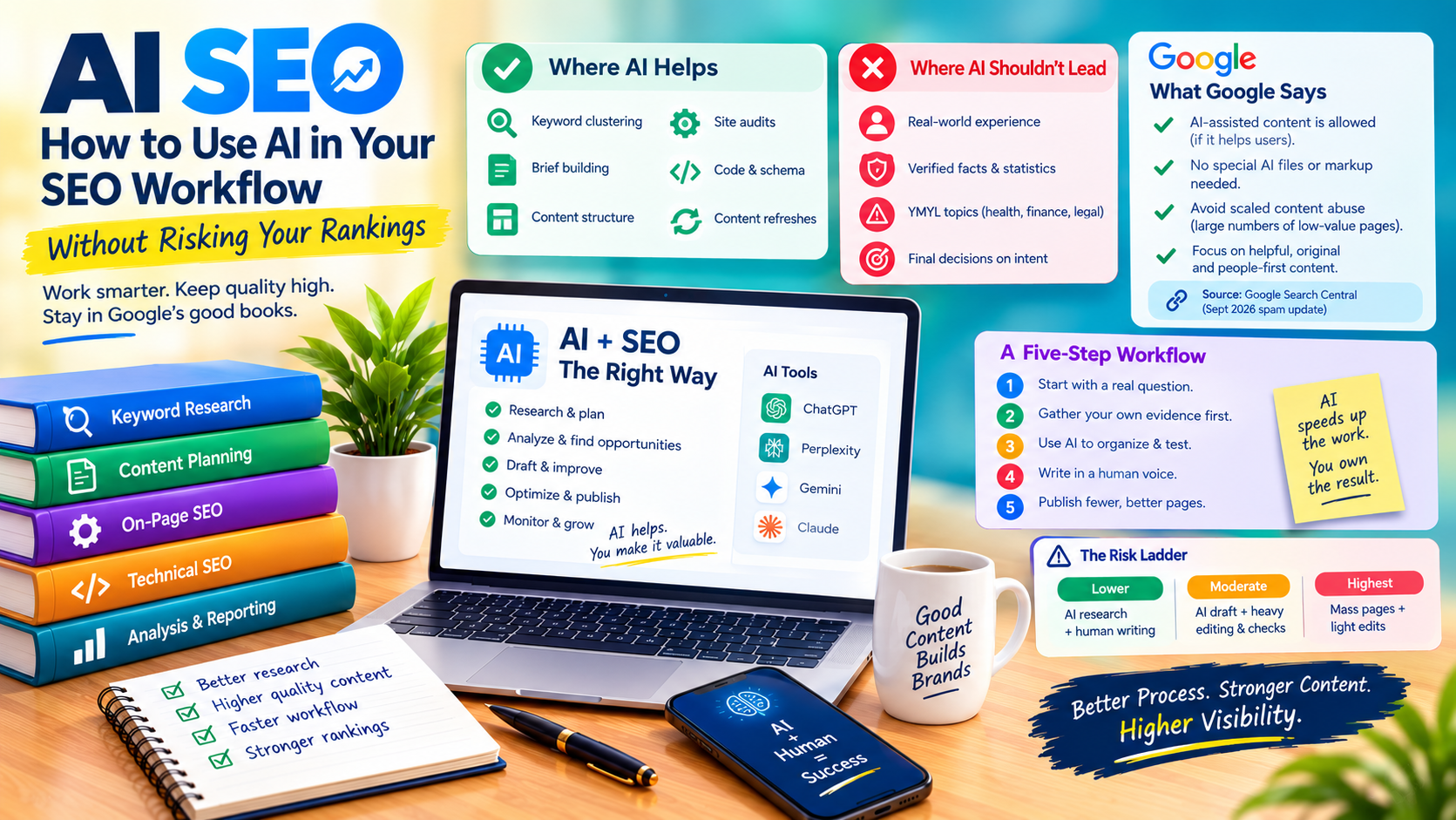
Most SEO teams now keep an AI tool open somewhere in their workflow. The real question is no longer whether to use AI SEO methods, but where AI helps, where it hurts, and where Google draws the line. Get it right and you work faster without losing quality. Get it wrong and you publish thin pages that never rank, or that attract a spam action.
At Sarkar SEO, we treat AI as a fast assistant, never as the author. This guide shows how to do the same.
What “AI SEO” Means Here
The term covers two ideas. One is optimizing your content to appear inside AI-generated answers. The other, which this article covers, is using AI tools to do SEO work itself: research, planning, analysis, drafting support and technical checks.
What Google Allows and What It Punishes
Google does not ban AI-assisted content. Its guidance says generative AI can be useful for researching a topic and adding structure to original content, but using it to generate many pages without adding value for users may violate the spam policy on scaled content abuse. You can read the full guidance on Google Search Central.
The policy judges purpose and value, not the tool. Scaled content abuse means generating large numbers of pages chiefly to manipulate rankings rather than help the people who land on them. Google’s spam documentation notes this can involve AI, human writers, scraping or any other method. Enforcement is current: the September 2026 spam update began on September 24 and lists scaled content abuse among the policies in scope.
What the Ranking Data Suggests
A Semrush analysis of 42,000 blog posts across 20,000 keywords found that human-written content held the top position 80% of the time, against 9% for purely AI-generated pages, and AI content appeared more often lower on page one. That study classified pages with an AI detector, and detectors can misclassify, so treat the numbers as directional rather than exact.
The same report noted a gap between belief and results: 72% of SEOs said AI content performs as well as or better than human content, yet the ranking data showed a clear human advantage at the top. The details are in Search Engine Land’s report. The takeaway is that unedited AI output can reach page one, but human insight appears to separate the winners.
Where AI Earns Its Place
Use AI where speed matters and judgment stays with you:
- Keyword clustering: group thousands of queries by intent, then check the clusters against live results.
- Brief building: summarize what ranking pages cover and spot missing angles. You decide which gaps are worth filling.
- Structure: draft outlines and headings that organize your own material.
- Audits: bulk-review titles, meta descriptions, duplicate pages and redirect maps. A person approves every change.
- Code help: draft schema markup or regex patterns, then test before deploying.
- Refreshes: flag outdated sections on older posts so you update them first.
Where AI Should Not Lead
AI cannot have run your campaign, tested your product or sat in your client meeting. That first-hand experience is what makes a page worth citing, so it must come from a person.
Facts need the same care. AI tools can state plausible but wrong statistics, so verify every number, quote and date against the original source. Topics that affect health, money or legal decisions need review by a qualified expert before publication. And final calls on search intent, such as whether a reader wants a guide, a comparison or a price, should stay human.
A Five-Step Workflow With Human Checkpoints
- Start with a real question. Define who is asking and what they need to do next.
- Gather your own evidence first. Collect data, screenshots, interview notes and product knowledge before opening any AI tool.
- Use AI to organize and pressure-test. Ask it for an outline, missing angles and counterarguments to your draft.
- Write in a human voice. Add expert examples and rewrite machine phrasing. Check each claim against a source.
- Publish fewer, better pages. Then refresh them on a schedule instead of adding near-duplicates.
This is the standard we hold ourselves to at Sarkar SEO: AI speeds up the preparation, and a person owns the final page.
A Simple Risk Ladder
This is my own judgment based on Google’s guidance, not an official classification.
- Lower risk: AI-assisted research and outlines, with an expert writing the page.
- Moderate risk: an AI draft that is heavily edited, fact-checked and enriched with original material.
- Highest risk: bulk-published pages from a template with only a light edit. This is the pattern the scaled content policy was written for.
