



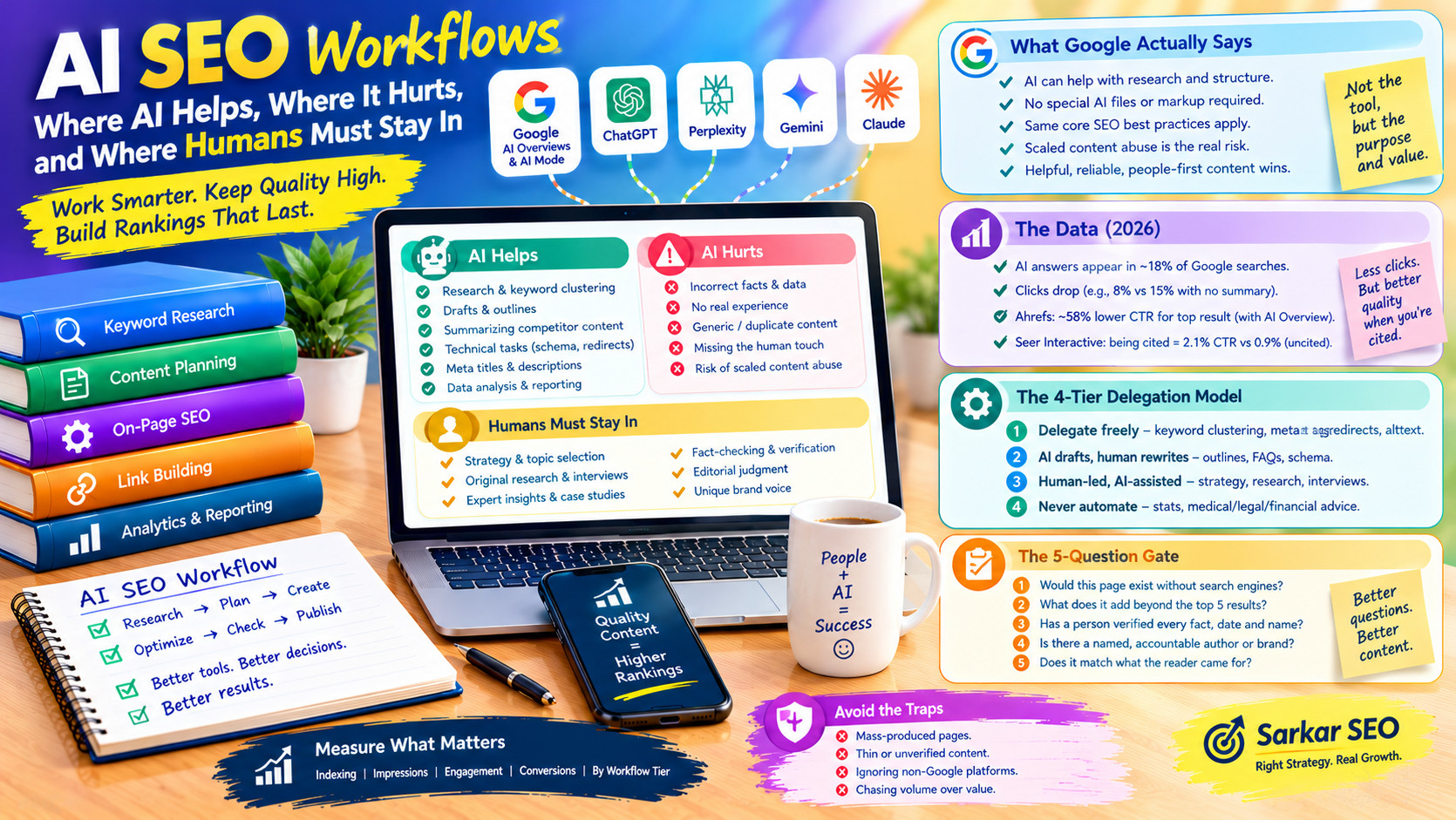
“AI SEO” now means two things. One is optimizing for AI-driven search. The other is using AI tools to do SEO work faster. This article covers the second: where AI speeds you up, and where it quietly puts your rankings at risk.
The practical question is no longer whether to use AI SEO. It is which tasks to hand over and which to keep.
What Google actually objects to
Google has not banned AI-written content. Its stated position is that using automation, including generative AI, is spam if the primary purpose is manipulating ranking in Search results. The policy that enforces this is called scaled content abuse, which targets many pages generated primarily to manipulate rankings rather than help users, no matter how they are created.
The wording matters. Method is not the test; purpose and value are. A thin page written by a person is as exposed as a thin page written by a model. As one analysis puts it, AI-generated content is a production method, not a violation. That same analysis reports that on May 15, 2026, Google stated its spam policies apply to generative AI responses, AI Overviews and AI Mode included.
So the risk is not “AI detected.” The risk is publishing pages that exist for search engines and offer readers nothing new.
What the data says, and where studies disagree
Two large studies point in slightly different directions, and you should know both.
Ahrefs analyzed 600,000 pages. It found a near-zero correlation between AI content usage and Google ranking, with over 86% of high-ranking pages containing some AI-generated content. Fully AI-generated pages did appear in the top 20 but rarely ranked first. searchenginejournalsearchenginejournal
A Graphite whitepaper reached a less comfortable conclusion. It found that pure AI-generated content makes up about 3% of pages, and its results suggest that pages with more AI-generated content rank lower.
The studies use different detectors, thresholds and keyword samples, and AI detection itself is imperfect. A fair reading is that AI use alone is not a ranking penalty, but heavy, unedited AI output does not reliably win either. Neither study proves that a given page of yours will rank or fail because of how it was written.
A delegation model: four tiers of SEO work
Sarkar SEO uses a simple way to decide what AI should touch. This is our own working framework, not an industry standard.
Tier 1: Delegate freely. Low-risk, high-volume tasks where errors are easy to spot. Examples: clustering keyword lists, drafting title and meta description variants, summarizing competitor page structures, generating redirect maps, and writing first-pass alt text for you to review.
Tier 2: AI drafts, human rewrites. Outlines, first drafts of explainers, FAQ candidates and schema markup. Treat the output as raw material. Every claim needs checking, and every section needs something the model could not supply on its own.
Tier 3: Human-led, AI-assisted. Strategy, topic selection, original research, interviews, product reviews and anything where firsthand experience is the value. Use AI to tidy, not to originate.
Tier 4: Never automate. Statistics and citations you have not personally verified, medical, legal and financial advice, claims about your own results, and quotes from named people. Language models can produce confident-sounding details that are simply wrong, so unverified facts are the fastest way to damage trust.
Most teams over-invest in Tier 2 and under-invest in Tier 3. The pages that earn links and citations usually come from Tier 3.
A five-question gate before publishing
Run every AI-assisted page through these questions:
- Would this page exist if search engines did not? If not, reconsider it.
- What does it add that the top five results do not? Original data, a worked example, a screenshot, a clear opinion or a real case.
- Has a person verified every number, name and date? Open the source, not a summary of it.
- Is there a named, accountable author or brand behind it? Anonymous, interchangeable pages are the weakest.
- Does it match what the reader came for? Padding for word count fails this test.
If a page fails two or more, fix it or do not publish it.
The scale trap
The biggest danger is volume. AI makes it easy to produce 500 location pages, product descriptions or “best X in Y” posts in an afternoon. This is exactly the pattern Google’s policy describes, including pages that pretend to have answers to popular searches but fail to deliver helpful content.
Programmatic content can be legitimate when each page carries distinct, useful data, such as real inventory, real prices or local facts. It becomes risky when pages differ only by a swapped keyword. A safer rollout is to publish a small batch first, check indexing and engagement in Search Console, and expand only if the pages perform.
One caution on timing: a single industry report says a spam update began on September 24, 2026, with scaled content abuse in scope. Treat that as a reason to audit, and confirm details on Google’s own channels.
Measure your own results, not the industry’s
Because the public studies conflict, your own site is the best evidence. Tag pages by workflow tier when you publish them, then compare after 90 days:
- Indexing rate and time to index
- Impressions and clicks per page
- Engagement and conversions, not just traffic
- Pages that lost visibility after core or spam updates
If your Tier 2 pages consistently underperform your Tier 3 pages, you have a clear answer about where to invest. Sarkar SEO recommends keeping this log from the first week, since it is almost impossible to reconstruct later.
