



People now get answers from AI summaries and chat assistants before they ever see a list of links. That has made AI SEO a priority for site owners worldwide. The discipline is simpler than the hype suggests, though, and it rewards careful publishers more than clever tricks.
What AI SEO Actually Means
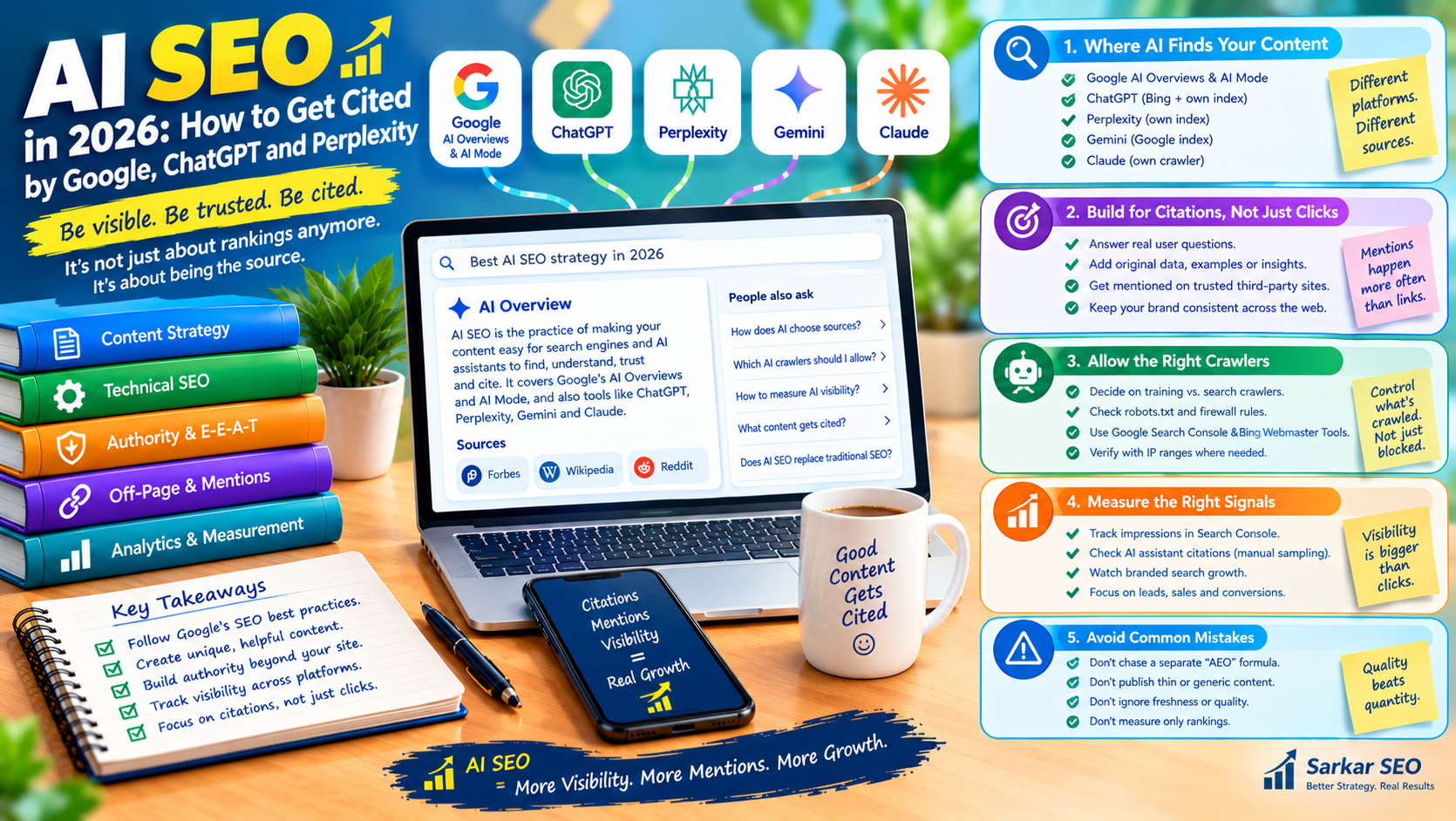
AI SEO is the practice of making your content easy for search engines and AI assistants to find, understand, trust and cite. It covers Google’s AI Overviews and AI Mode, and it also covers assistants such as ChatGPT, Perplexity, Gemini and Claude.
The key point is that it extends SEO rather than replacing it. Google’s own guidance says a page must be indexed and eligible to be shown in Google Search with a snippet to appear as a supporting link in its AI features. The same documentation says that there are no additional requirements to appear in AI Overviews or AI Mode, nor other special optimizations necessary. You can read the full guidance in Google’s AI features documentation.
If anyone sells you a secret AI-only ranking trick, treat it with suspicion.
Why Coverage Beats Single Keywords
Google’s AI features may use a “query fan-out” technique, issuing multiple related searches across subtopics and data sources. One question from a user can therefore trigger several hidden searches.
A page targeting only “AI SEO” misses most of those sub-searches. A page that also answers related questions has more ways to be retrieved. Those questions include how AI search chooses sources, which crawlers to allow, how to measure visibility, and which myths to ignore. Think in clusters of questions rather than single phrases.
Each AI Engine Finds Content Differently
Google’s features draw on Google’s index. Other assistants use different pipelines, and published comparisons suggest they can cite quite different sources. One analysis reported that only 11% of cited domains overlap between platforms. That is a vendor-published study, so treat the exact figure as indicative rather than definitive.
The general picture from several industry sources looks like this:
- ChatGPT blends OpenAI’s own crawl with third-party indexes. Reports describe Bing as one of its third-party providers, which is why Bing indexing is worth checking.
- Perplexity runs on Perplexity’s own index, crawled by PerplexityBot.
- Claude has its own crawler, Claude-SearchBot, which indexes pages for Claude’s web search. Some analyses say its retrieval leans on Brave Search, but that claim is less well documented.
Platforms change quickly, so verify against each vendor’s current documentation before making technical decisions.
A Practical AI SEO Playbook
- Make sure the right bots can reach you
A surprisingly common failure is a blanket robots.txt block added in reaction to AI-scraping headlines. One practitioner guide describes a site that blocked OAI-SearchBot and PerplexityBot, the exact crawlers that power citations. Training crawlers and search crawlers are separate agents. For example, OpenAI runs OAI-SearchBot for search and GPTBot for training as separate agents. You can decide on each one deliberately.
Also check that your CDN or firewall is not silently blocking them.
- Get indexed beyond Google
Submit your sitemap to Google Search Console and to Bing Webmaster Tools. Bing indexing matters because several assistants rely on it in part. Fix coverage errors in both.
- Answer first, then explain
AI systems extract passages, not whole pages. Put a direct, self-contained answer in the first two sentences under each heading, then add nuance, examples and evidence. Write each section so it still makes sense if lifted out on its own.
- Add information that isn’t already everywhere
Most articles on this topic repeat the same checklist. To earn citations, offer something an assistant cannot synthesize from ten similar pages. Good options are original data, a documented test, a clear framework, or expert judgment on trade-offs.
Be honest about what you can verify. Unsupported claims erode the trust these systems are trying to measure.
- Build real authority signals
Show who wrote the content and why they are qualified. Keep facts current and cite primary sources. Earn mentions on other credible sites, because assistants cross-reference entities across the web. A clear author profile and consistent business details help both people and machines.
- Keep the technical basics clean
Fast loading, crawlable internal links, clear headings, descriptive titles and accurate structured data still matter. Use schema only where it matches visible content, and never mark up information readers cannot see.
How to Measure AI Visibility
Measurement used to be the weak spot. Recent reporting says Google introduced dedicated Search Console reports for impressions in generative AI features, with separate views for Search and Discover in June 2026. Check whether the report is available for your property, and compare it against your usual performance data.
For other assistants, track a fixed set of 20 to 30 real customer questions monthly. Record whether your brand is mentioned, whether your page is cited, and which competitors appear. Treat this as directional, since AI answers vary between runs.
Also expect click behavior to change. An Ahrefs study of 300,000 keywords reportedly found AI Overviews correlate with a 58% lower clickthrough rate for the top-ranking page. Because that is a correlation reported through a secondary news summary, use it as a warning sign rather than a forecast. The practical response is to judge success on qualified leads, branded searches and conversions, not on clicks alone.
Common AI SEO Mistakes
- Chasing a separate “AEO” formula. Google’s guidance frames this as SEO, not a new discipline.
- Publishing thin definitions. Assistants can generate a generic definition on their own, so there is little reason to cite yours.
- Ignoring freshness. Outdated statistics make a page less trustworthy to both readers and systems.
- Stuffing keywords or FAQ blocks. This hurts readability and adds no value.
- Measuring only rankings. Visibility now includes citations and brand mentions.
A Realistic Starting Plan
If you have limited time, work in this order:
- Audit robots.txt and firewall rules for search crawlers.
- Confirm indexing in both Google and Bing.
- Rewrite your top ten pages so each section opens with a direct answer.
- Add one piece of original evidence to each important page.
- Set up monthly tracking of the questions your customers actually ask.
This sequence fixes the cheapest problems first and builds toward harder, more durable advantages.
