



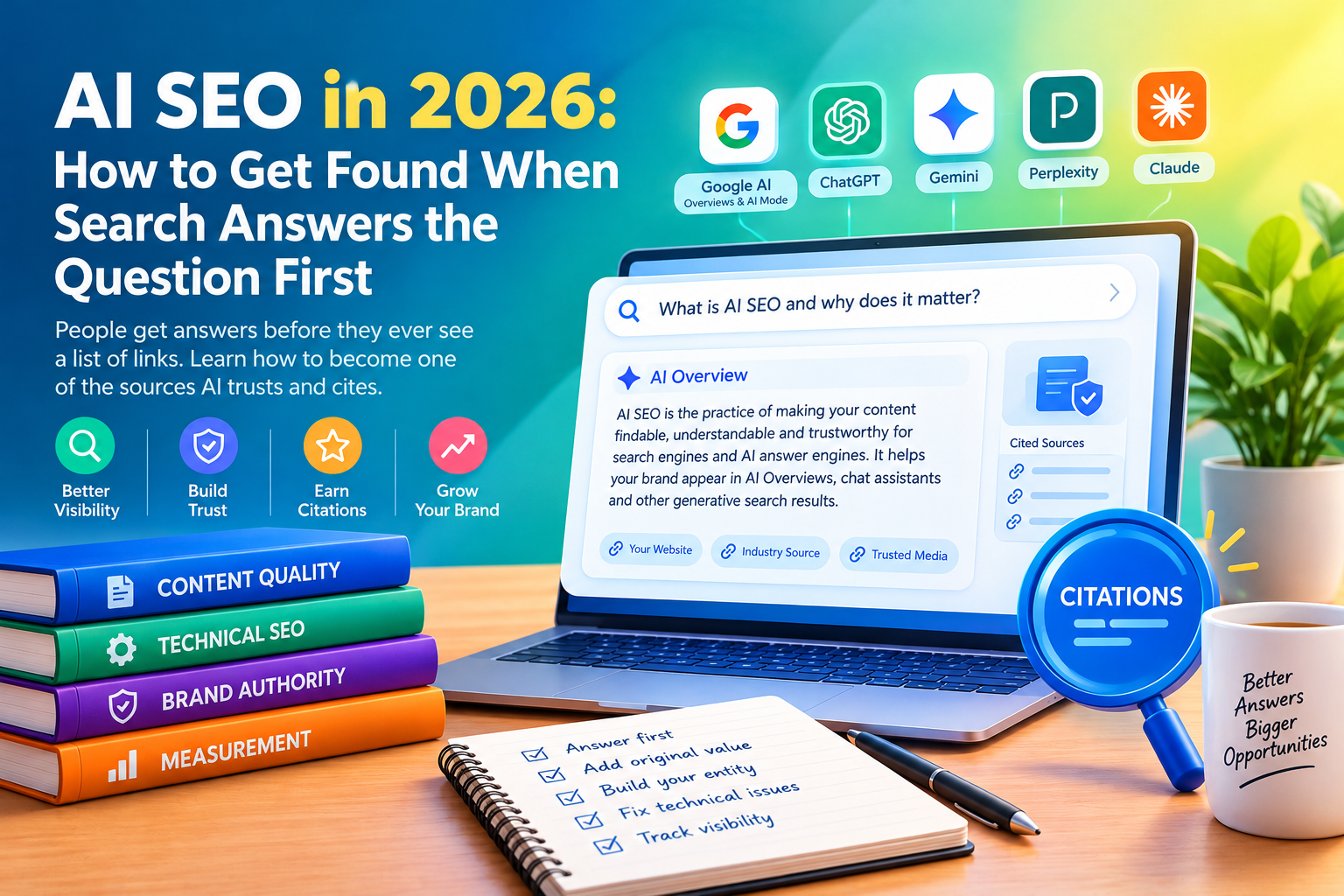
People now get answers before they ever see a list of links. Google’s AI Overviews and AI Mode, ChatGPT, Perplexity, Gemini and Claude all summarise the web, then decide which sources deserve a mention. AI SEO is the work of making your site one of those sources. At Sarkar SEO, we see it as classic search optimisation with a wider finish line: earn the ranking, and also earn the citation.
What AI SEO Actually Means
AI SEO is optimising content, technical setup and brand presence so that both search engines and AI answer engines can find, trust and cite you. You will also see it called GEO (generative engine optimisation) or AEO (answer engine optimisation). The labels differ, but the goal is the same: appearing inside the answer, not just beneath it.
It is not a replacement for SEO. Almost every AI answer starts with retrieval, and most retrieval starts from a search index. If a page can’t be crawled, indexed and understood, no AI system will cite it.
What Google Says
Google’s guidance is more reassuring than the hype suggests. Its documentation says the best practices for SEO remain relevant for AI Overviews and AI Mode, with no additional requirements or special optimisations needed. It also says you don’t need to create new machine-readable files, AI text files or markup to appear. In May 2026, Google went further with a dedicated guide, Optimizing your website for generative AI features. It explains that these features are built on core ranking and quality systems, using retrieval and “query fan-out” techniques.
The guide’s central message is that creating content people find unique, engaging and helpful will matter more in the long run than any other suggestion in it.
What the Data Suggests
Most numbers in this space come from vendor studies with differing methods, so treat them as directional.
- Ranking still matters, but less predictably. One Ahrefs analysis, as reported by a secondary source, found the share of AI Overview citations going to top-10 organic pages fell from 76% to 38% between July 2025 and March 2026. Ranking well helps, but it no longer guarantees a citation.
- Position on the page matters. A Kevin Indig and Gauge study of 18,012 verified citations found 44.2% of ChatGPT citations came from the first 30% of a page. Burying your answer costs you.
- Citations are volatile. After Gemini 3 took over Google’s AI Overviews in January 2026, one tracker reported 42.4% of previously cited domains dropped out. Visibility can shift overnight.
- Other people’s words carry weight. Muck Rack reported that 82% of AI citations come from earned media. What others say about you may count for more than what you say about yourself.
Five Moves That Hold Up
- Lead with the answer, then earn the depth. Open each section with a direct, self-contained answer of two or three sentences, then support it. AI systems extract passages, not whole articles. A clean answer near the top is easier to lift, and readers benefit from the same structure.
- Publish something only you can publish. Google calls for valuable, unique, non-commodity content. If your article restates what ten competitors already say, an AI has no reason to cite you over any of them. Original data, first-hand case notes, clear methodology, and expert opinions with named authors give a model something it can’t get elsewhere.
- Build the entity, not only the page. Answer engines weigh who you are across the web. Keep your brand name, authors, services and profiles consistent, and make sure credible third parties describe you accurately. Google’s guide notes that its generative features may reflect what is said about products and services across blogs, videos and forums. Digital PR, genuine expert commentary and community participation are now part of SEO.
- Remove technical friction. Make sure important pages are crawlable, load quickly and use clear headings. Use structured data only when it matches the visible text on the page, as Google advises. Don’t block the crawlers you want to cite you. Check your robots rules and snippet controls deliberately, not by accident.
- Measure visibility, not only traffic. AI traffic often hides inside “direct” or “referral” reports. Google says sites appearing in AI features are included in overall Search Console traffic, so you won’t get a separate report there. Track a fixed set of 20 to 30 priority questions monthly across several AI tools. Note whether you are mentioned, cited or absent, and who appears instead.
What to Skip
Resist the shortcuts. In one compiled review of GEO statistics, an llms.txt file showed no citation benefit, and the same review found FAQ schema alone didn’t help, although FAQ-style sections written into the body of the page did. Schema is useful for clarity, but it is not a cheat code. Keyword stuffing and mass-produced, near-identical pages work against you in both classic and AI search. elitecontentmarketer
Be sceptical of confident claims about conversion, too. Some studies report that AI-referred visitors convert at roughly 1.26 to 3 times the rate of traditional organic traffic. That range is wide and context-dependent. Test it against your own analytics before you build a budget around it.
A Simple Starting Plan
You don’t need a new department. Start here:
- Pick ten commercial or informational pages that already earn impressions.
- Rewrite their openings to answer the main question in the first few sentences.
- Add one original element to each: a data point, a worked example, or a documented process.
- Fix crawl, speed and indexing issues on those pages.
- Earn two or three credible external mentions per quarter through guest expertise, partnerships or research.
- Re-check your tracked questions every month and adjust.
Do this consistently for a quarter and you’ll learn more about your real AI visibility than any generic checklist can tell you.
