



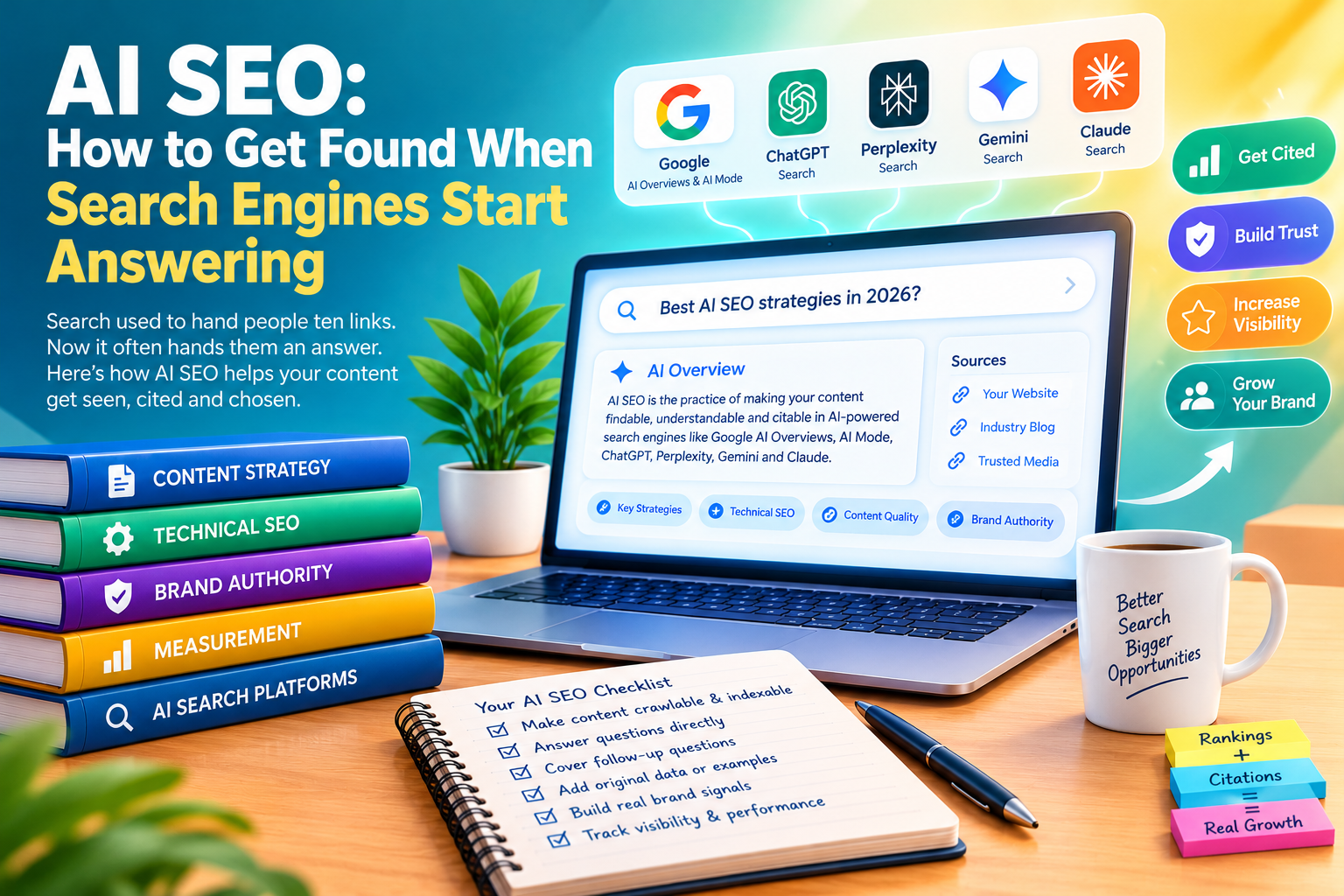
Search used to hand people ten links. Now it often hands them an answer. When someone asks a question in Google, ChatGPT, Perplexity, Gemini or Claude, a model reads many pages, combines what it finds, and cites only a few. AI SEO is the practice of making your content one of those few.
What AI SEO Actually Means
AI SEO is the work of making a website easy for both people and AI-driven search systems to find, understand, trust and cite. It covers traditional rankings, appearances in Google’s AI Overviews and AI Mode, and mentions inside conversational assistants.
It is not a separate discipline. Google’s documentation says the same foundations apply to its AI features as to Search generally: meet the technical requirements, follow Search policies, and create helpful, reliable, people-first content. The same guidance notes that no specific optimization is required for these features.
That is good news, but it is easy to misread. “Nothing new is required” does not mean “nothing changes.” The way your content gets selected has changed a great deal.
Why It Matters Now
The scale is large. One 2026 guide, citing Google, reports that AI Overviews reach more than 2.5 billion monthly users, and AI Mode passed 1 billion monthly users as of May 2026. A separate industry analysis estimates that roughly 93% of AI Mode sessions end without a visit to any external website. That is a third-party figure, so treat it as directional rather than exact. llmpulsenogood
The takeaway is not that clicks are dead. Fewer, more qualified visits are possible, and being named in an answer builds brand recognition even when nobody clicks. Visibility now includes being recognised, not only being ranked.
How AI Search Picks Its Sources
Google says AI Overviews and AI Mode may use a “query fan-out” technique, issuing multiple related searches across subtopics and data sources. In practice, one question becomes many smaller ones, and your page can be pulled in for any of them.
This is the most important shift for writers. You are no longer competing only for one keyword. You are competing to be the best answer to a cluster of related sub-questions.
Three consequences follow:
- Depth beats breadth. A page that answers the main question plus its obvious follow-ups has more chances of being retrieved.
- Eligibility comes first. Google’s AI features draw on its normal index, so a page must be crawlable and indexable before it can be cited. There is no separate AI index. trustedshops
- Sources differ by platform. Each assistant uses different models and retrieval methods, so results vary. Google itself says AI Mode and AI Overviews may use different models and techniques.
A Practical AI SEO Framework
- Fix access before anything else
Check that Googlebot can reach your pages, that nothing important is marked noindex, and that key content is not hidden behind scripts or logins. If you want to appear in other assistants, review your robots.txt rules for their crawlers too, since each company publishes its own bot names and controls. Blocking a crawler is a legitimate choice, but know that it also removes you from that assistant’s answers.
- Write answer-first sections
Put a direct, plain answer in the first one or two sentences under each heading, then add nuance. Models extract passages, not whole pages. A section that opens with a clear statement is far easier to lift accurately than one that builds to its point.
- Cover the fan-out
Before writing, list the questions a reader would naturally ask next: costs, risks, comparisons, steps, exceptions. Give each its own heading. This is where most competing articles are thin, and where you can gain a real edge.
- Add information that is only yours
Generic summaries are interchangeable, and models can generate them without you. What they cannot generate is your own data, tested processes, screenshots, case notes, original comparisons or professional judgement. Include something a reader cannot find by reading the top five results.
- Show who is behind the content
Name authors, state their experience, and link claims to primary sources. Trust signals are not decoration. Systems that choose which pages to cite lean toward sources that look accountable. Mentions of your brand on other reputable sites also help.
- Keep structure clean
Use descriptive headings, short paragraphs, tables for real comparisons, and relevant structured data where it genuinely matches the page. Keep it accurate. Markup that describes content not visible on the page can hurt rather than help.
- Maintain what you publish
Update facts, dates, screenshots and examples. Outdated pages lose out quickly in fast-moving topics.
Common Mistakes
Chasing a trick. Files, formats or phrasing hacks promising guaranteed AI citations are mostly speculation. Be cautious about any claim that is not backed by a platform’s own documentation.
Publishing at volume. Mass-produced, lightly edited text adds nothing new. It tends to be indistinguishable from what the model already knows.
Ignoring the rest of search. Strong organic rankings remain the foundation for being cited in Google’s AI features, so abandoning classic SEO to chase “AI visibility” backfires.
Measuring only clicks. Sites appearing in AI features are included in the overall search traffic in Search Console, so impressions and queries matter alongside sessions.
How to Measure Progress
Track a mix of signals rather than a single number:
- Impressions, clicks and query growth for question-style searches in Search Console.
- Branded search volume, which often rises when you are cited more.
- Manual checks: run your target questions in several assistants monthly and record whether you are cited, mentioned or absent.
- Referral traffic from AI platforms in your analytics, and the conversion quality of those visits.
Treat manual checks as snapshots. Answers vary between runs, users and locations.
Where to Start This Month
Pick your ten most commercially important pages. Confirm each is crawlable, rewrite the opening of every section to answer directly, add the follow-up questions you left out, and attach a named expert and a source to every key claim. This is the type of audit Sarkar SEO builds around, because small structural improvements to existing pages usually outperform publishing something new.
For teams short on time, a sensible split is 70% on improving existing high-value pages and 30% on new topics. Sarkar SEO also recommends tracking one repeatable list of 20 target questions, so you can see real movement rather than guess.
