



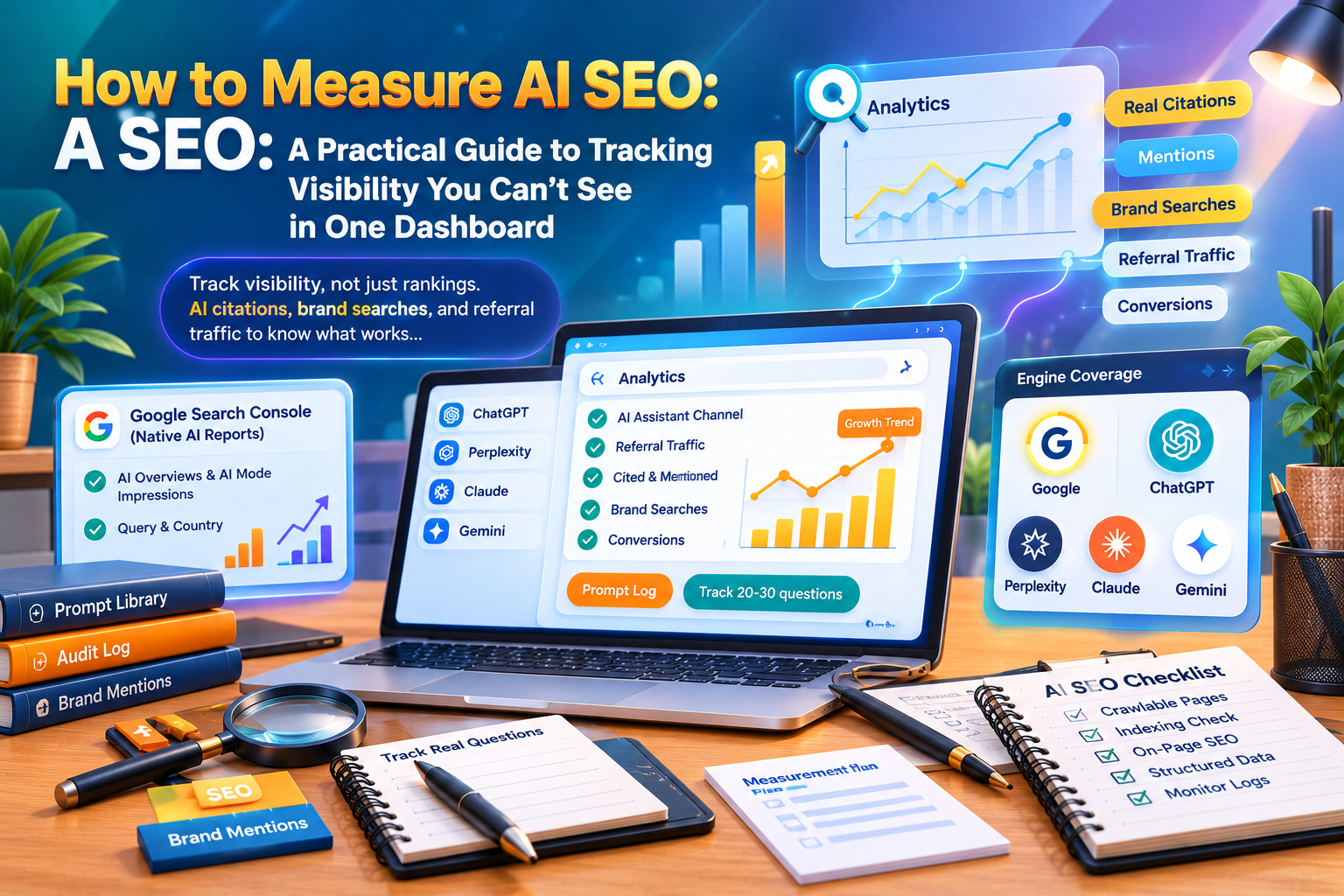
Most teams invest in AI SEO and then hit the same wall: how do you know it’s working? Rankings don’t capture it. Traffic may stay flat while your brand appears in dozens of AI answers. Or traffic may rise, and you can’t tell why.
Measurement is the weakest part of AI SEO, which makes it a real opportunity. Teams that build a reliable tracking routine can make better decisions than competitors who guess. This guide shows what can be measured, what can’t, and how to combine imperfect signals into a trustworthy picture.
The Core Problem: No Single Dashboard Exists
Unlike classic search, there is no unified report. One 2026 guide puts it plainly: there is no “AI Search Console,” because the engines that decide whether to cite you do not report on those decisions. Another summary reaches the same conclusion: no single tool reports AI search visibility end to end in 2026, so you should combine impression data, citation data and referral data into one monthly report. superblogsupermetrics
So the goal isn’t a perfect number. It’s a consistent method that shows direction over time.
Layer 1: Google’s Own Data
Google has finally added native reporting. According to one measurement guide, Search Console’s generative AI performance reports, announced in June 2026, cover impressions for AI Overviews, AI Mode and AI features in Discover, broken down by page, country, device and date.
That is valuable, but know its limits. A separate analysis notes that the report covers impressions only. You can see that your page appeared, not how many people clicked from the AI answer specifically. Another caution from the same source: clicks from AI Overviews and AI Mode carry the standard google / organic tag and blend into regular Search totals. cliquestudioscliquestudios
Also note that rollout may be gradual. One source says the reports are rolling out to a subset of sites only, so check whether your property has them before building a process around them.
Layer 2: Referral Traffic From Other Assistants
Visitors from ChatGPT, Perplexity, Claude and Gemini arrive in analytics as referrals. Google Analytics now offers a dedicated channel for them: traffic from ChatGPT, Perplexity and other platforms is grouped into the AI Assistant channel, introduced in May 2026.
Two practical tips:
- Order your rules carefully. If you build a custom channel group, place the AI rule above your organic and referral rules, because Analytics applies the first matching condition and stops.
- Expect leakage. One site that audited its own referrals found the same assistants appearing in the AI Assistant channel, in generic referral traffic, and under a medium of “not set” at the same time. Review all three buckets before reporting totals.
Treat the number as a floor. As one practitioner puts it, your referral count is a floor, not the truth, because many people read the answer and never click.
Layer 3: Server Logs, the Most Overlooked Signal
Analytics tools only record visitors who run scripts. Your server logs record what crawlers actually fetch. One guide argues that server logs are the most reproducible AI visibility signal available. You can track requests from crawlers such as OAI-SearchBot (live ChatGPT retrieval), PerplexityBot and ClaudeBot.
Why this matters: a rise in search-bot fetches on a page often arrives before citations and traffic follow. A page that bots never request can’t be cited by live search. Sarkar SEO uses this as an early-warning check, because it reveals access problems weeks before any traffic chart does.
A caution: crawlers serve different purposes. Some collect training data, others fetch pages live to answer a question. Separate them in your reports, or you’ll misread what the numbers mean.
Layer 4: Prompt Sampling
Since citations don’t always produce clicks, you need to check the answers directly. The method is simple:
- Write 20 to 30 real questions customers ask, mixing broad and specific.
- Run them monthly in each assistant you care about.
- Record whether you were cited with a link, mentioned by name only, or absent.
Keep citations and mentions separate. Both are valuable, but they measure different dimensions of visibility. Also be aware of mode: ChatGPT can answer from its stored knowledge or from the live web, and only search-enabled responses generate verifiable, clickable citations.
Dedicated tracking platforms automate this at scale. Several exist, with entry plans reported at roughly the price of a software subscription, though independent comparisons are limited. A spreadsheet is enough to start.
One honest limit: answers vary by run, location and wording. Test the same prompts the same way each month, and judge trends, not single results.
Layer 5: Brand Demand
The final signal is indirect. When an assistant names your company, some readers search for you later instead of clicking. Several sources recommend tracking this: watch searches for your brand name in Search Console over time as a proxy for influence you can’t measure directly.
Combine it with direct traffic trends, but don’t over-credit. Brand searches also rise from ads, PR and word of mouth.
Add one conversion metric, such as enquiries or sign-ups from AI referrals. Some vendors report that AI-referred visitors convert at higher rates than organic visitors, with one source citing 10.5% for Perplexity against 1.76% for Google organic. Treat that as a vendor claim, and check your own data before assuming it applies to you.
What Good Looks Like
There’s no universal benchmark. One practitioner guide suggests that appearing in about half of your manual checks, alongside steady growth in AI referrals and branded search, indicates the work is compounding, even before any single metric alone is conclusive. Use that as a rough guide, not a target.
