



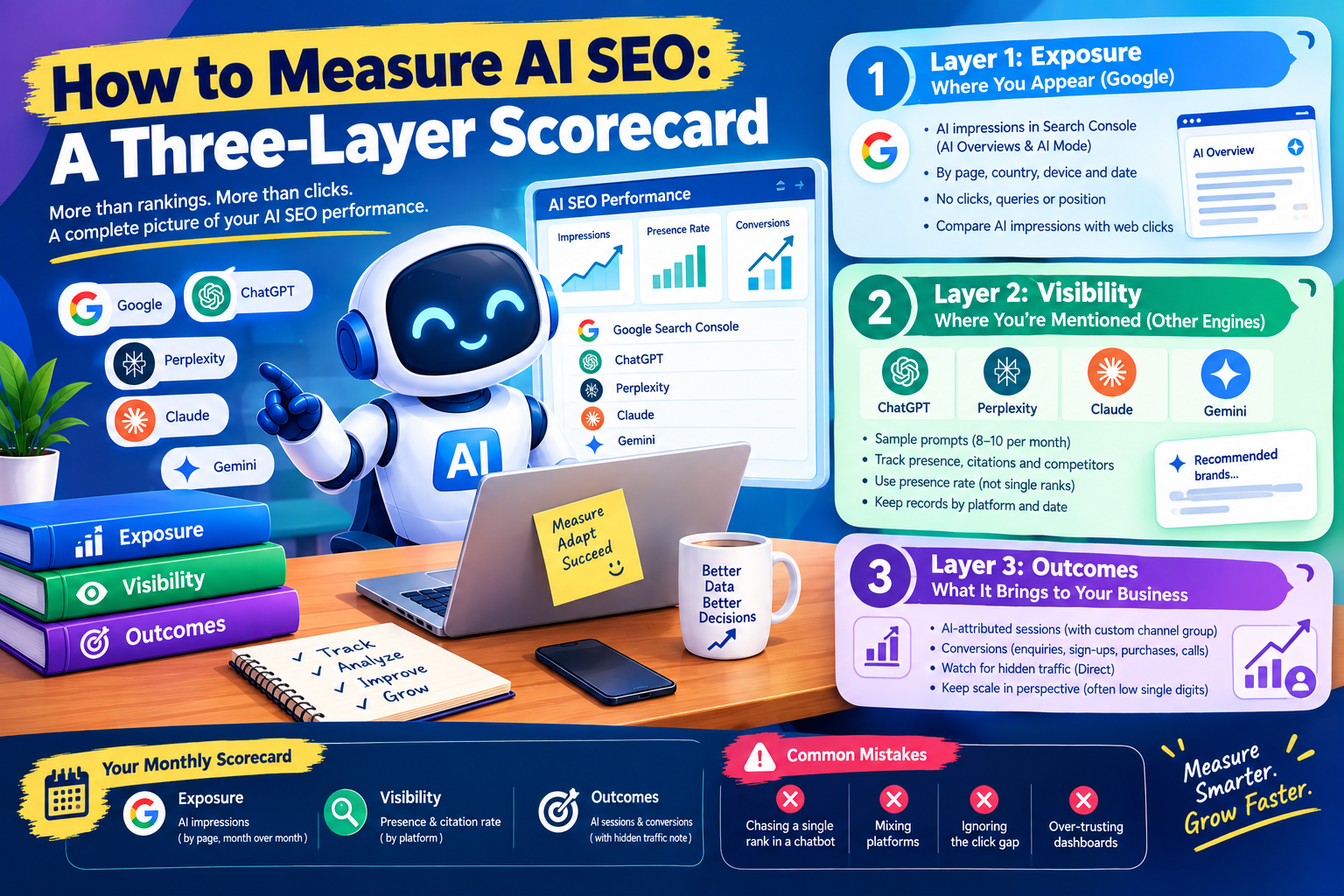
Most teams that invest in AI SEO can’t answer a simple question: is it working? Rankings no longer tell the whole story. Clicks are only part of it, and no single dashboard covers Google, ChatGPT, Perplexity and the rest. Sarkar SEO treats measurement as its own discipline, and this article lays out a practical scorecard built on three layers: exposure, visibility and outcomes.
Why one number can’t do the job
In classic SEO, one report showed position, impressions and clicks together. AI search splits those signals apart. A page can be shown inside an AI answer without earning a click. A brand can be recommended in a chatbot without any trace in your analytics. So the useful question is no longer “what is my rank?” but “where am I present, how often, and what happens next?”
Layer 1: Exposure inside Google
Google now gives site owners a dedicated view. Summaries of Google’s announcement say the Generative AI performance report launched on June 3, 2026, with separate views for Search and Discover. A later report states that, as of August 31, 2026, the reports were available to all websites worldwide.
Know what it shows and what it leaves out. The report counts how many times links to your site appeared in AI Overviews and AI Mode, by page, country, device and date. It shows impressions only, with no clicks, queries, CTR or position. Clicks still exist, but they sit in the normal Performance report under the Web search type, mixed with all other clicks. Two quirks affect how you read the numbers. An AI Overview takes one position, and every link inside it shares that position. Also, sites with too few AI impressions may see no report at all. Search Console Generative AI Report: How to Read It (2026) +3
I read these details through secondary guides rather than Google’s help pages, so confirm them in your own Search Console account.
A useful check: compare AI impressions for a page with its web clicks over the same dates. High AI impressions alongside weak clicks suggest Google is answering with your page and users may not click. That is a finding about the format, not necessarily a failure of the page.
Layer 2: Visibility on other answer engines
Google’s report covers only Google. For ChatGPT, Claude and others, you have to sample the answers yourself, and the data is noisy.
SparkToro’s study, run with Gumshoe.ai, asked how consistent AI recommendations really are. It used 600 volunteers who ran 12 identical prompts through ChatGPT, Claude and Google’s AI about 2,961 times. The result: there is a less than 1 in 100 chance that ChatGPT or Google’s AI, asked 100 times, would give the same list of brands twice. The order was even less stable, matching in fewer than 1 in 1,000 runs. Performance Marketing Insider: AI Brand Recommendations: Chaotic, Inconsistent +2
That sounds like bad news for tracking, but the author’s own conclusion was more careful. He wrote that his hypothesis that tracking is entirely useless was probably wrong. A secondary analysis reports that top brands in each category appeared in 55% to 77% of responses regardless of how the prompt was phrased.
So the lesson is this: individual rankings in AI answers are noise, but presence across many runs is a signal. A report that says “you’re third in ChatGPT” is a single dice roll. A report that says “you appeared in 6 of 20 runs” is a measurement.
A sampling method you can run yourself
This is my own suggested protocol, not an industry standard:
- Pick 8 to 10 prompts that mirror real customer questions, including a few phrased differently.
- Run each prompt several times per platform, in fresh sessions, on a fixed date each month.
- Record whether your brand appears, whether your pages are cited, and which competitors appear.
- Report presence rate (appearances divided by runs), not position.
- Log the date, platform and exact prompt so results can be compared later.
Treat small month-to-month swings with caution. With only a handful of runs, a move from 30% to 35% is probably chance.
Layer 3: Traffic and outcomes
The final layer asks whether any of this reaches your business. In analytics, AI traffic is partly visible and partly hidden.
What you can see: ChatGPT began appending utm_source=chatgpt.com to citation links in June 2025, and Perplexity consistently passes its domain as a referrer. By default, though, GA4 files these visits under generic Referral alongside forum backlinks and directory listings. A custom channel group that groups the main AI domains is the common fix. One setup guide warns that a new channel placed below Referral may stay at zero, because GA4 assigns each session to the first matching rule. Order your rules accordingly.
What you can’t see: when a referrer is missing, GA4 often records the session as Direct. One guide adds that AI mobile apps may send no referrer at all. A practical heuristic from one vendor: if Direct traffic to deep pages rises alongside your measured AI referrals, hidden AI traffic is a likely cause. Treat that as a hypothesis, not proof.
Also keep scale in perspective. A vendor guide reports AI referrals are typically low single-digit percentages of sessions for most B2B sites. That is a vendor claim, so check your own data before assuming it applies to you.
Whatever the volume, measure what those visitors do: enquiries, sign-ups, purchases or calls. A small channel with high-intent visitors can still matter more than its share of sessions suggests.
The monthly scorecard
Put the three layers on one page:
- Exposure: AI impressions in Search Console, by key page, month over month
- Visibility: presence rate and citation rate across your sampled prompts, by platform
- Outcomes: AI-attributed sessions, plus conversions from those sessions, with a note on likely hidden traffic
Add a short written commentary each month. Numbers without interpretation invite false conclusions.
Common measurement mistakes
- Chasing a single rank in a chatbot. The research above shows why this misleads.
- Mixing platforms. Google’s AI features and ChatGPT retrieve differently, so report them separately.
- Ignoring the click gap. Rising impressions with flat clicks is a different story from falling impressions.
- Over-trusting dashboards. Vendor tools that report an “AI rank” are usually selling one sample as if it were a stable fact.
