



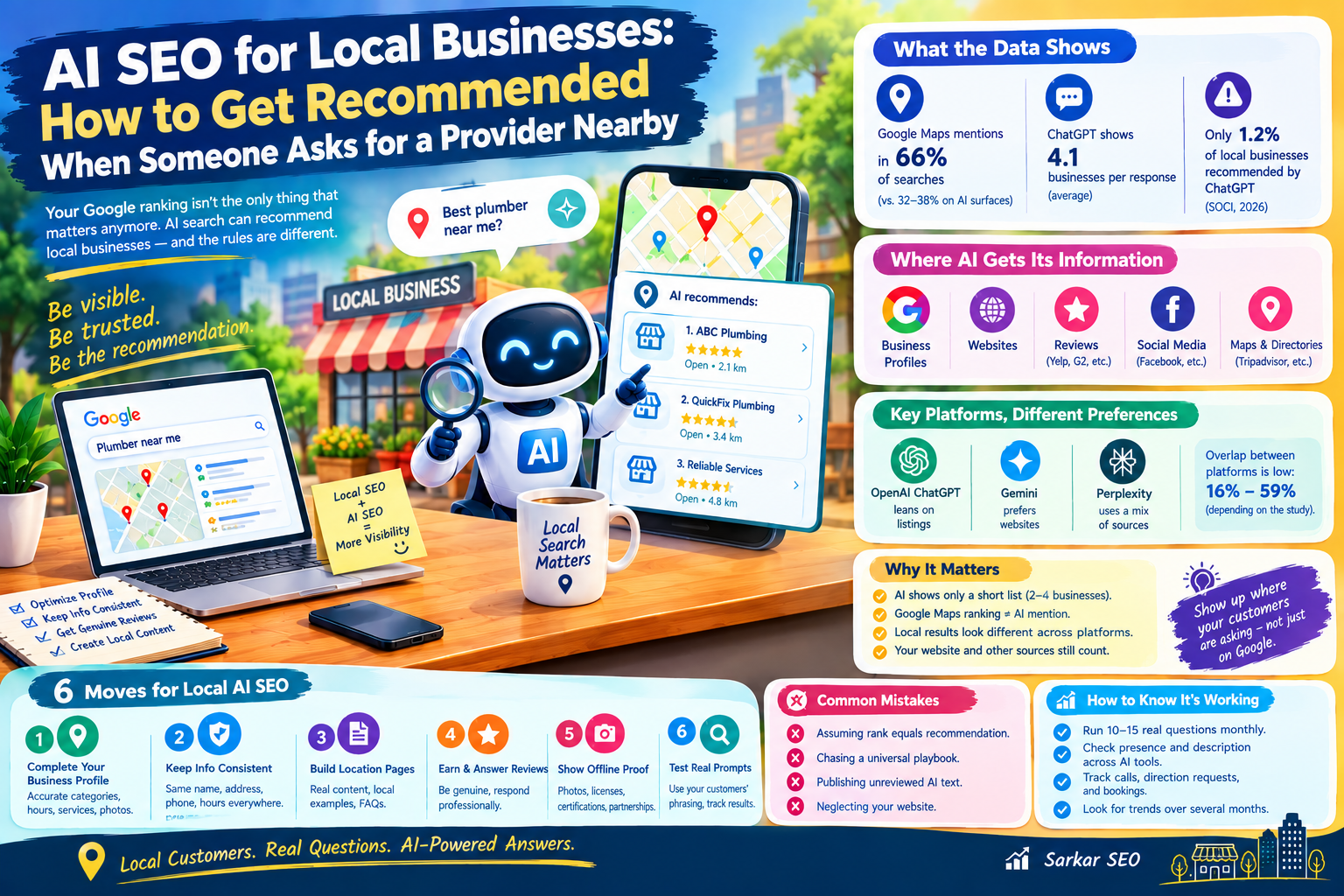
“Who is a good electrician near me?” used to produce a map and ten listings. Now it may produce a short list assembled by an AI system, and some businesses with strong Google rankings are missing from it.
This article covers what the evidence says about local AI SEO visibility, where it is genuinely unclear, and six practical moves for any business that serves a specific area.
Local Search Behaves Differently
The 2026 Local Search Ranking Factors report from Whitespark, an expert-opinion survey, says local search has stayed somewhat insulated from the upheaval hitting informational sites. For the first time, its participants also scored factors by their influence on AI visibility. One caveat from the report itself: none of the experts has special access to Google’s internal workings. These are informed judgments, not measurements.
The measured gap is more sobering. SOCi’s 2026 Local Visibility Index, as cited by LocalIQ, found ChatGPT recommends only 1.2% of local businesses. In retail, fewer than half the brands performing well in traditional local search also appeared in AI recommendations. A strong map ranking does not guarantee an AI mention, and the two need separate checks.
What Feeds the Answers
Google’s guide to generative AI features, published May 15, 2026, includes local and shopping guidance. Summaries of it stress that a complete, accurate Business Profile and a well-built website should work together. Reporting also says these features draw on Business Profile records and Merchant Center product feeds.
Other engines differ. Yext’s analysis of 6.8 million citations reported that Gemini favored websites (52.1%), OpenAI leaned on listings (48.7%), and Perplexity spread across sources such as MapQuest and Tripadvisor. Yext sells listings software, so read that with its interest in mind.
Whitespark’s panel illustrates the point from another angle. One expert said a factor like additional Business Profile categories would score zero for ChatGPT but matter for Google’s AI Mode and Gemini, because only Google holds that data. Some vendor guides claim every AI engine reads Google profile data directly, and I found no confirmation of that. Sarkar SEO treats it as unproven and plans for each engine separately.
Six Moves for Local AI SEO
This is my own checklist, drawn from the sources above.
- Treat your Business Profile as a data file, not a billboard. Fill in categories, services, products, hours, attributes, and photos accurately. Hours deserve attention because Whitespark’s factor list includes whether a business is open at the time of search. Wrong or stale details are the cheapest errors to fix.
- Make your facts identical everywhere. Use the same name, address, phone number, and hours on your website, profiles, and directories. AI systems reconcile sources, and conflicts weaken confidence. Because platforms vary by country, check which maps and directories matter in your market and not only the dominant one.
- Build location pages with real substance. Describe the services you actually offer in each area, with local examples, pricing guidance, staff, and answers to questions customers ask. Avoid cloning one template across fifty towns. That pattern invites low-value judgments, and it gives an AI nothing specific to cite.
- Earn reviews honestly and answer them. Recent, detailed reviews that mention the service and location give models concrete material. Reply to them, including negative ones, with specifics. Don’t generate reviews with AI. Reporting on Google’s policy says reviews primarily produced by automated programs or AI are not allowed.
- Show proof that exists offline. Photos of real work, licenses, certifications, years in business, and local partnerships. These are facts a model cannot invent, and they separate you from generic competitors.
- Test with customers’ real phrasing. Ask the questions your buyers ask, for example “who repairs [problem] near [neighborhood]?” Vary wording and location, and run each query on several tools. Yext’s report notes that AI answers depend on a person’s real-world location, so results from your desk may not match what a customer sees across town.
A Quick Illustration
Imagine a dental clinic whose profile lists the wrong weekend hours, while its website shows the correct ones. A person asking an AI for an open dentist on Saturday may be told the clinic is closed, or not shown it at all. Fixing one field costs minutes. (This is a hypothetical example, not a client result.)
Mistakes to Avoid
Assuming rank equals recommendation. The SOCi finding shows the overlap is partial, so measure AI visibility on its own.
Chasing a universal playbook. An informal LinkedIn study of lawyers, accountants, and dentists across six cities found little overlap in some sectors, with accountants especially fragmented. It is a small, unreviewed sample, but it fits the broader message: results vary by industry and engine.
Publishing unreviewed AI text. Google has tested AI-written profile descriptions while telling owners to check them for accuracy. A confident but wrong service listing can do more harm than a blank field.
Neglecting your website. The profile may feed the map, but your site explains why you are the right choice. Answer pricing, process, and coverage questions plainly.
How to Know It’s Working
Keep a simple log. Each month, run the same 10 to 15 customer questions across the AI tools your audience uses, note whether you are named and how you are described, and record calls, direction requests, and bookings from your profile and site. Look for movement across several months, since single answers vary between runs.
