



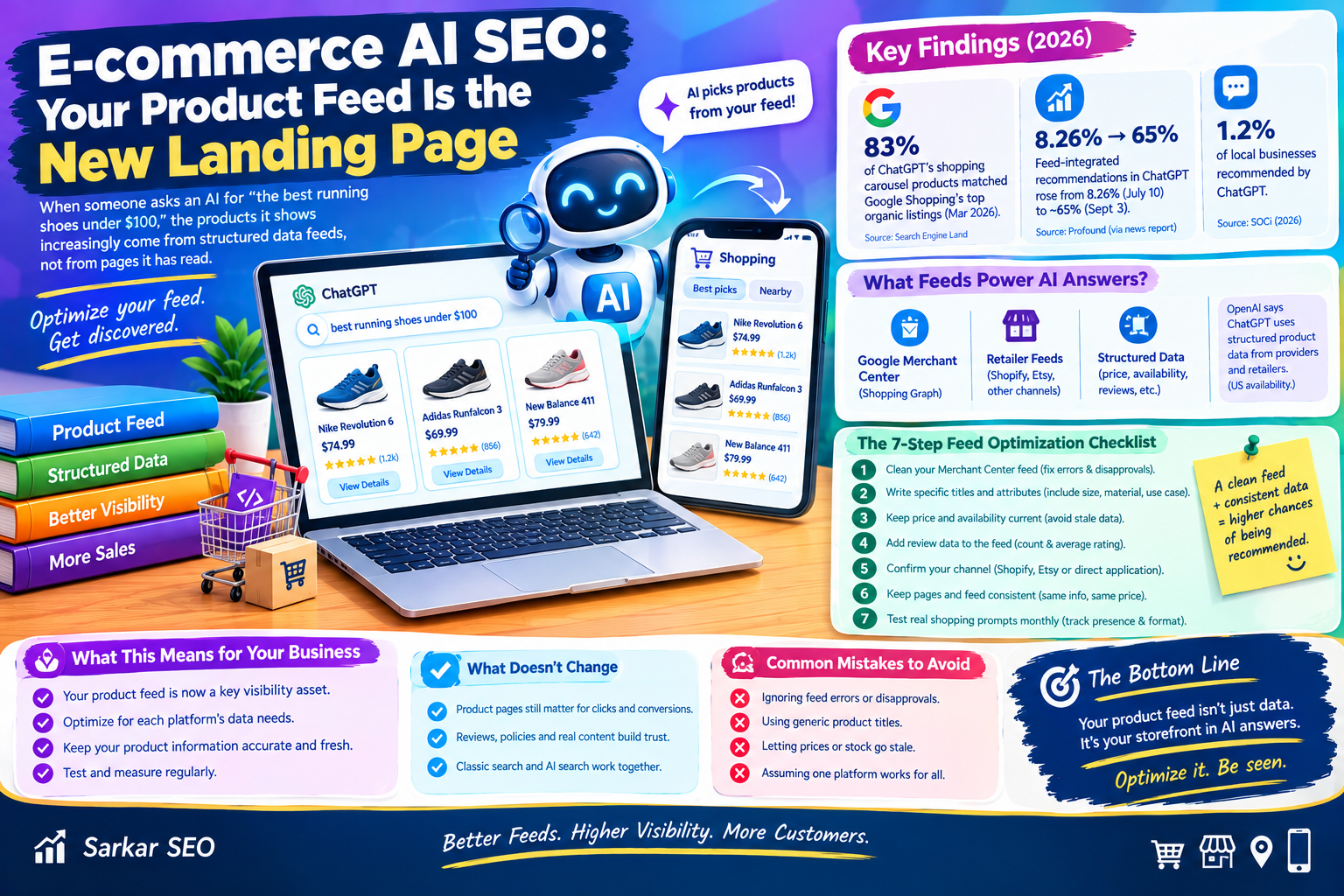
For years, online stores optimized product pages: titles, descriptions, images, schema. AI SEO shopping tools changed the order of operations. When someone asks an assistant for “the best running shoes under $100,” the products it shows increasingly come from structured data feeds, not from pages it has read. Sarkar SEO looked at the most recent evidence on how this works, where the data is shaky, and what a store can do this month.
What changed in 2026
The picture moved quickly. In March, an analysis reported by Search Engine Land found that 83% of the products in ChatGPT’s shopping carousels matched Google Shopping’s top organic listings. That pointed to Google’s ecosystem as the main source. getpassionfruit
Then the pattern shifted. Profound, an AI analytics company, tracked about 1.76 million ChatGPT shopping prompt runs and reported that the share of recommendations it classed as feed-integrated rose from 8.26% to 61.54% on July 10, and reached roughly 65% by September 3.
Treat that carefully. The figures come from Profound’s own tracking of a set of prompts, not from OpenAI, and they do not represent all ChatGPT shopping traffic. I read them through a secondary news summary, not Profound’s original report. The lesson is still useful: the sources behind AI product answers can change within a few months, so a strategy built on one study’s snapshot ages fast.
Who gained and who lost
Profound examined 687 of its customers who tracked shopping prompts daily. Around July 10, 450 of them saw their shopping visibility drop by at least one third, while 67 saw a rise of the same size. The report also found concentration: the share of references going to the top 10 merchants rose from 22.5% to 41.8%, while unique merchants fell from 13,524 to 10,607.
Profound links the shift to a model release on July 9. That is its interpretation. OpenAI has not made that connection, and its release notes list no shopping updates for those days. In other words, the change is observed, but the cause is unconfirmed.
What OpenAI itself says
OpenAI’s help documentation, as summarized in the same report, says ChatGPT uses structured product data, including price and description, from data providers and individual retailers, and that results are selected independently and are not ads. Shopify and Etsy catalogs are already connected. Other retailers can apply for direct feed access, though the summary says applicants may be placed on a waitlist.
One caution for a worldwide audience: that summary states ChatGPT Shopping is available to ChatGPT users in the U.S. If your customers are elsewhere, check current availability before investing heavily in this channel.
The Google side
Google’s AI shopping answers draw on its Shopping Graph, which gets most merchant data through Google Merchant Center. Secondary reports also say Google added six conversational attributes to Merchant Center in May 2026, designed around how people phrase requests in AI Mode. I could not verify that against Google’s own documentation, so confirm the attribute names in your Merchant Center account. Yahoo FinanceYahoo Finance
What a store can do now
This checklist is my own synthesis of the evidence above:
- Clean your Merchant Center feed. Fix disapprovals and errors first. A broken feed removes you from the pool, whatever your pages say.
- Write specific titles and attributes. One source notes that generic titles get skipped in conversational queries, where specificity determines relevance. Include size, material, use case and compatibility where they apply.
- Keep price and availability current. Guides list price, product availability, reviews and authority among the signals that influence recommendations. Stale stock data is an avoidable loss.
- Put review data in the feed. One guide says ChatGPT’s feed format accepts review count and average rating as fields. Add accurate product markup on the page too.
- Confirm your channel. Shopify and Etsy sellers should verify that their data actually flows through. Others should look at direct application or an approved feed provider.
- Keep pages and feed consistent. If the feed says one price and the page says another, you create doubt for both people and systems. This is my reasoning, not a published rule.
- Test real shopping prompts monthly. Try phrases like “best [product] under [price]” and “[your product] vs [competitor],” then record whether your products appear and in what form.
Sarkar SEO suggests treating the feed audit as a standing monthly task, not a one-time fix.
What this does not mean
Feeds do not make product pages irrelevant. Pages still serve shoppers who click through, still carry reviews and policies, and still matter for classic search. Google’s own guidance, covered earlier in this series, says AI features rest on core search fundamentals. And not every AI engine behaves like ChatGPT: Perplexity, Gemini and others may weight sources differently, and I could not verify their current behavior from primary documents.
Also remember that most of the shopping evidence here comes from vendors with a commercial interest in AI visibility, so read their headline numbers as signals rather than settled fact.
