



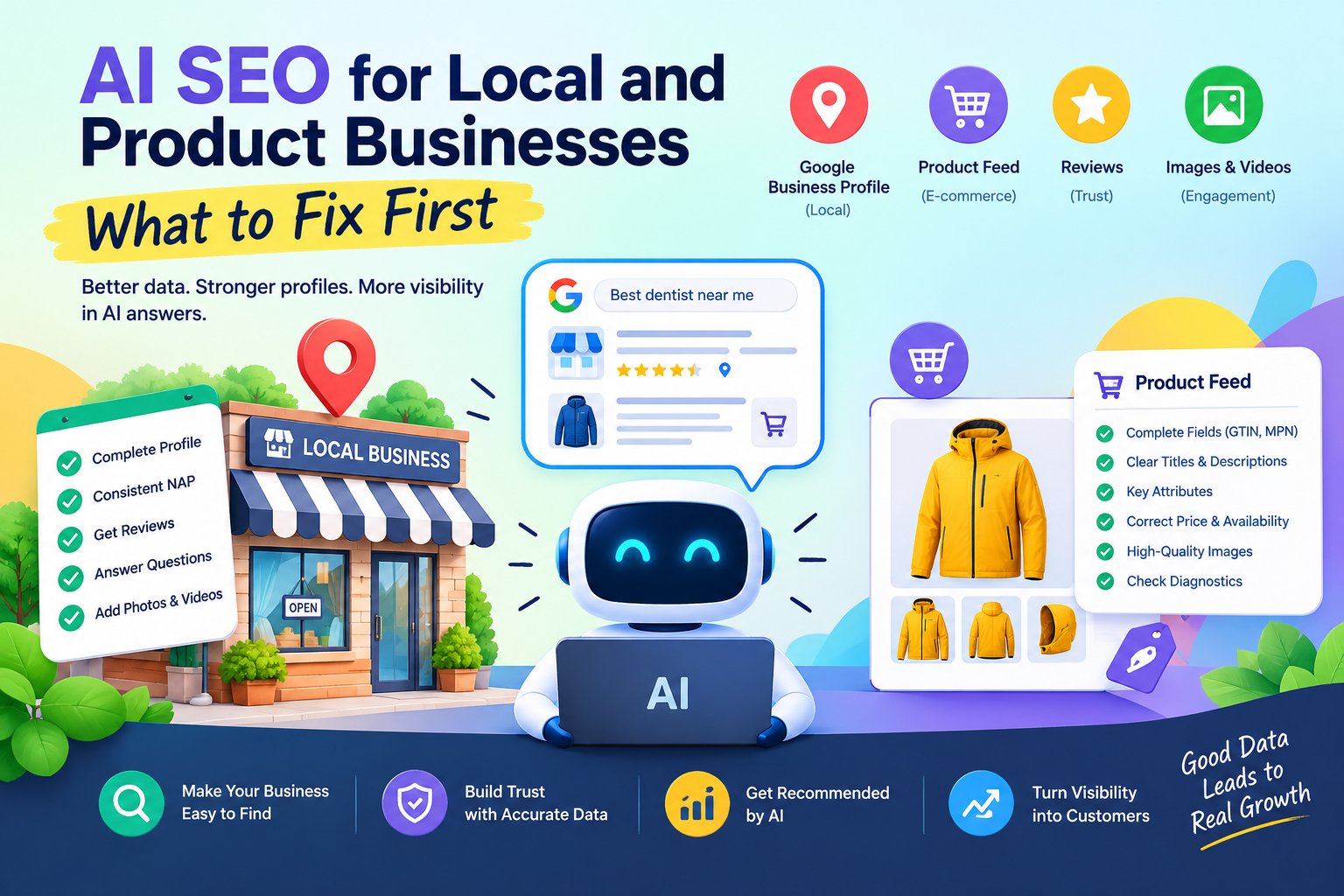
For a shop, clinic, restaurant or online store, AI SEO is less about blog content and more about data. When someone asks an AI tool for a nearby dentist or a waterproof jacket, the answer often draws on business profiles, product feeds, reviews and images. Fix those first, and your website content has a stronger base to build on. That is the order Sarkar SEO recommends for most small businesses.
Why Local and Product Searches Behave Differently
Google’s May 2026 guide on generative AI features says AI responses can include product listings, product information and local business information. Its practical advice is specific: use Merchant Center, including product feeds, and Google Business Profiles to help products and services appear in AI responses and other Search results.
That matters because these answers are assembled from structured sources, not only from web pages. A well-written page cannot compensate for a product feed with missing fields or a business profile with the wrong hours.
The Gap Between Ranking and Being Recommended
Third-party data suggests the two do not always match. SOCi’s 2026 Local Visibility Index, as reported in a secondary article, analyzed more than 350,000 business locations. It found ChatGPT recommended about 1.2% of them, and only 45% of brands leading in traditional local search also appeared among the most recommended in AI results.
Treat these figures with care. We could only review them through a vendor’s summary, which did not explain how the queries were run, and that vendor sells AI search services. The direction is still useful: strong local rankings do not guarantee an AI mention, so you need to check both.
A Local Business Checklist
Our working order of priorities, based on Google’s guidance and the sources above, is:
- Claim and complete your Business Profile. Categories, hours, services, phone and address should be exact. Google names this as a route into AI responses.
- Keep your name, address and phone identical everywhere. Several local guides argue that mismatches weaken trust. This is reasoning from practitioners, not a proven ranking factor, but inconsistencies also confuse customers.
- Build a steady stream of genuine reviews. One practitioner article names review volume and website content as leading drivers of AI recommendations, but gives no sample size. Specific thresholds you may see quoted, such as a minimum number of reviews or a 4.3-star cutoff, were unsourced in the guide we reviewed, so do not chase them.
- Make service pages answer real questions. Name the services, the areas you cover, prices or price ranges where possible, and how booking works.
- Add real photos and short videos. Google’s guide says generative AI features can surface relevant images and video, creating chances to appear beyond standard links.
Start with the profile and reviews, because they cost little and affect every channel.
A Product Business Checklist
For stores, the product feed is the core asset. A Shopify guide published in April 2026 describes how AI Mode shows curated product panels rather than a ranked list of links, and how listings that fail Google’s product data rules can be disapproved and may stay out of AI-powered results.
What to prioritize in your feed:
- Complete every required and recommended field, including identifiers such as GTINs or MPNs and product categories.
- Write plain, specific titles: brand, product type and key differences, not keyword stacking.
- State the attributes shoppers compare, such as material, size, capacity or temperature rating.
- Match price and availability between your store and your feed.
- Use clear images from several angles.
- Check Diagnostics in Merchant Center regularly for disapprovals.
The same guide notes that features such as agentic checkout are rolling out in limited regions and may not reach every merchant, so check availability for your market before planning around them.
Prepare Your Site for AI Agents
Google’s guide also covers AI agents, which are systems that complete tasks such as booking a reservation or comparing product specifications. It notes that browser agents may read a site through screenshots, page structure and the accessibility tree, and it points site owners to agent-friendly practices. The simplest step is semantic HTML: real headings, labelled buttons and form fields, and working links. Google says this also helps screen readers, so it serves customers either way. The guide describes this area as new, so expect change. At Sarkar SEO, we treat clean, semantic pages as basic hygiene for exactly that reason.
What Google Says You Do Not Need
Google’s guide treats optimizing for generative AI search as part of SEO, not a separate discipline. It says you do not need to rewrite content with special phrasing or chop pages into small pieces, and that seeking artificial mentions across the web is not helpful. It also says structured data is not required for generative AI search, though it remains worth using for rich result eligibility. For a small business, that is a relief: the work is accurate data and genuine reputation, not tricks.
How to Check Where You Stand
Each month, ask the main AI tools ten questions a customer might ask, such as “best [service] in [your area]” or “which [product] suits [need]”. Record whether you are mentioned, cited, or described accurately. Answers vary between runs, so repeat important prompts rather than relying on one test, and note any wrong details to correct at the source.
Do small businesses need a blog for AI SEO? Not first. Accurate profiles, complete product data, reviews and useful service pages usually come before blog content.
Can I pay to appear in AI answers? Merchant Center standard listings are free, according to the Shopify guide, while paid campaigns are billed per click. Organic inclusion in AI answers cannot be bought.
