



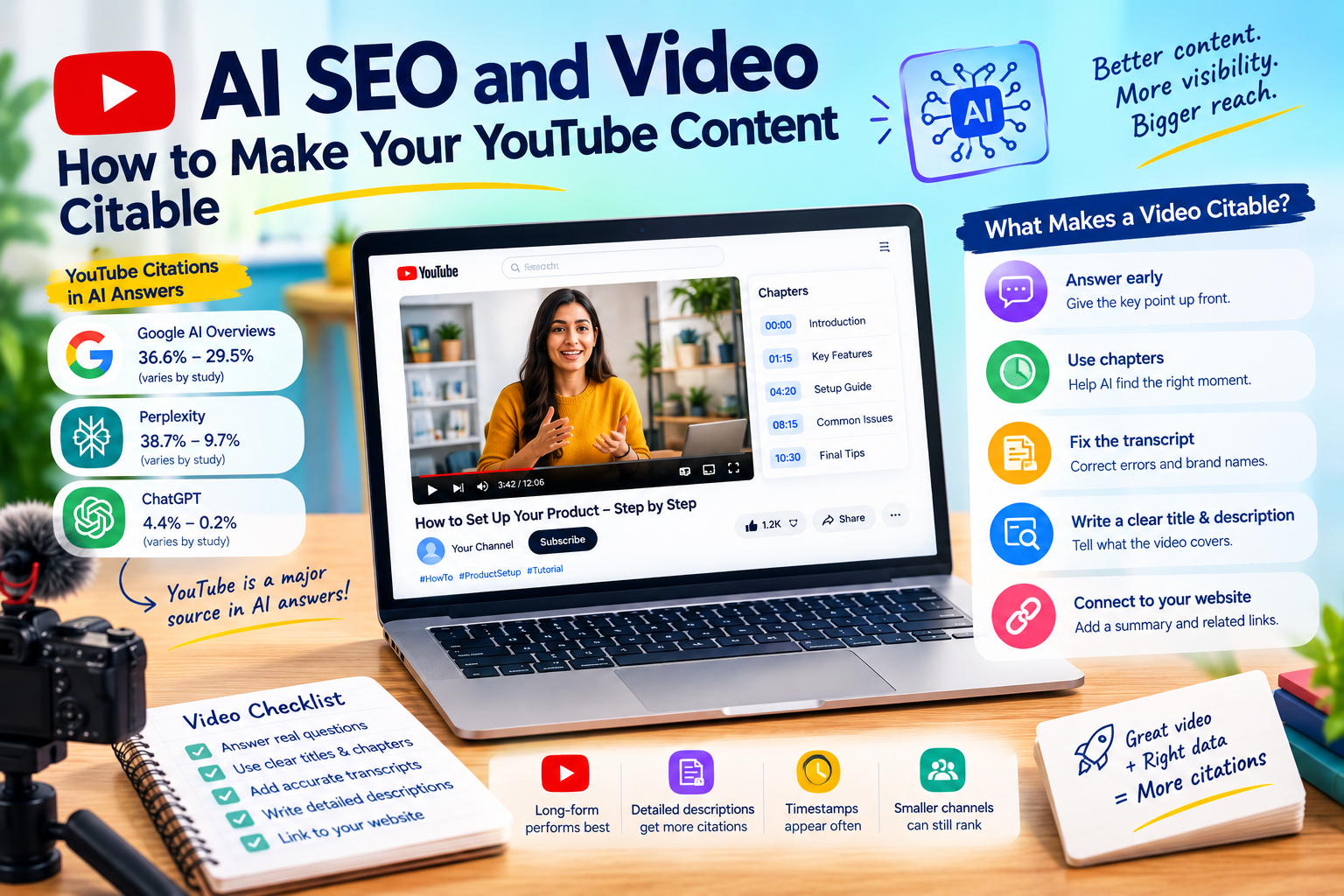
Most AI SEO work focuses on text. Yet when AI tools answer a question, they often point to a video. If your business explains things well on camera but has never thought about how a machine reads that video, you may be missing a source of visibility. At Sarkar SEO, we treat video as an extension of your written content, and this article explains why and how.
What the Citation Studies Show
Several studies have counted how often AI answers cite YouTube. One widely shared study reports that YouTube accounts for 38.1% of all social media citations in AI-generated answers, making it the second-most-cited social platform. A separate summary of OtterlyAI’s analysis of more than 100 million citations gives a different figure for the same idea: 31.8% of all social media citations. webfxveed
The numbers disagree because the studies used different data and methods. That is a good reason to read them as “YouTube is a major source” and not to quote a precise percentage. Several of these publishers also sell AI visibility or video services, so they have a stake in the finding.
Platforms Behave Differently
The pattern varies by AI tool. OtterlyAI’s breakdown of YouTube citations puts Perplexity at 38.7%, Google AI Overviews at 36.6% and ChatGPT at 4.4%. BrightEdge data cited elsewhere gives YouTube a 29.5% citation share in Google AI Overviews, 16.6% in Google AI Mode, 9.7% in Perplexity and 0.2% in ChatGPT.
Those two sets answer different questions. One asks where YouTube citations come from. The other asks how much of each tool’s citations go to YouTube. Both suggest the same thing: video matters most for Google’s AI features and Perplexity, and far less so, for now, in ChatGPT. One report warns that a video strategy built for Google AI Overviews will not perform inside ChatGPT, and vice versa. Check which tools your own customers use before deciding how much to invest.
AI Reads Your Video as Text
The most useful insight is that these systems do not watch footage. One report says AI engines process video through transcripts, structured metadata and chapter markers, not the visual signal itself. That has a practical consequence: a brilliant visual demonstration with weak spoken explanation may be nearly invisible, while a clear talk with a clean transcript may be quotable.
What the Data Suggests About Format
Take these as correlations, not rules.
- Long-form dominates. OtterlyAI reports that 94% of YouTube AI citations go to long-form videos, with Shorts getting just 5.7%. At the same time, the study notes that duration alone does not guarantee citations, so padding a video is pointless. veedromesentinel
- Descriptions help. The same study reported that description length correlates with repeat citations at r = 0.31, a moderate relationship. Fuller descriptions may simply come from more careful creators.
- Timestamps appear often. According to one summary, 31% of cited videos contained timestamp signals, and Google AI Overviews accounts for 73% of all timestamped citations. Chapters let a system point to the exact part that answers a question.
- Subscriber count is not the gate. One guide stresses that citations do not require subscribers. A small channel with a precise answer can compete.
How to Make a Video Citable
This working process is our own suggestion, built on the findings above.
- Start from a real question. Use the questions your sales and support teams hear. One video, one question, answered fully.
- Answer early. Give the short answer in the first minute, then explain the detail. This mirrors the advice for written pages, as both readers and systems extract opening statements.
- Speak in complete, specific sentences. Say the product name, the number, the step. Avoid “as you can see here”, which means nothing in a transcript.
- Add chapters. Label each section with a descriptive question or topic, not “Part 2”.
- Fix the transcript. Automatic captions mishear brand names and technical terms. Correct them, because the transcript is what machines read.
- Write a real description. Summarise what the video covers, who it is for, and link to a related guide on your site.
- Use a plain title. A title that states the question beats a clever one.
Connect Video to Your Website
A video should not sit alone. Embed it on a relevant page and put a written summary and key steps beside it, so that the page works for readers who prefer text and for systems that read HTML. Link back from the video description. One report notes that self-hosted video can be cited when paired with schema, transcripts and entity authority, but this comes from an agency’s index, so treat it as a hypothesis. Our earlier article on schema explains why markup is helpful but not a guaranteed lever.
Where Video Is Worth the Effort
Not every business needs a channel. Video tends to suit topics where seeing matters: how-to guides, product demonstrations, setup walkthroughs, repairs, comparisons and explanations of complex processes. It is a weaker fit for quick definitions, where text answers faster. One source also notes that LinkedIn video is significant in B2B and executive queries, and negligible in consumer. Match the platform to your audience.
A Realistic Starting Test
Choose five questions your customers ask. Search each in the AI tools you care about and note whether videos are cited and from whom. If competitors hold those slots, plan two or three strong videos on those exact questions, with chapters and clean transcripts. Check again after six to eight weeks and compare. Answers vary between sessions, so look for a trend, not a single result.
What to Avoid
- Publishing many thin, automated videos to chase volume. Quality still decides trust.
- Relying on Shorts alone, based on the citation split above.
- Ignoring the transcript and description.
- Quoting a precise citation share from a single study.
