



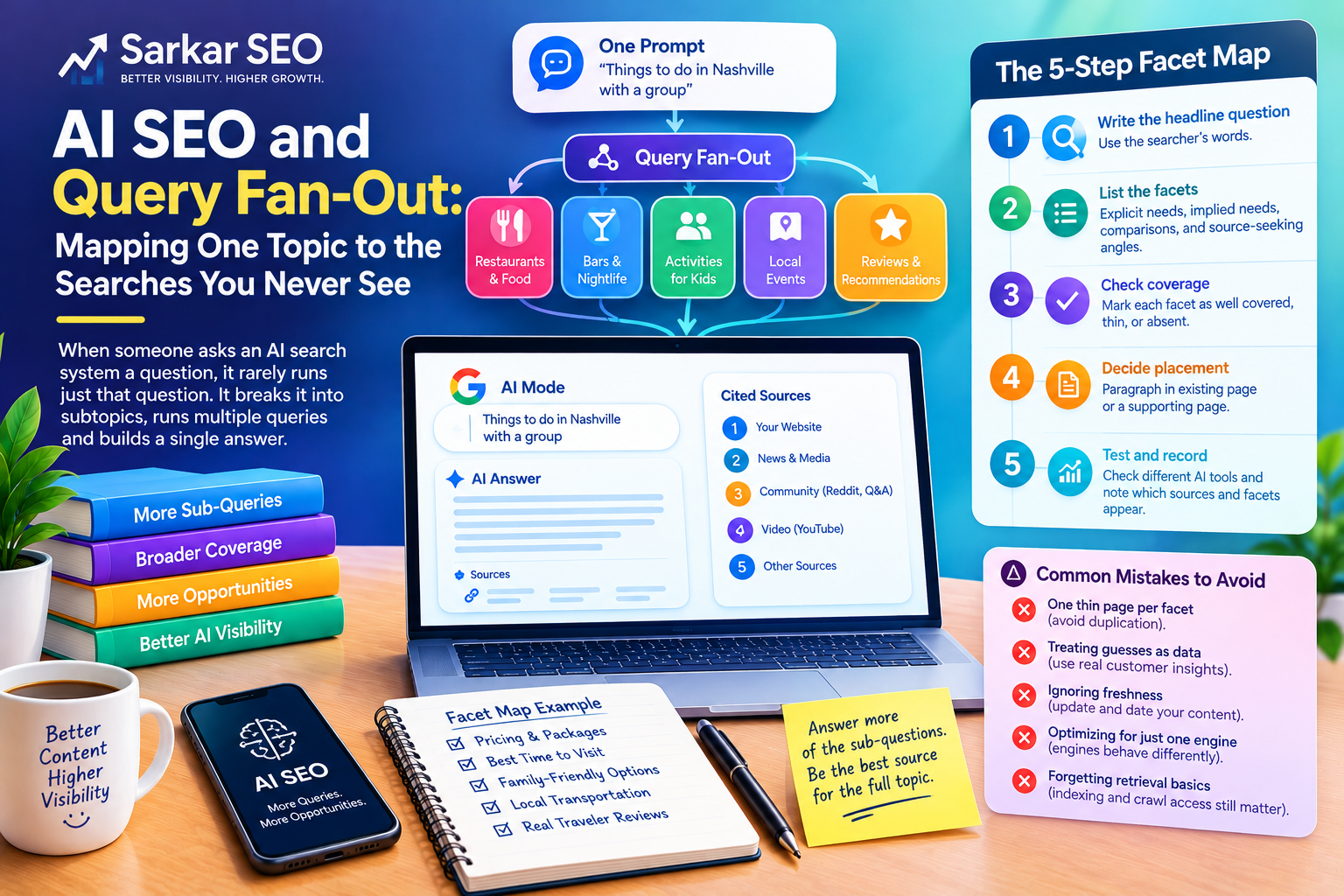
When someone asks an AI search system a question, the system rarely runs just that question. Google describes AI Mode as breaking a question into subtopics and issuing many queries at once. For AI SEO, the practical consequence is this: your page can be retrieved for a sub-question the searcher never typed, or missed because you answered only the headline query.
What Query Fan-Out Is
Query fan-out is the process by which an AI search system expands one prompt into several related searches, runs them, and combines the results into a single answer with links. Google’s Robby Stein explained in a July 2025 interview that for a request like “things to do in Nashville with a group,” the system may generate questions about restaurants, bars, and activities for kids, then search for each.
Two details matter. Google Search acts as the backend tool, so retrieval still runs through search. And harder questions can trigger Deep Search, which Stein said can issue dozens or hundreds of background queries. Simple factual questions may barely fan out at all.
What Is Known, and What Is Not
Google has described the mechanism. It has not published the sub-queries it generates, how it weighs sources, or how often your page is chosen. Anyone showing you “the fan-out queries” is inferring them.
Outside analyses exist, with caveats. An analysis attributed to the agency Nectiv, reported by WebSearchAPI.ai, claims Google averaged about nine sub-queries per prompt while ChatGPT averaged about two, and that around 95% of fan-out phrases show zero monthly search volume. Treat these as directional. The collection method was not disclosed, the reported sample sizes were not reconciled, and the publisher sells search-related tools.
The volume claim, if even roughly true, has a useful implication. Keyword tools measure what people type, while fan-out queries are generated by software, so they may never appear in your keyword reports.
A Facet Map in Five Steps
SEO consultant Aleyda Solis proposed grouping sub-queries by type, and that framing is a sound planning tool, though it is her interpretation rather than a Google specification. Use it to build a facet map for each page you care about.
- Write the headline question in the searcher’s words.
- List the facets. Separate the explicit needs, the implied needs, comparisons, and source-seeking angles such as reviews, specifications, and expert opinion.
- Check coverage. For each facet, find where your site answers it. Mark each as answered well, answered thinly, or absent.
- Decide placement. A facet that needs only a paragraph belongs in the existing page. One that needs depth earns a supporting page that links back.
- Test and record. Ask the same question in several AI tools and note which sources appear and which facets they address.
Where Fan-Out Planning Goes Wrong
- One thin page per facet. Splitting every variation into its own page invites duplication. Create a separate page only when the facet is a real question with real depth.
- Treating guesses as data. A plausible sub-question is a hypothesis. Validate it against customer emails, sales calls, and support tickets, which show what people actually ask.
- Ignoring freshness. The Nectiv analysis suggests systems may add the current year to searches. That is unconfirmed, but it is a cheap reason to date your updates visibly and keep figures current.
- Optimizing only for ChatGPT or only for Google. The reported gap in sub-query counts suggests engines behave differently, so a single-page strategy may suit one and a cluster strategy another.
- Forgetting retrieval basics. Fan-out retrieves pages through search, so indexing and crawl access still decide eligibility.
Why Original Evidence Beats Rephrasing
Fan-out rewards pages that answer a facet better than other pages do. If your section on memory requirements repeats what ten other pages say, it adds nothing to the synthesized answer. If it reports your own benchmark, a documented customer scenario, or a firsthand comparison, it offers something the system cannot assemble elsewhere. Sarkar SEO recommends looking inside your own operations for these details before commissioning a writer.
Turning the Map Into an Editorial Plan
Rank your facet gaps by two measures: how close each facet sits to a buying decision, and how much evidence you can honestly provide. Fill the facets where both are high first. Then revisit the map quarterly, because the questions people ask AI tools shift as products and prices change.
