



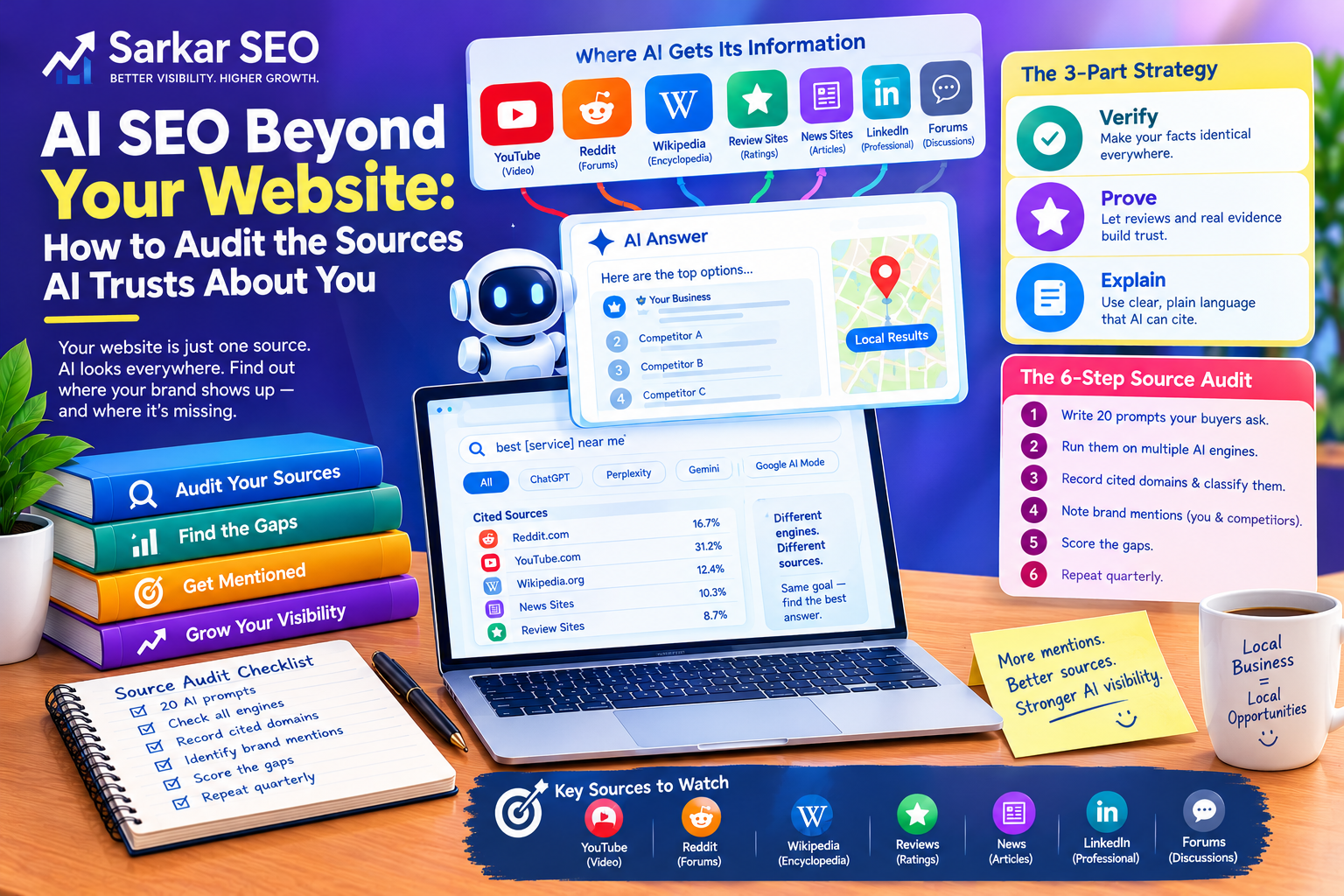
Your website is only one of the places an AI answer can learn about your business. Large citation studies keep showing the same pattern: AI search engines lean heavily on forums, video platforms, encyclopedias, and review sites. For AI SEO, that means a strong website is necessary but not sufficient. You also need to know which outside sources shape the answer in your category.
Which Sites AI Engines Cite
The leaders differ by engine, and the numbers shift from one study to the next. Ahrefs analyzed about 78.6 million searches from June 2025 and found Wikipedia led ChatGPT’s mentions at 16.3%, while YouTube led Perplexity’s at 16.1%. Reddit and Quora appeared only in Google AI Overviews’ top ten, at 7.4% and 3.6%.
A more recent view comes from Obsurfable, a vendor that republished Ahrefs Brand Radar snapshots labeled July 2026. It reported Reddit at 16.7% of ChatGPT’s top-source mentions, YouTube at 31.2% for Perplexity, and Reddit and YouTube near 18% to 21% each in Google’s AI Overviews. These are secondary figures from a vendor, and the report itself warns that methodologies differ.
Three cautions apply. The studies measure general prompts, and your niche may look different. Shares move month to month. And Claude is largely absent from the Ahrefs data, so assume nothing about its sources.
Why One Platform Is Not Enough
Semrush’s AI Visibility Index, published on June 30, 2026, covered 126 million US prompts from January to April 2026 across ChatGPT, Gemini, AI Mode, and AI Overviews. Of more than 1,200 brands tracked, only 36 stayed in the top 100 most-mentioned on every platform in every month.
Dependence on one engine is common. Semrush reported that Cleveland Clinic drew 86% of its AI mentions from AI Overviews. Patagonia held a steady visibility score, which the report attributed to third-party outdoor-gear review sites generating more than 65,000 mentions. The lesson is not that every brand needs a review-site strategy. It is that where your mentions come from determines how fragile your visibility is.
The same report found that 45% of 481 surveyed marketers could not properly measure their AI visibility, and only 9% could measure all relevant metrics. Most teams are guessing.
The Source Audit
Generic top-domain lists describe averages. Your audit should describe your market.
- Write 20 prompts a buyer would ask, from broad category questions to specific comparisons.
- Run them in ChatGPT, Perplexity, Gemini, Google AI Mode, and Claude, using fresh sessions.
- Record every cited domain and classify it: forum, video, encyclopedia, review platform, news, professional network, competitor site, or your own.
- Note brand mentions, including cases where competitors appear and you do not.
- Score the gaps. Rank sources by how often they appear and how absent you are.
- Repeat quarterly, because the results change.
Sarkar SEO recommends logging dates, prompts, and engines in a simple spreadsheet. Without that record, you cannot tell a real improvement from ordinary variation.
A Worked Example
This is a hypothetical illustration. A small accounting-software company runs its 20 prompts and finds a software review platform cited in most answers about comparisons, a video channel cited for how-to questions, and a forum cited for “is it worth it” questions. The company appears on none of the three with a complete profile.
That points to three specific jobs: complete the review profile with accurate details, publish two or three genuinely instructive videos, and answer real questions in the forum without promotion. Each job matches a gap found in the audit, instead of following a generic checklist.
What Not to Do
Because outside mentions matter, shortcuts will tempt you. Resist them.
- Fake reviews and planted forum posts. They break platform rules and mislead readers. Reports on Google’s May 2026 guidance say it advises that pursuing inauthentic mentions is not worth the effort for its own AI features.
- Self-written encyclopedia entries. Earn independent coverage first, because a promotional entry is likely to be challenged or removed.
- Copy-pasted profiles. Identical text across platforms adds little. Tailor each one to its audience.
- Chasing the biggest domain regardless of fit. A forum thread nobody in your category reads will not move your answers.
Earning Mentions Honestly
The durable approach is to give other people something worth referencing. That includes original data, a clear definition of a concept you understand well, a free tool, or a well-argued comparison. Subject experts at your company can contribute to industry publications, answer questions where your buyers already ask them, and encourage genuine customers to leave accurate reviews. None of this is fast, which is partly why it works.
Keep the facts consistent across every profile: company name, descriptions, locations, services, and dates. Conflicting details confuse people first, and they may confuse automated systems too, though no study cited here proves that.
Measuring Progress
Track three things: how often your brand appears in your 20 prompts, which sources cite you, and branded search volume in Search Console. Treat changes of a few points as noise, since AI answers vary between runs, and repeat each prompt a few times before drawing conclusions. A source that appears in most of your repeated runs matters more than one that appears once. Look for patterns over several months. Sarkar SEO treats this as a scorecard to guide the next quarter’s work, not as a promise of results.
