



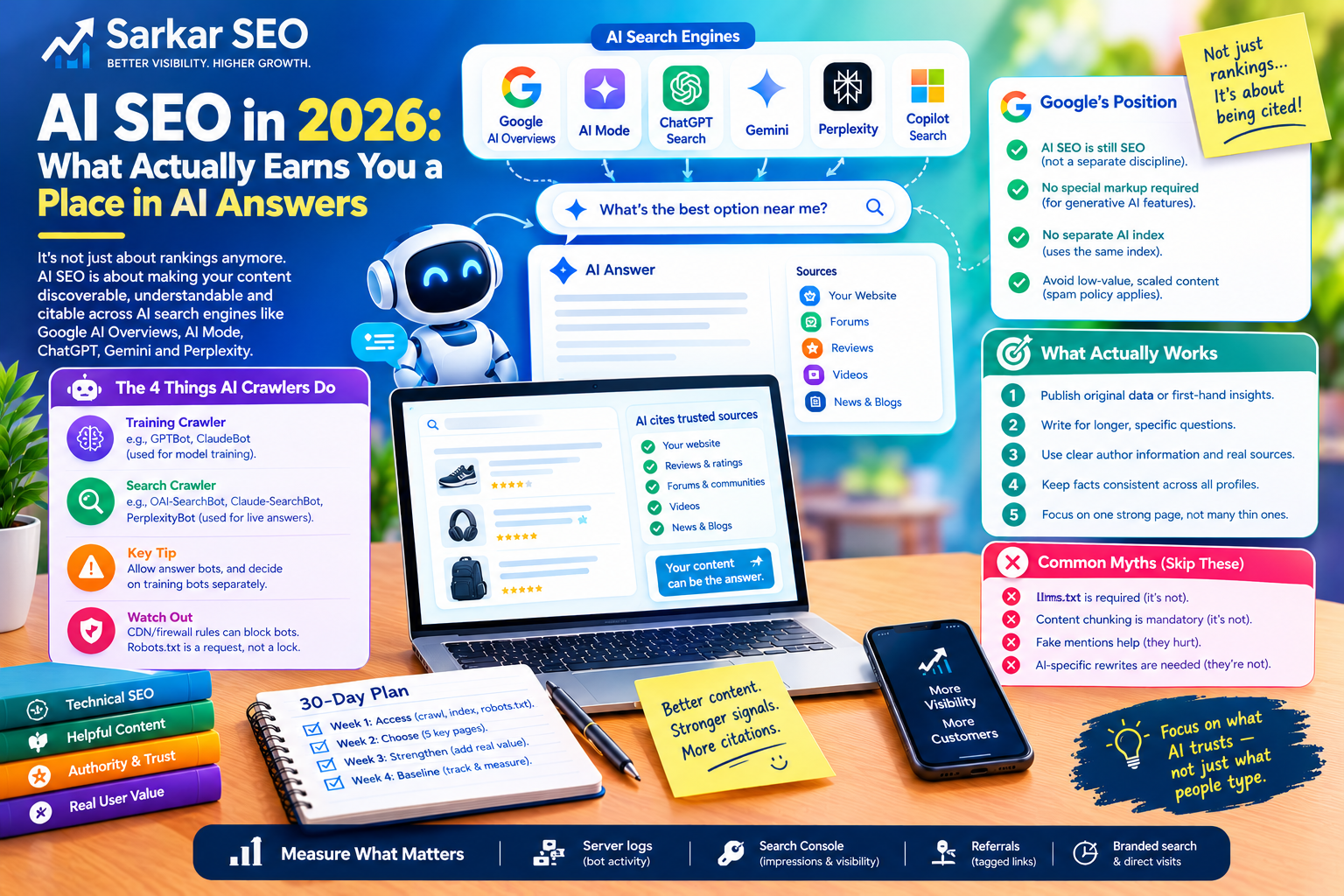
Every few months, search marketing gets a new acronym and a fresh wave of panic. GEO, AEO and LLMO each arrive with a checklist and a price tag. In May 2026, Google published its own guidance, and it is calmer and more demanding than most vendors admit. At Sarkar SEO, we read it as a filter: it separates AI SEO work worth funding from work that only looks busy.
What AI SEO means now
AI SEO means making pages that can be discovered, understood, extracted and cited in AI-powered search experiences such as Google AI Overviews, AI Mode, ChatGPT search and Copilot Search. This article covers that meaning, not the use of AI tools to produce content.
Google’s position: it is still SEO
Google published its guide to optimizing for generative AI features on 15 May 2026. Its core statement is that optimizing for generative AI search is optimizing for the search experience, and so is still SEO. Google does not treat AEO and GEO as separate from SEO when applied to Google Search. Google Publishes New AI Optimization Guide for Websites +2
That does not mean nothing changes. One analysis of the guide put it well: the work becomes more exacting, with cleaner technical SEO and less generic content.
Step one: make the page eligible
Before quality matters, eligibility does. A page must be indexed and eligible to show in Google Search with a snippet to appear in generative AI features. A page that fails this will never be cited, however good it is.
A practical check:
- Confirm key pages are indexed and not blocked by a stray noindex.
- Look for snippet restrictions that could limit what Google can show.
- Make sure the mobile version carries the full content, because Google uses the mobile version of a site’s content for indexing and ranking.
- Keep internal links crawlable and descriptive.
Step two: publish what cannot be summarized from elsewhere
Google’s guidance asks for helpful, reliable, people-first content that goes beyond common knowledge. Its guide also says that content people find unique, compelling and useful will likely influence presence in generative AI search over the long run more than any other suggestion.
If an AI system can write your page from its general knowledge, your page adds nothing it needs to cite. In practice, non-commodity content usually comes from one of four places:
- Original data, such as your own surveys, audits or benchmarks.
- First-hand testing, with what you tried, what failed and what changed.
- Named expertise, meaning an accountable author with a real track record.
- A clear point of view that takes a position instead of listing options.
There is a trap here. Because AI Mode can generate related queries, some teams will be tempted to create a page for every possible sub-question. Google’s spam policy on scaled content abuse covers this. Google describes it as an ineffective long-term strategy because quantity is not relevance. One strong page that answers a topic thoroughly beats fifty thin ones.
Myths worth dropping
The guide includes a “mythbusting” section. Google says you do not need llms.txt files, content chunking, AI-specific rewrites, inauthentic mentions or excessive schema.org markup. Each deserves a brief reality check:
- llms.txt: John Mueller compared it to the keywords meta tag, noting that no AI services used it and bots did not request the file.
- Chunking: There is no requirement to break content into small pieces for AI systems. Write for the reader.
- Fake mentions: Google acknowledges that AI features can reflect what is said about products across blogs, videos and forums, but says seeking inauthentic mentions is not as helpful as it might seem. Earned reputation is the only version that lasts.
Beyond Google: the crawler layer
Google is not the only answer engine, and the others have their own gatekeepers. The most common mistake is confusing training crawlers with search crawlers. GPTBot governs crawling for model training, while OAI-SearchBot governs search retrieval, so you can allow one and disallow the other. The consequence is easy to miss: blocking GPTBot does nothing to your presence in ChatGPT search, but OpenAI is explicit that sites opted out of OAI-SearchBot will not appear in ChatGPT search answers. Claude-SearchBot and PerplexityBot work on the same principle for their own products. anglerageotoolbox
This is not a small problem. One crawler study found that nearly four in ten of the world’s most popular sites are inaccessible to a well-behaved AI crawler that respects robots.txt. Some of those blocks are deliberate. Many are inherited from the 2024 wave of “block every AI bot” advice. Also check your CDN and firewall, since bot-protection rules can block answer bots in ways robots.txt does not show.
The choice about training bots is a business decision, not a technical one. Decide it on purpose, and keep answer bots separate from it.
Write for longer, more specific questions
Google’s own early testing found that AI Mode queries were twice as long as traditional Google searches. People ask AI search things like “which approach suits a small team with no developer,” not “SEO tools.” Pages that name the situation, the constraint and the trade-off match these questions better than pages written around a single head term.
Measure honestly
Measurement is improving but still imperfect. One report says Search Console is gaining reports that show URL visibility in AI Overviews and AI Mode, so check your own property to see whether it is available to you. For ChatGPT, referral clicks arrive tagged with utm_source=chatgpt.com, which you can segment in analytics.
Expect gaps. Some AI visibility produces brand exposure without a click, so track branded search demand and direct visits alongside referrals.
A realistic 30-day plan
Week 1: Access. Audit indexing, snippet settings, robots.txt and firewall rules for both Google and answer-engine crawlers.
Week 2: Choose. Pick five pages that already matter commercially. Ask of each: what do we know that others cannot copy?
Week 3: Strengthen. Add original evidence, named authorship, and honest limits to those pages. Remove padding.
Week 4: Baseline. Record impressions, citations, referral sessions and branded demand, then review monthly.
Teams often skip the baseline, then cannot tell whether anything worked. At Sarkar SEO, we treat measurement as part of the work, not an afterthought.
