



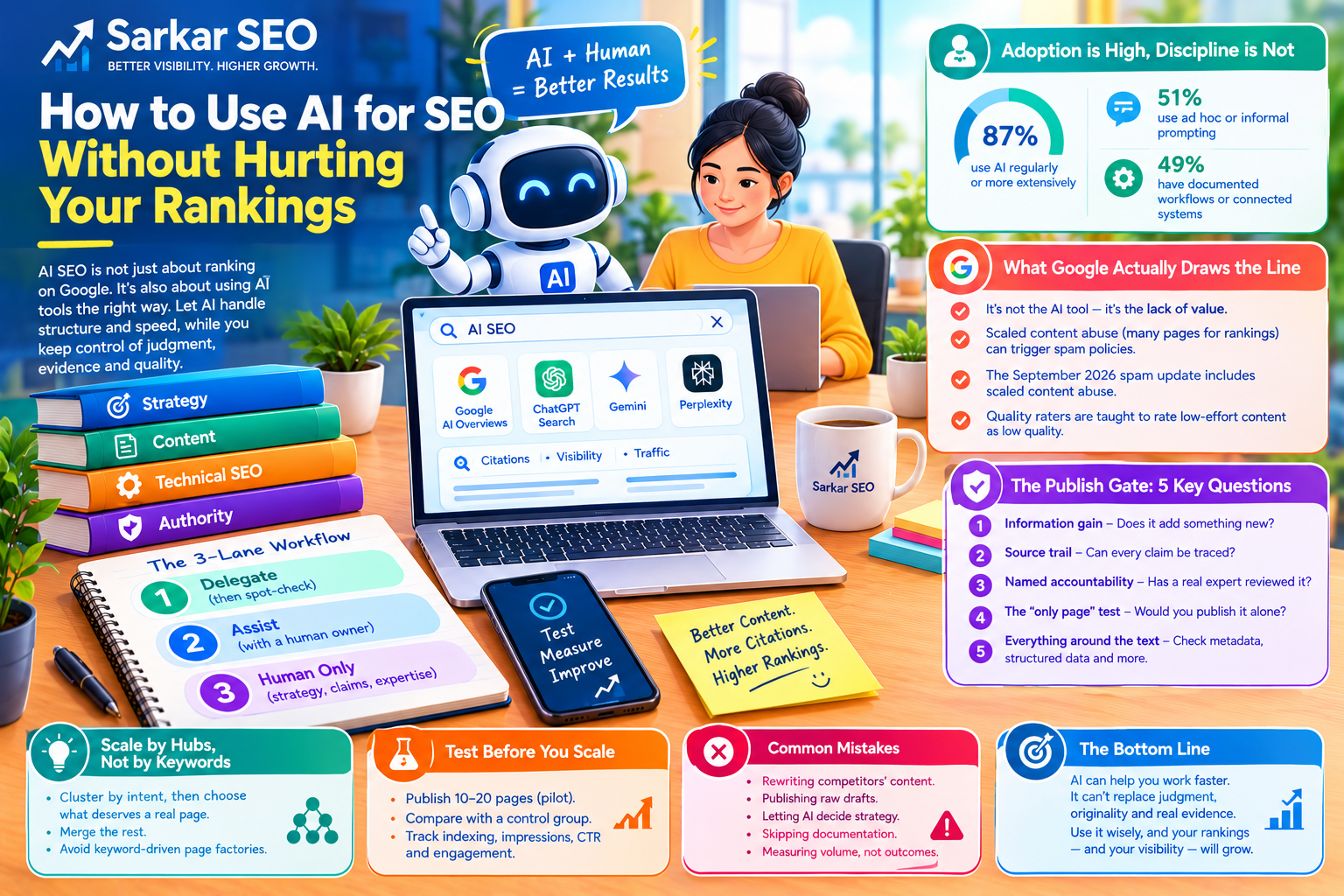
“AI SEO” now means two things: optimizing your site to be cited by AI search, and using AI tools to do the AI SEO work itself. This article covers the second. Most teams already do it, so the real question is how to use AI safely. The safe approach is to let AI handle structure and speed while people handle judgment, evidence, and final responsibility.
Adoption is high, discipline is not
In a Keyword.com survey of 97 SEO professionals, 87% said they use AI regularly or more extensively. The sample is small, but the maturity gap is telling: 51% rely on ad hoc or informal prompting, while 49% have documented workflows or connected systems. Most teams have tools. Few have rules.
Where Google actually draws the line
Google does not treat AI as the offense. Analysts of the policy describe AI-generated content as a production method, not a violation. The target is scale without value: producing many pages primarily to manipulate rankings rather than help users.
Google’s Search Liaison has been blunt that the method is irrelevant here. Danny Sullivan said Google doesn’t care whether scaled content comes from AI, automation, or people. Mueller added that quality raters are taught to rate this kind of low-effort content as low quality. searchenginejournalsearchenginejournal
The policy is also current. Google’s September 2026 spam update began on September 24 and lists scaled content abuse among the policies in scope. Some studies suggest the risk is practical as well as policy-based. One analysis found articles classified as AI-generated tended to rank lower, though the researchers did not evaluate heavily human-edited AI-assisted content. Read that as a warning about unedited output, not about AI itself.
The three-lane workflow
A simple way to avoid both over-trusting and under-using AI is to sort every SEO task into one of three lanes. This is the framework we use at Sarkar SEO when deciding what to automate.
Lane 1: Delegate, then spot-check. These are structured, repetitive tasks where a wrong answer is easy to catch: keyword clustering, search intent tagging, summarizing audit exports, drafting meta descriptions, and writing report commentary. One agency source lists keyword clustering and technical audit summarization among the main AI use cases, and claims clustering time falls by 60 to 70%. Treat that figure as a vendor claim, but the direction is plausible. The key rule is to keep data pulls deterministic. One agency describes pulling keyword data and dropping zero-volume terms through scripts, and using AI only for intent classification before a senior reviews it. Numbers come from tools. Interpretation comes from AI. Sign-off comes from a person.
Lane 2: Assist, with a human owner. AI can draft briefs, outlines, content refreshes, FAQ ideas, and internal link suggestions. The human adds what the model cannot: real experience, product knowledge, opinions, and examples. The same source says brief production drops from 60 to 90 minutes to 15 to 20 minutes. That saved time should go into original input, not into publishing more pages.
Lane 3: Human only. Positioning, strategy, claims that need evidence, original research, and advice on health, money, or legal topics belong here. One tools roundup puts it well: AI tools shine in structure, not strategy.
The publish gate: five questions before anything goes live
Run every AI-assisted page through these checks:
- Information gain. Does it contain something the current top results lack, such as data, a process, or a firsthand example?
- Source trail. Can every number and factual claim be traced to a source you actually opened? AI is known to invent statistics.
- Named accountability. Has a real person with relevant experience reviewed it and put their name on it?
- The “only page” test. Would you publish this page if it were the only one you published this month? If the answer is no, volume is driving the decision, not users.
- Everything around the text. Google’s guidance calls for manual review of AI-generated content for accuracy, including metadata and structured data, not just body copy.
Scale by hubs, not by keyword variations
The most common route into trouble is the keyword spreadsheet that becomes a page factory. Publishing AI pages for every keyword variation can become scaled content abuse, and the safer alternative is fewer, stronger topic hubs. The warning sign is pages that exist only because a keyword list said to create them. rankairankai
A better pattern is to cluster keywords by intent, then ask which cluster deserves one genuinely complete page. Merge the rest. If AI is involved in creation, consider disclosure where readers would reasonably wonder how the content was made. Google’s 2023 guidance says disclosures are useful in those situations.
Test before you scale
Before rolling any AI-assisted process across a whole site, run a pilot. This is a practical suggestion rather than a Google requirement:
- Publish 10 to 20 pages using the new workflow and keep a similar group produced the old way as a control.
- After a few weeks, compare indexing status, impressions, click-through rate, and engagement.
- If pages are crawled but not indexed, or impressions stay flat, the content probably lacks something. Add original input before producing more.
Be careful when diagnosing drops. A core update can change which pages perform best without establishing that the pages losing ground violated a policy, whereas a manual action in Search Console means a human reviewer found a policy issue. Check Search Console before blaming AI.
Common mistakes
- Using AI to rewrite competitors’ pages. The output rarely adds anything new.
- Publishing raw drafts because they “read fine.”
- Letting the tool decide strategy, then retrofitting content to its suggestions.
- Skipping documentation, which is why 51% of teams stay in ad hoc mode.
- Measuring output volume instead of outcomes.
