



Many site owners now see a familiar pattern: rankings hold, impressions rise, and clicks fall. This is the central tension of AI SEO in 2026. Being visible and being visited have drifted apart. This article looks at what the evidence says about the click decline, why the damage is uneven, and how to decide where to fight, adapt, or measure differently.
What the research shows
No single study settles the question, but they point the same way.
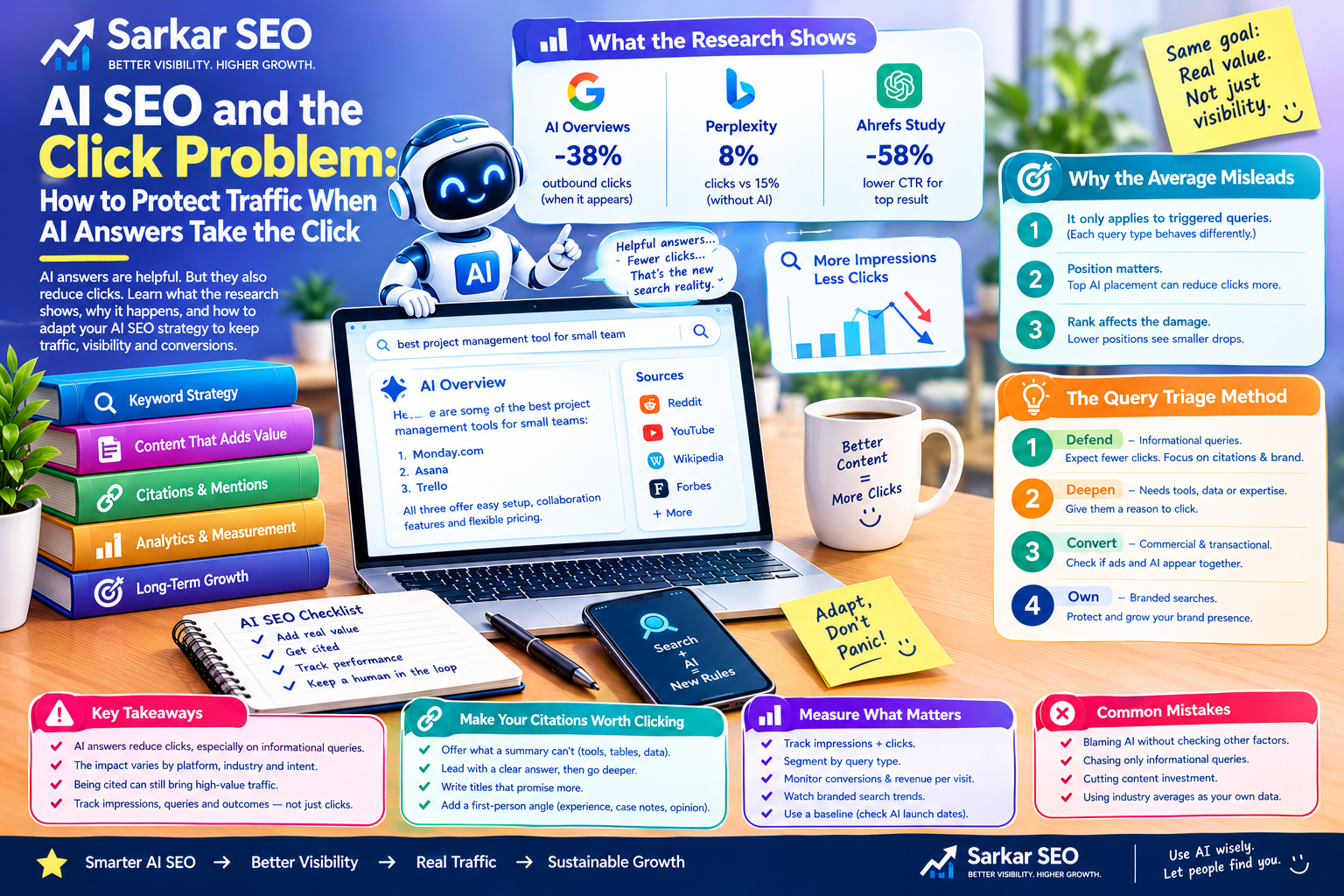
- A controlled experiment. Researchers at the Indian School of Business and Carnegie Mellon ran a randomized field study in early 2026. AI Overviews cut outbound organic clicks by 38% on the queries where they appeared, and zero-click searches rose from 54% to 72%. Notably, self-reported search satisfaction stayed nearly unchanged when the summaries were hidden. searchenginejournalsearchenginejournal
- Observed browsing. Pew Research found users click on results 8% of the time when an AI Overview appears, versus 15% without one.
- Search Console data. An Ahrefs study of 300,000 keywords found AI Overviews correlate with a 58% lower click-through rate for the top-ranking result.
There is one dissenting view. A First Page Sage meta-analysis argues AI Overviews have minimal impact on organic CTR. Studies also differ in method: some measure behavior, others correlate Search Console averages, and several come from firms that sell SEO services. The honest summary is that the decline is real and large on affected queries, but the exact figure depends on who measured it and how.
Why the average misleads you
The headline numbers hide three details that matter for planning.
It only applies to triggered queries. In the experiment, AI Overviews appeared on 42% of queries, so the 38% drop applies to that slice, not to your whole account.
Position inside the page matters. Removing top-position AI Overviews nearly doubled outbound clicks, while lower-placed ones had no effect. searchenginejournal
Rank changes the damage. One analysis found position two lost about 50.8% of clicks when an AI Overview appeared, while positions seven to nine saw smaller drops of roughly 19% to 30%. The same source notes that those lower positions started with little traffic anyway.
So your own exposure depends on your keyword mix, and you can measure it instead of guessing.
The query triage method
At Sarkar SEO, we suggest sorting your keywords into four buckets before deciding where to spend effort. This is a practical framework rather than a standard, so adapt it.
- Defend. Simple informational questions where an AI summary can fully satisfy the reader (“what is,” “how many,” definitions). Expect clicks to fall. Aim to be a cited source and build brand recall, and don’t expect traffic to return.
- Deepen. Questions where the answer needs a tool, a template, original data, or professional judgment. A summary can introduce these topics but can’t replace the resource, so give people a reason to click beyond the paragraph.
- Convert. Commercial and transactional queries. Here the relationship with ads is useful context: Seer Interactive found AI Overviews appeared in only 7% of its paid dataset, suggesting ads and AI Overviews are rarely paired. Verify this on your own queries, because it may differ by market and industry.
- Own. Branded searches. These are the queries where people already know you, and they are the best defense against any layout change. Protect them with accurate, complete pages.
Review the buckets quarterly. AI features expand, so a Deepen query today can become a Defend query next year.
Make the citation worth clicking
If your page is cited, you’ve earned some advantage. An April 2026 Seer Interactive study reportedly found pages cited inside an AI Overview earned roughly 120% more organic clicks per impression than uncited pages on the same queries. Another roundup of the same research cites a smaller gap of 35% more organic clicks, so treat the size of the benefit as uncertain while accepting the direction. outerboxdesignbloggersideas
To turn a citation into a visit:
- Offer what a summary can’t. Calculators, checklists, comparison tables, downloadable templates, and annotated examples invite the click.
- Lead with a clear answer, then hold something back. Give the definition, but tease the process, the pitfalls, or the data behind it.
- Write titles that promise more. A title that merely restates the answer gives readers little reason to open the page.
- Add a first-person angle. Experience, case notes, and opinion are harder to compress into a generic summary.
Fix your reporting before you panic
Traffic alone no longer measures search value. Consider these adjustments:
- Report impressions alongside clicks. Rising impressions with flat clicks can signal presence in AI-influenced results, though it can also indicate other causes, so investigate rather than assume.
- Segment by query type. Compare your triage buckets separately so a loss in Defend queries doesn’t hide a gain in Convert queries.
- Track outcomes per visit. Conversion rate, leads per session, and revenue per organic visitor can rise even as sessions drop, since remaining visitors are often more motivated. Check this against your own data.
- Watch branded search trends. Growth suggests people remember you after seeing your name in answers.
- Compare against a baseline. Note the dates AI features launched in your market before judging a decline.
Common mistakes
- Blaming a drop on AI without checking for tracking changes, seasonality, or ranking losses.
- Chasing every informational query when a summary will absorb the click.
- Cutting content investment entirely, which removes your chance of being cited.
- Reporting averages from other industries as your own reality.
