



Your rankings hold, impressions climb, and clicks quietly slide. If that pattern looks familiar, you are not imagining it, and it is not a reporting error. AI SEO answers now sit above many results, and they change what users do next. The useful question is not whether this hurts. It is which of your pages it hurts, by how much, and what to do about each group. Sarkar SEO’s view is that this is a triage problem, not a panic problem.
What the studies say, and where they disagree
Several independent measurements point the same way, even though the sizes differ:
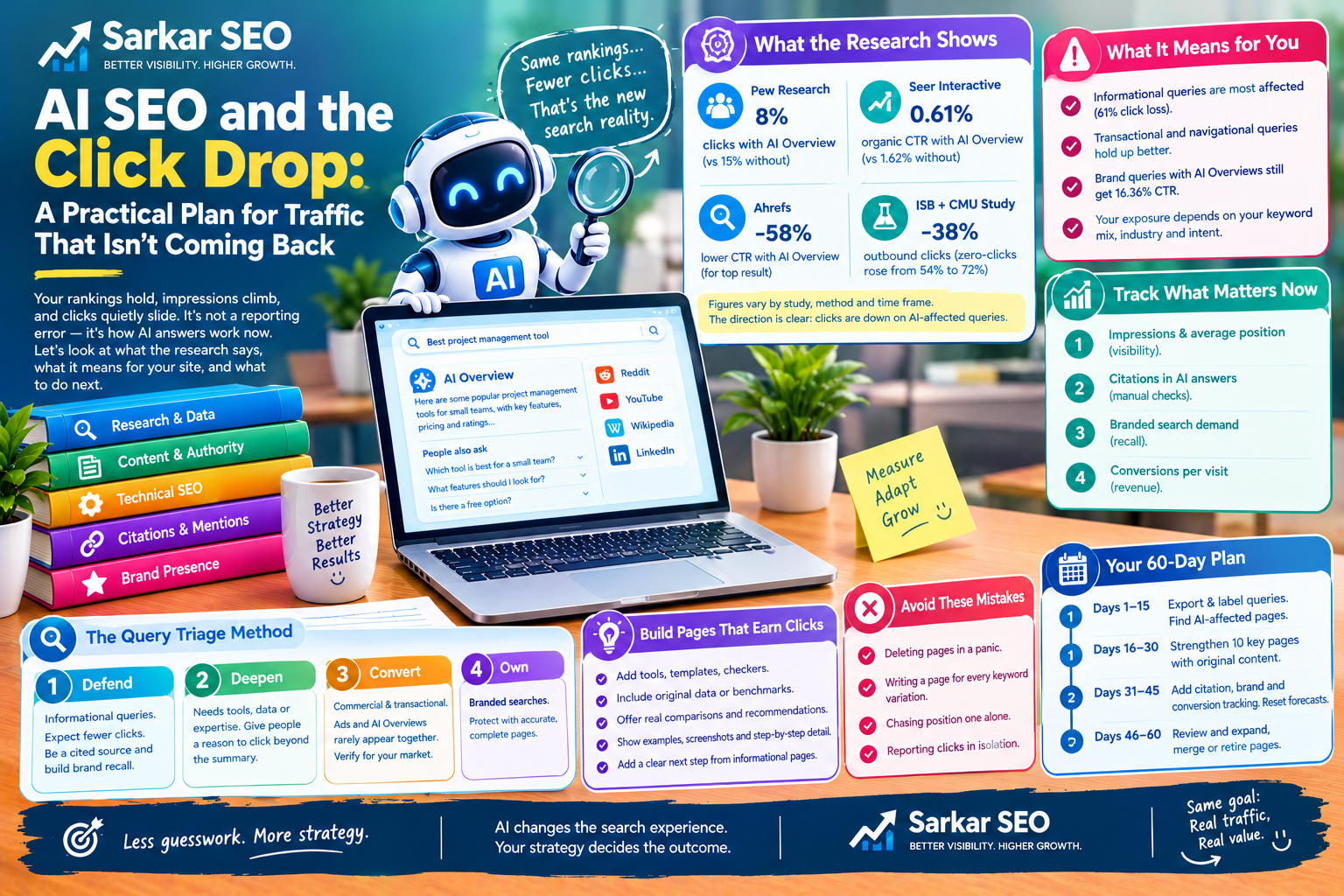
- Pew Research found that only 8% of users click through to organic results when an AI Overview appears, against 15% when it does not.
- Seer Interactive’s study of 53 brands and more than 2 billion impressions found organic click-through of 0.61% on queries with an AI Overview, against 1.62% without.
- Ahrefs reported that AI Overviews correlate with a 58% reduction in click-through rate for top-ranking pages, nearly double the 34.5% it documented in April 2025.
- A randomized field experiment by researchers at the Indian School of Business and Carnegie Mellon found that the summaries reduced outbound organic clicks by 38% on triggered queries, while zero-click searches rose from 54% to 72%.
Treat the spread as normal. These studies use different methods, panels and query sets. One roundup even flags an outlier, First Page Sage’s meta-analysis, which argues AI Overviews have minimal impact on organic CTR. The honest summary is that the direction is consistent and the magnitude depends on your queries.
There is also some relief in the data. One 2026 analysis of Seer’s work notes that the steep decline seen through much of 2025 did not continue in a straight line. Click loss looks more like a step change that is settling than a free fall.
Your exposure depends on intent
The same AI Overview does not hurt every page equally. Reported patterns are consistent in direction: informational queries are the most vulnerable, while transactional and brand queries hold up better, and brand queries with AI Overviews present still generated a 16.36 percent click-through rate in Seer’s research. One analysis of year-over-year traffic puts the contrast starkly, with informational queries losing 61% of clicks, transactional 16% and navigational 3%. Do you want to be found on Do you want your business to be found on Google? +2
Be cautious with exact trigger rates. Published estimates conflict badly. One source puts commercial-research queries at 8 to 18% while another says 71% of commercial queries show an AI Overview. Use these numbers for direction, then measure your own site.
Run your own triage
You do not need a vendor study to find your exposure. Use a Search Console export for the last 12 months:
- Export queries and pages with clicks, impressions and average position.
- Label each query as informational, commercial, transactional, navigational or local.
- Compare year-over-year clicks for each label, holding position roughly constant.
- Flag pages where impressions rose or held while clicks fell. Those are your AI-affected pages.
- Separate pages that mostly serve definitions and how-to answers from pages that serve a decision.
The result usually sorts your site into three groups: pages that are barely affected, pages that are heavily affected but still valuable for brand and discovery, and pages that were only ever traffic bait.
Change what you measure
Clicks alone now understate visibility. Track four things together:
- Impressions and average position for target queries.
- Citations in AI answers for your priority questions, checked manually each month.
- Branded search demand, which shows whether people remember you.
- Conversions per visit, because fewer visitors can still mean the same revenue.
Citation is worth tracking, with caveats. Seer reported that pages cited inside an AI Overview earned roughly 120% more organic clicks per impression than uncited pages on the same queries, but another roundup of the same research gives 35% more organic clicks. Seer itself said it cannot definitively prove that citation causes higher CTRs. Cited pages may simply be stronger pages. SERP CTR by Position & Feature: Click-Through-Rate on Google for Organic Search +2
Plan around lower baselines
Seer’s recommendation is blunt: build 2026 strategy around the assumption that CTRs for high-funnel queries will be 20 to 30 percent lower than current levels. Forecast with that in mind. A traffic target that assumed 2023 click behavior is now unrealistic, whatever your ranking work achieves.
Rebuild pages around what a summary cannot replace
When an AI answer can satisfy a simple question, a page that only repeats the answer loses its reason to be clicked. Pages keep earning visits when they offer something beyond a summary:
- Calculators, templates, checkers and other tools people use, not read.
- Original data, benchmarks or testing that exist nowhere else.
- Comparisons with real criteria and a clear recommendation.
- Worked examples, screenshots and step-by-step detail.
- A point of view from a named expert.
For informational pages you keep for visibility, add a next step: a related tool, a checklist download, or a link to the decision-stage page. Give the reader who does click a reason to go deeper.
Mistakes to avoid
Deleting pages in a panic. A page with falling clicks may still be cited, remembered or assisting conversions. Check before removing anything.
Writing a page for every follow-up question. Google’s guidance treats scaled pages built around query variations as a spam risk, and the effort rarely pays back.
Chasing position one alone. Position matters, but a top ranking beneath an AI answer now delivers less than it used to.
Reporting clicks in isolation. Executives who see only sessions will conclude SEO is failing when the real change is in how people find answers.
A 60-day plan
Days 1 to 15: Export and label queries, then identify your AI-affected pages.
Days 16 to 30: Choose ten pages to strengthen with original evidence, tools or clearer decision support.
Days 31 to 45: Add a measurement layer covering citations, branded demand and conversion rate. Reset forecasts to lower click baselines.
Days 46 to 60: Review results and decide which pages to expand, merge or retire.
