



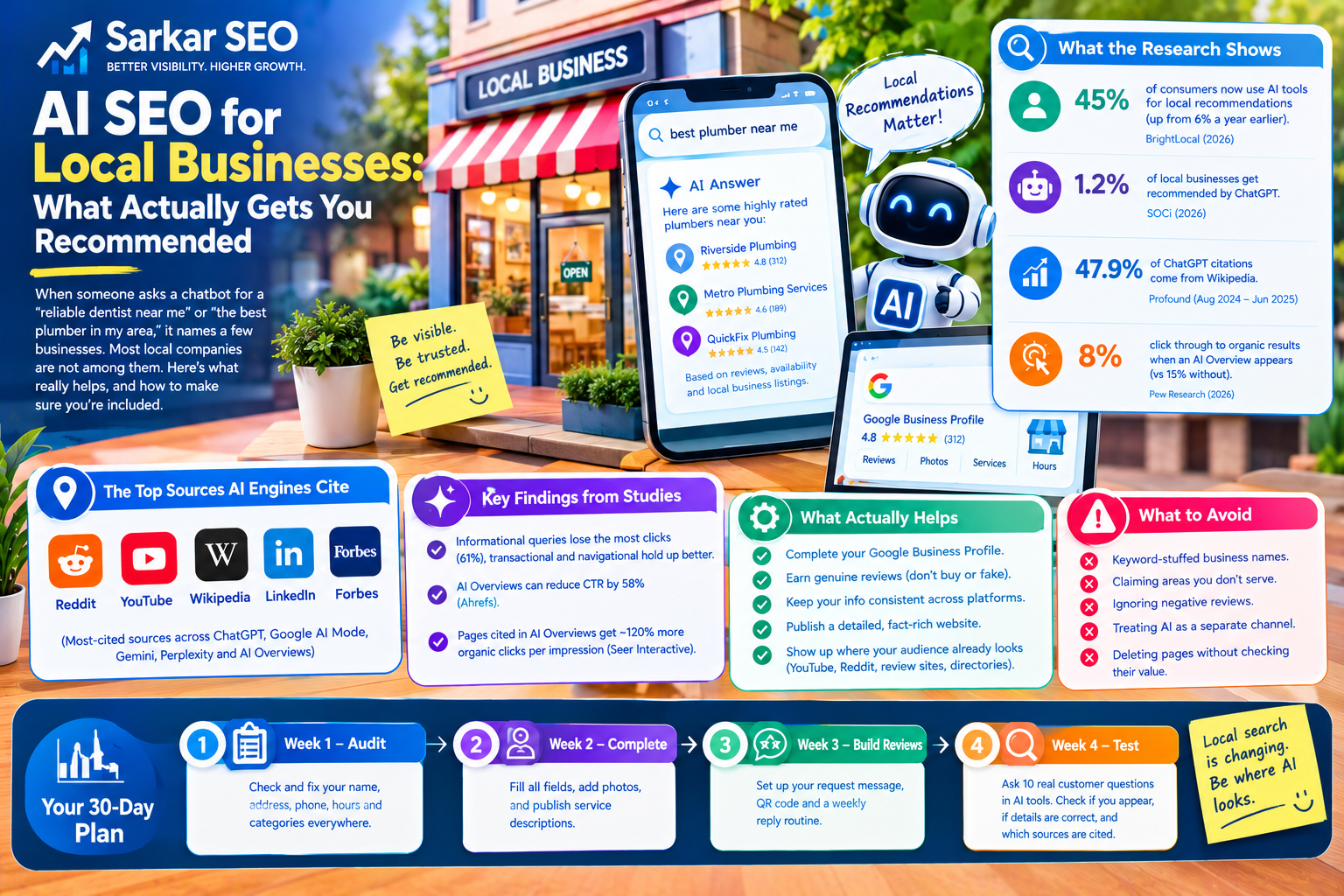
Ask a chatbot for “a reliable dentist near me” or “the best plumber in my area,” and it will name a few businesses. Most local companies are not among them. That gap is the opportunity in local AI SEO: the businesses that understand what these tools look for can appear where competitors don’t. This article covers what the available research says about being recommended, and a practical plan for acting on it.
Demand is rising faster than visibility
BrightLocal’s 2026 survey found that 45% of consumers now use AI tools for local recommendations, up from 6% a year earlier, with ChatGPT used by 31% and Google’s AI Mode by 23%. Yet recommendations are scarce. SOCi’s 2026 Local Visibility Index, covering more than 350,000 locations, found ChatGPT recommends only 1.2% of them. Strong traditional performance is no guarantee either. In retail, fewer than half the brands doing well in conventional local search also appeared in AI recommendations. Emulent Digital Marketing Agency Let’s Talk +2
These surveys are largely US-centered, so adoption rates in your country may differ. The direction, though, is clear enough to plan around.
What the largest local study found
Insites, a vendor of AI visibility tools, analyzed 10,000 US businesses across ChatGPT and Perplexity. Three findings stand out:
- Reviews showed the strongest link. Businesses found by both ChatGPT and Perplexity averaged 133 Google reviews. Businesses invisible to AI averaged just 11.
- Local Pack presence mattered. Businesses appearing in the Local Pack were recommended 3.5 times more often than those that were not.
- The website was the anchor. The report says a business’s own website was cited in 72% of AI answers.
Apply two cautions. These are correlations from a vendor with a commercial interest, so successful businesses may simply attract more reviews and more citations for the same reasons. The report also says technical SEO had no meaningful relationship with AI recommendations. Read that carefully: it measured specific tidiness checks, not whether a site is crawlable at all. A page that search engines can’t access won’t be recommended, so treat basic access as the entry ticket and not the differentiator.
Start with the profile, not the website
For local queries, your Google Business Profile often supplies the structured facts. Google’s AI Mode leans heavily on Maps data drawn from the profile. The same study reported that 77.8% of AI-recommended businesses had fully complete profiles, compared with 31.5% of those ignored.
Complete every field: primary and secondary categories, services, hours (including holiday changes), service areas, attributes, and real photos. Then make sure the details match everywhere else. SOCi found only 68% of contact details surfaced by ChatGPT and Perplexity matched the Google Business Profile, which means mismatches are common and can undermine trust in your listing.
Earn reviews the right way
Review volume is the lever you control most, but shortcuts are risky. Google has tightened its policies against bulk solicitation, incentivized reviews, and coordinated campaigns. Fake or bought reviews can put your profile at risk and don’t build real trust.
A sustainable approach:
- Ask at the right moment. Request a review right after a satisfying job, by text or email, with a direct link.
- Make it easy. A QR code at the counter or on an invoice removes friction.
- Reply to everything. Thoughtful responses show activity and give you a chance to mention services naturally.
- Spread across platforms. One report says ChatGPT now uses licensed Yelp reviews, ratings, and photos, so a presence beyond Google can help. That report comes from a software vendor, so confirm how the integration works in your market. eclincher
Turn your website into a fact source
Since the site is so often cited, give AI something precise to cite. Create a plain “facts” page or section for each location covering: what you do, who you serve, areas covered, typical price ranges or how pricing works, opening hours, licenses and qualifications, and answers to the ten questions customers actually ask. Use specific, checkable statements instead of slogans. “Family-run since 2009, licensed for gas and electrical work” beats “the best in town.”
Add staff names and credentials, original photos, and short case descriptions that mention the neighborhood and the problem solved.
A 30-day plan
This sequence is our own suggestion at Sarkar SEO, not a standard, so adjust it to your business size.
- Week one: audit. List your name, address, phone, hours, and categories across Google, Bing, Yelp, Facebook, and major directories. Fix every mismatch.
- Week two: complete the profile. Fill empty fields, add current photos, and publish service descriptions.
- Week three: build the review habit. Set up the request message, QR code, and a weekly reply routine.
- Week four: publish the facts page and test. Write ten realistic customer questions, such as “emergency plumber open on Sunday near [area],” and ask each in several AI tools. Record whether you appear, whether the details are right, and which sources are cited.
Repeat the test monthly. Sarkar SEO recommends tracking accuracy as well as presence, because a recommendation with the wrong phone number loses the lead.
What to avoid
- Keyword-stuffed business names. Google’s 2026 local enforcement is pushing small businesses away from stuffed names, inflated service areas, and duplicate listings.
- Claiming areas you don’t serve. It confuses both customers and systems.
- Ignoring negative reviews. Respond professionally and fix the underlying issue.
Treating AI as a separate channel. The same fundamentals feed traditional local results, and businesses appearing across AI platforms tend to share a well-maintained profile, helpful website content, and consistent information across the web.
