



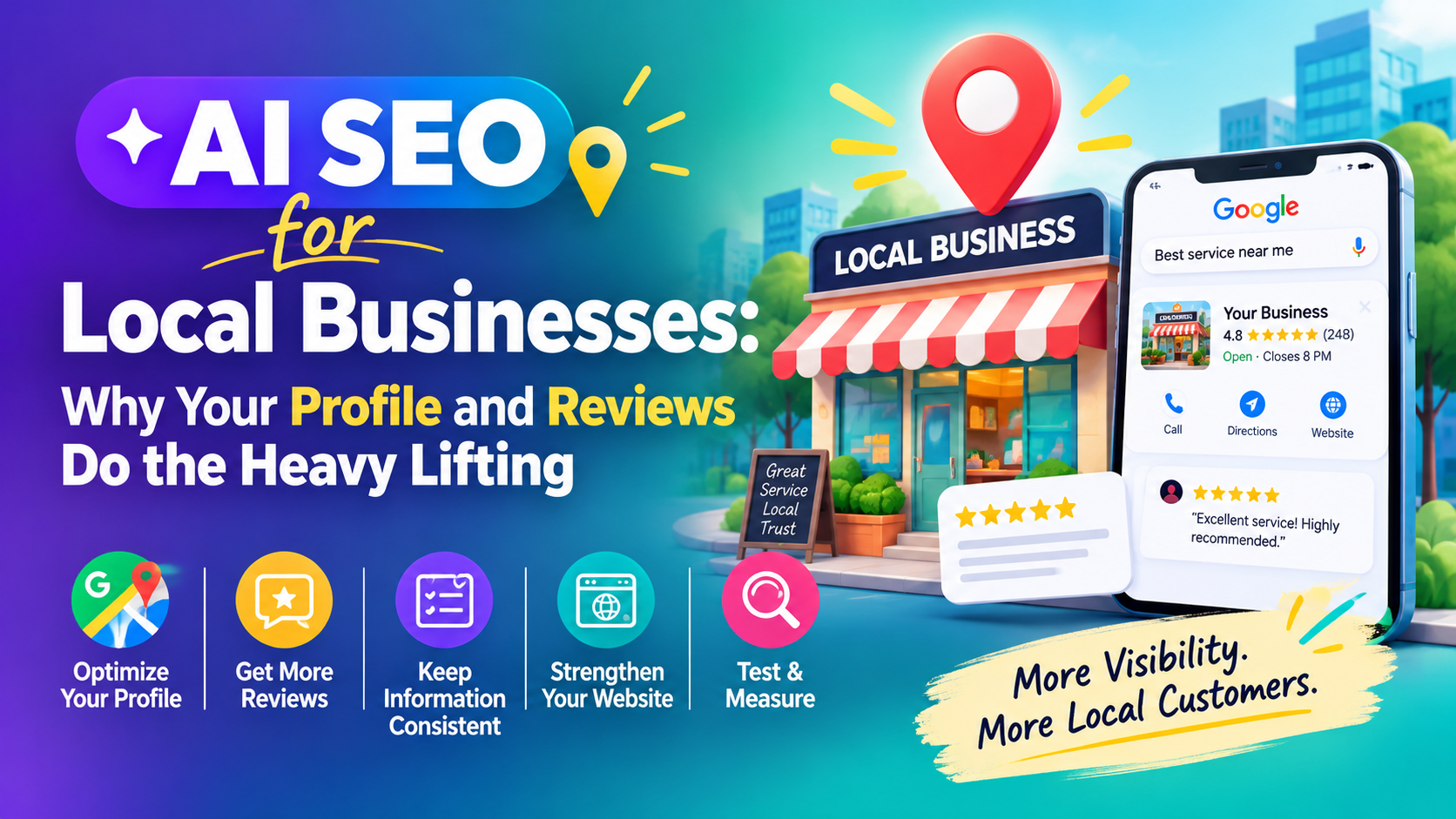
“Best plumber near me.” “A dentist who’s good with anxious kids.” Local searches like these are moving into AI tools fast, and the way those tools pick businesses is different from how a website ranks for an article. For a local business, AI SEO is less about clever content and more about whether systems can find, trust and confirm that you exist and do good work. Sarkar SEO treats local AI visibility as a trust-and-consistency job, and the evidence supports that view.
Local discovery moved quickly
BrightLocal’s 2026 Local Consumer Review Survey reports that consumer use of AI for local business recommendations jumped from 6% in 2025 to 45% in 2026, with ChatGPT used by 31% of consumers for this purpose and Google’s AI Mode by 23%. The same source adds that 64% of active AI users say they trust AI recommendations as much as online reviews.
Keep the scope in mind. That survey covers 1,002 US adults, so adoption will differ in other countries and with other age groups. The direction is clear, but treat the exact percentages as a US snapshot.
Most businesses are still invisible
Being recommended is not guaranteed. SOCi’s Local Visibility Index, covering more than 350,000 business locations, found that ChatGPT recommends just 1.2% of them. In a US restaurant study, Local Falcon compared 189,905 ChatGPT results with Google’s and found that 83% of restaurants were completely invisible in ChatGPT, against only 14% in Google. emulentEntrepreneur
That gap is the opportunity. A small group of businesses with complete, consistent and well-reviewed profiles gets nearly all the mentions. Whitespark’s 2026 ranking factors report even describes local search as “insulated” from the AI disruption affecting the broader industry, because the signals that mattered before still matter.
The profile is the anchor, with a caveat
Across studies, the Google Business Profile keeps appearing as the foundation. One source claims that AI now pulls from the profile, website, reviews, photos and third-party sites at once, with the profile supplying structured signals and reviews delivering trust and relevance. Another local SEO guide puts the point plainly: there is no separate “AI local SEO,” because the same inputs decide both, with review text and third-party mentions weighing visibly more in synthesized answers.
Here is the caution. Whitespark observed that AI local recommendations often drew on public information from Google Maps, reviews, ratings and Business Profiles, but this does not mean a profile directly causes an AI recommendation, since the relationship is still developing. Good profiles correlate with visibility. Nobody has proven the mechanism. Entrepreneur
Reviews are the raw material
AI summaries of local businesses are built largely from what customers say. Review quality matters for a second reason as well: 65% of consumers who rejected a local business did so for at least one review-related reason, such as negative reviews, low ratings, or too few or outdated reviews.
Practical habits that help:
- Ask every customer for a review, at the moment they are happiest, with a simple link.
- Encourage specifics: the service, the staff member, the situation. “Fixed our boiler on a Sunday night” is far more useful than “Great service.”
- Reply to every review, including negative ones, in a calm and factual way.
- Keep reviews recent, because stale profiles look inactive.
Do not buy or incentivize reviews. Google has tightened its Business Profile review policies, cracking down on bulk solicitation, incentivised reviews and coordinated campaigns. A suspended profile is worse than a quiet one.
Consistency beats cleverness
Systems read your business as an entity, so inconsistency creates doubt. One practitioner’s advice: keep the business name identical everywhere, optimize the Google Business Profile, and make every listing match exactly, so systems read one business rather than three similar ones.
Audit these items:
- Business name, address and phone number across your website, profile, directories and social accounts.
- Opening hours, including holidays and temporary changes.
- Categories and services, which should reflect what you actually offer.
- Duplicate or abandoned listings.
Avoid shortcuts. Local SEO enforcement in 2026 is pushing small businesses away from keyword-stuffed business names, inflated service areas and duplicate listings.
Make your website the supporting evidence
Your website is not the star of local AI answers, but it is the proof. Give it concrete detail a system can verify:
- A page for each core service and each location you really serve, with real specifics, not swapped city names.
- Staff names, qualifications and photos of actual work.
- Pricing ranges or “what affects the price” explanations.
- Answers to the questions your team hears on the phone.
- Clear contact details and opening hours that match your profile.
Test the way customers ask
Local AI answers depend on wording and location, so test them directly. Write ten prompts as customers would phrase them, including situation and neighbourhood, such as “emergency electrician open late near the station” or “a vet who is calm with nervous dogs.” Run them monthly in Google AI Mode, ChatGPT and Perplexity, and record whether you appear, which competitors do, and which sources are cited. Results vary by place, so test from the area you serve.
A 30-day plan
Week 1: Verify and complete your profile: categories, services, hours, photos, description. Fix name and contact inconsistencies everywhere.
Week 2: Set up a simple review request routine after every job. Reply to all recent reviews.
Week 3: Improve service pages with real detail and add a short FAQ built from actual customer questions.
Week 4: Run your prompt test and save it as a baseline. Sarkar SEO suggests repeating it on the same day each month.
Know the limits of the evidence
Most of the data above comes from US studies, often on restaurants, and from vendors who sell local SEO tools. Platform mix also differs worldwide: which directories, maps and review sites matter depends on your country, so check where your customers actually look. Some sources quote conflicting figures for how often AI Overviews appear on local queries, which is a good reason to measure your own market instead of trusting averages.
