



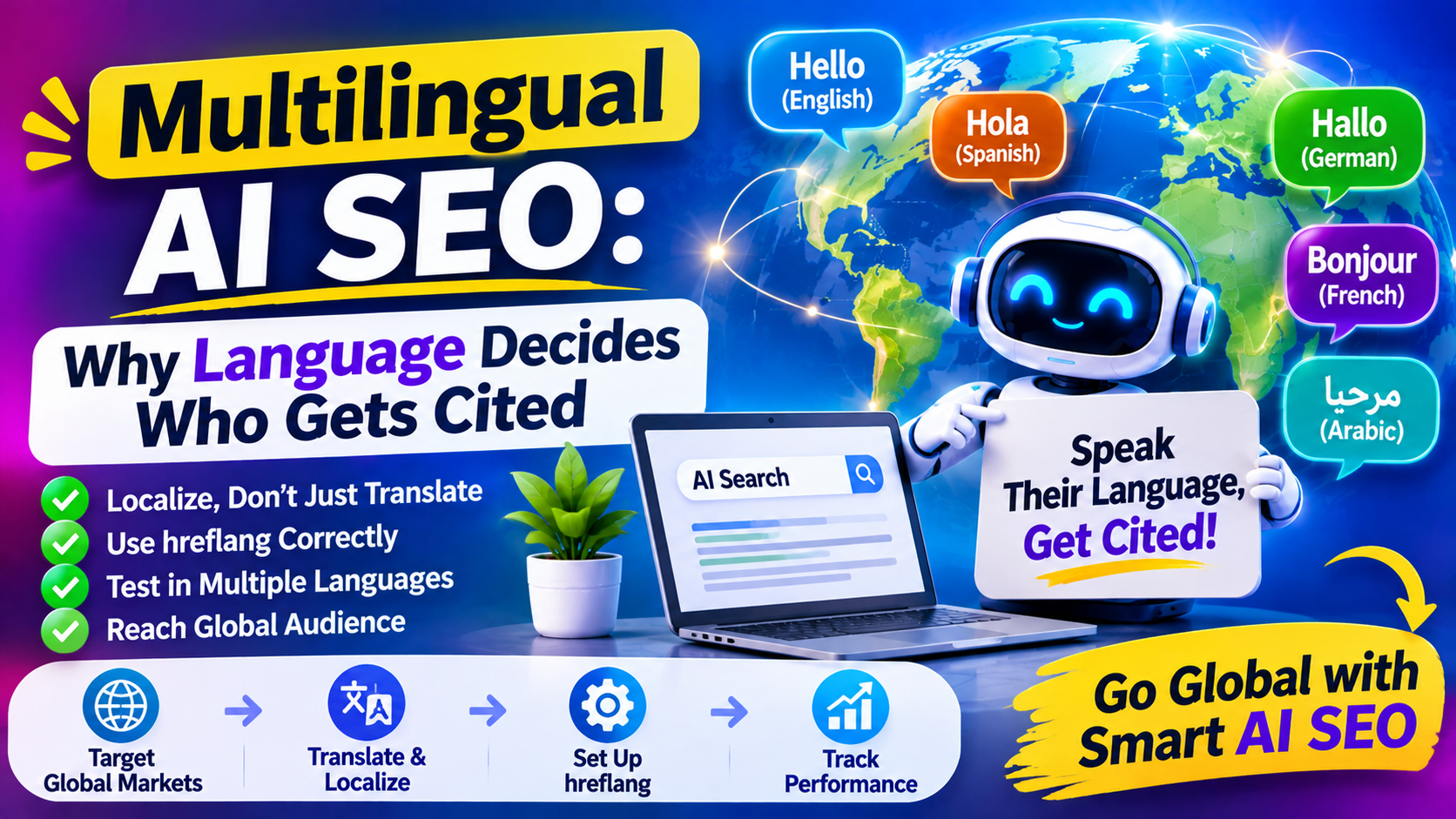
If your audience is worldwide but your site speaks one language, AI search may be quietly filtering you out. Traditional international SEO taught us to think about hreflang tags and country folders. AI answers add a new question: when a person asks in Spanish, German or Arabic, which pages does the system reach for, and does yours exist in that language? Sarkar SEO looks at AI SEO through this lens for global audiences, because the research suggests language is a visibility factor, not just a courtesy.
AI search is spreading across languages quickly
Google’s AI features no longer stay in English for long. Reports from late 2025 describe AI Mode launching in 40 new countries and 35 new languages. A Google executive has argued that the feature reached many countries and languages within a few months because the models behind AI Mode are more multilingual by design. The May 2026 Search update continued the pattern, with the new Search box rolling out in all countries and languages where AI Mode is available. google ai mode news search updates more seofomo 12 oct 2025 +2
The same coverage notes that Google still frames AI visibility as part of Search visibility, not a separate optimization system. So there is no hidden multilingual trick. There is a practical consequence: the gap between a product change and its effect on international visibility is shrinking.
What the translation research found
The most cited study comes from Weglot, which analyzed 1.3 million citations across Google AI Overviews and ChatGPT, focusing on Spanish-language sites in Spain and Mexico. Its core finding: untranslated sites kept strong visibility in their own language but dropped sharply for searches in languages they did not offer.
The gaps were large:
- A sample of 98 untranslated Spanish sites received 17,094 citations for Spanish queries against 2,810 for the equivalent English queries.
- Translated sites in Spain received 10,046 citations in Spanish against 8,048 in English, a much smaller gap.
- Overall, translated sites achieved 327% more visibility than untranslated ones and earned 24% more total citations per query.
One important caveat: Weglot sells website translation software, so it has an interest in the result. The sample was also limited to Spanish and English, and the study measured correlation. Sites that translate their content may differ in other ways, such as size and investment. Treat the direction as credible and the exact percentages as indicative.
Not every engine behaves the same way
The Weglot study also found that when looking at ChatGPT, the bias almost vanished, with translated sites seeing near-equal citations in both languages. A separate Search Engine Land analysis reached a different conclusion about ChatGPT: it reports that ChatGPT strongly favors English pages, unlike Google AI and Copilot. searchenginejournalsearchengineland
One proposed reason is mechanical. As the analysis explains, a non-English prompt can be split into English “fan-out” queries before anything is retrieved. It adds that in its tests, English over-indexing is clear in ChatGPT data, but the bias mostly disappears in Copilot, AI Mode and AI Overviews, because those systems use search indexes that have been multilingual for years.
The two studies disagree on ChatGPT, which is a reminder that the evidence is young and method-dependent. If ChatGPT matters to your market, test it yourself before adding or removing languages on the strength of one report.
Query language shapes the sources
A summary of separate research from Profound reports a study of 3.25 billion citations from 7 AI models in 14 countries, concluding that query language is the dominant force shaping which sources AI engines cite. I only saw this through a secondary playbook, so verify it against the original. The practical reading is still sensible: a French question will usually be answered from French material when good French material exists.
That also suggests an opportunity. The same playbook argues that non-English SERPs are dramatically less competitive, so strong local-language content may face fewer rivals than the same page in English. That is a commentator’s view, but it matches what many international teams report.
Localize, do not just translate
A translated page is not a localized one. For each priority market, check:
- Search behavior. People in different countries phrase the same need differently. Research prompts and queries in the local language, not literal translations of your English ones.
- Commercial details. Currency, units, payment methods, delivery times, taxes and legal terms should match the market.
- Proof. Local case studies, reviews, certifications and press carry more weight than imported ones.
- Tone and examples. Idioms and references that work in London may fall flat in Jakarta.
- Review by a native speaker. Machine translation is a fair starting draft, but unreviewed pages can read poorly and damage trust. Publishing large volumes of unreviewed pages also runs into Google’s scaled content abuse policy, which targets generating many pages primarily to manipulate rankings rather than help users.
Get the technical structure right
One guide calls hreflang the primary signal Google, Bing, AI Overviews, AI Mode, Gemini and Copilot use to decide which language version to serve. That wording is stronger than I can verify, but the practical advice holds: use consistent URL structures (folders, subdomains or country domains), add correct return-linked hreflang annotations, and give each language version self-referencing canonicals. A common error is missing reciprocal tags. Mistakes here can bury a good page in the wrong market.
Avoid these mistakes
Translating into 30 languages at once. Start with the two or three markets where you have customers, support and credibility.
Assuming English rankings carry over. Strong English visibility does not guarantee citations in other languages, as the untranslated-site gap shows.
Copying claims across borders. Regulations, prices and availability differ. A false statement in one market is worse than a missing page.
Ignoring local off-site presence. Local directories, press, communities and review sites matter for the same reasons they do in English.
A 60-day plan
Days 1 to 15: Review analytics to find which countries and languages already send visitors, then choose two target markets.
Days 16 to 40: Translate and localize your five most valuable pages, with native review. Set up hreflang and URL structure.
Days 41 to 60: Run 10 local-language prompts in each target market across Google AI Mode, ChatGPT and Perplexity. Record where you appear and who does instead. Sarkar SEO suggests repeating this monthly, and treating a shared results sheet as your baseline.
