



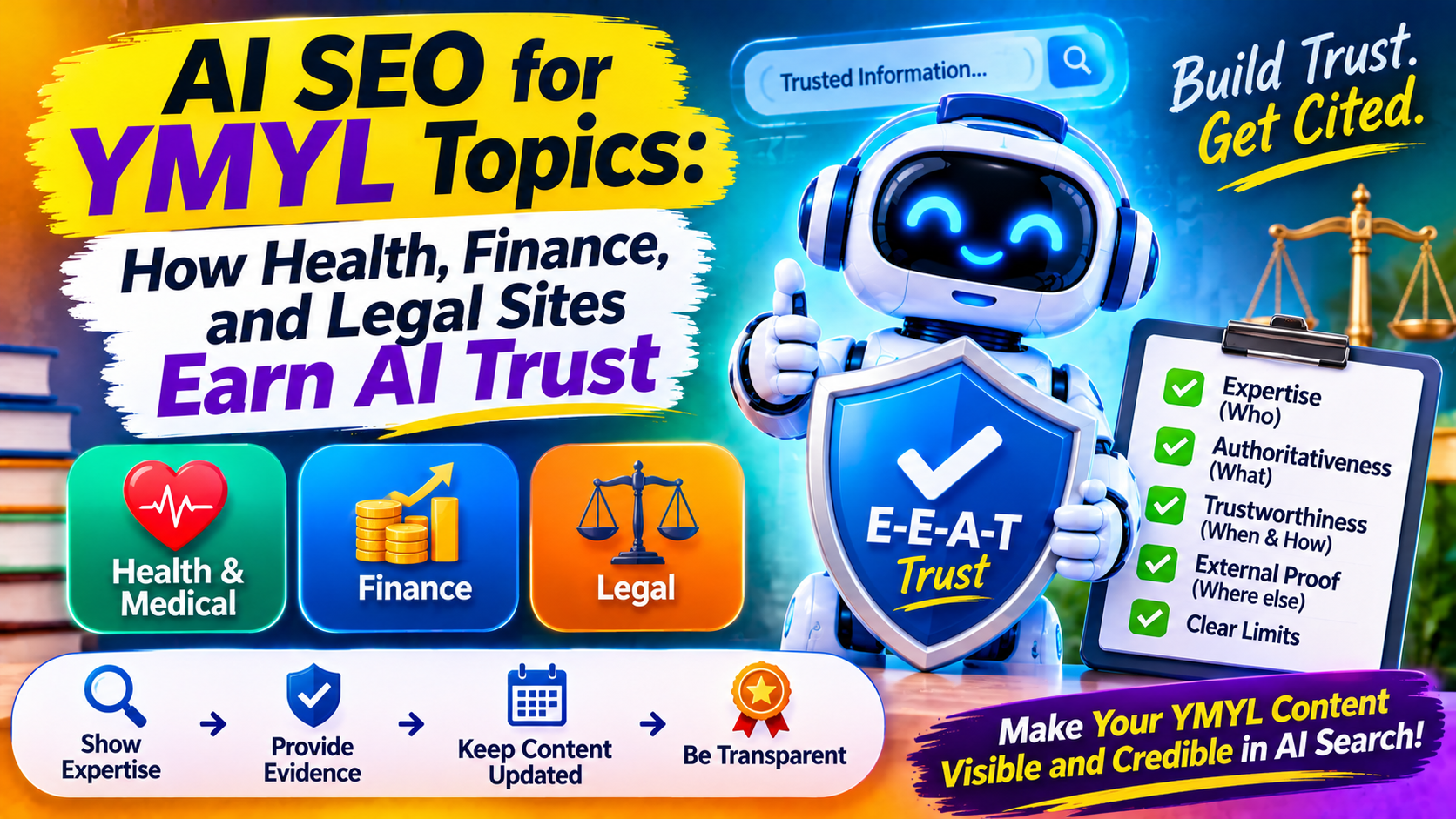
Some topics carry more risk than others. A weak answer about a film wastes an evening, but a weak answer about a medication, a tax rule, or a legal deadline can cost someone dearly. Search quality guidelines call these “Your Money or Your Life” (YMYL) topics, and AI answer engines appear to treat them with extra caution. If you publish in these areas, AI SEO is as much about proving trustworthiness as about structuring content. This article explains what the data shows and how to build visible credibility.
What counts as YMYL
Google’s Search Quality Rater Guidelines group YMYL topics into four categories: health and medical, financial advice, legal guidance, and news and civics. The same guidelines frame the concern simply: content that could affect health, financial stability, safety, or well-being deserves more scrutiny.
What citation data shows
BrightEdge’s AI Hyper Cube tracked health and finance citations in the United States for the week of 23 August 2026 and found that engines differ sharply. ChatGPT’s five most-cited healthcare sources were all government agencies or hospital systems, while Google AI Overviews placed YouTube first, above every clinical source. In finance, ChatGPT spread citations across five sources, whereas AI Overviews leaned on one source at roughly half of prompts. brightedgebrightedge
Two lessons follow. First, there is no single standard of “trusted” across platforms. Second, size is not the only path in. The same report notes that simplywall.st holds the fifth slot on ChatGPT for finance and is not a large publisher. That is one snapshot from one vendor, in one market and week, so treat it as illustration rather than rule. Still, it suggests specialist sources with clear expertise can compete.
Platform overlap is limited too. One analysis reports that only 11% of domains are cited by both ChatGPT and Perplexity, so success on one engine does not guarantee success on another.
What E-E-A-T is and is not
You will hear that “E-E-A-T is a ranking factor.” The more careful view is that E-E-A-T is not a single ranking factor but a useful framework for building trust signals. No one can show you a score. What you can do is make expertise and accountability visible, so that both readers and systems can verify them.
The trust stack
At Sarkar SEO, we think about YMYL credibility as five layers. This is our own working model, not an industry standard.
- Who. Name the author and, where appropriate, a reviewer with credentials. Every YMYL page should make clear who wrote it, who reviewed it, what their qualifications are, and when it was last updated. “Editorial team” is weaker than a named professional.
- What. Tie claims to evidence. One agency warns that wording like “clinically proven to reduce inflammation” without a cited study is a trust-degrading claim. That source is a vendor opinion, but the principle is sound: if a statement matters, show where it comes from, ideally a regulator, a peer-reviewed study, or a professional body. upgrowth
- When. Show update dates and review cycles. Regulations, tax thresholds, and clinical guidance change. A page that was right two years ago may be wrong now.
- How. Publish an editorial policy: how content is researched, who reviews it, how corrections are handled, and how to report an error. Link to it from the footer and from sensitive pages.
- Where else. Make credentials verifiable outside your own site, such as a professional registry entry, a published paper, or a recognized institution’s profile. The same agency argues a lead expert needs an externally accessible credentials profile, because a claim only on your own site is hard to confirm.
Build a claim register
One practical tool is a simple spreadsheet. For each factual claim on a sensitive page, record the claim, the source, the date checked, the reviewer, and the next review date. It sounds tedious, but it makes updates faster and gives your reviewers a clear task. It also protects you: if a regulation changes, you can search the register and find every affected page.
Use AI drafting with extra caution
If you use AI tools to draft YMYL content, treat the output as untrusted. A common failure mode is confident fabrication, including invented studies, misattributed quotes, and outdated regulations presented as current. The rules are strict: never publish a citation you haven’t opened, never let an AI summary stand in for expert review, and never use generated text for dosage, tax, or legal instructions without a qualified person checking every line. Speed is not a virtue here. texta
The same caution applies when you read AI answers about your own field. One guide advises treating AI citations as a starting point, not proof, and verifying source, recency, and expertise. texta
Be clear about limits
Trustworthy YMYL content knows where general information ends. State who the page is for, what it does not cover, and when a reader should consult a licensed professional. This is good ethics, and it also reduces the risk of your page being summarized in ways that overstate its advice. Avoid absolute promises such as guaranteed returns or cures.
Monitor how AI describes you
Set up a monthly check. Ask several AI tools questions about your organization, your services, and the topics you cover. Record whether you are cited, whether your details are accurate, and whether any answer misstates something you published. If an error traces back to your own page, fix it. If it traces to a third-party source, contact the publisher or strengthen your own authoritative page on the subject.
Common mistakes
- Anonymous bylines on sensitive topics.
- Statistics with no source or date.
- Reviewer credentials listed but not verifiable.
- Publishing AI-generated medical or financial text unreviewed.
- Chasing every keyword in a sensitive area instead of covering fewer topics with real depth.
