



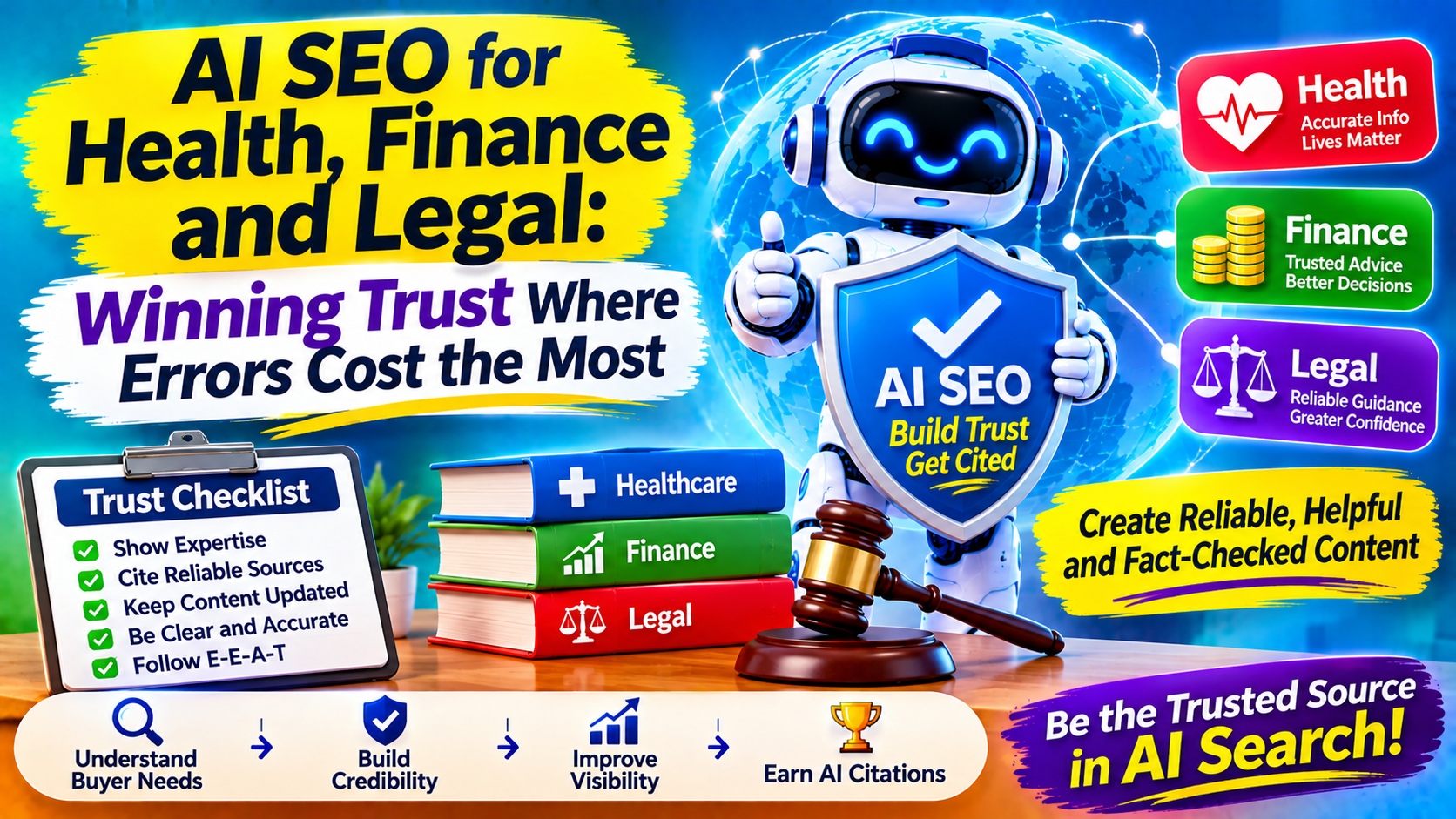
For most websites, a wrong AI answer is an annoyance. For clinics, banks, insurers and law firms, it can mean real harm to a reader and real liability for the business. Search systems treat these “Your Money or Your Life” topics with extra caution, yet the research suggests AI answers do not always favor the most qualified sources. That creates a duty and an opportunity. Sarkar SEO’s view is that in sensitive categories, AI SEO is mostly a trust-building exercise, and the businesses that document their expertise will be the ones worth citing.
What the health data shows
Most public research on AI answers and YMYL topics focuses on health, so that is where the evidence is strongest. SE Ranking analyzed 50,807 German-language health searches, run from Berlin, and mapped which sources Google’s AI Overviews cited. Findings that matter for publishers:
- More than 82% of the health queries triggered an AI Overview.
- Across 465,823 citations, only 34.45% came from a group the study classed as more reliable, such as large hospitals and clinics.
- YouTube was the most cited source at 4.43% of references, although it ranked only 11th in traditional organic results for the same queries.
- Academic journals and government health institutions together accounted for about 1% of citations.
- Only 36% of cited pages appeared in Google’s top 10 for the identical query.
Read the limits before the headline
This study deserves a careful reading. Coverage notes that it captured a single moment in time, a one-day snapshot from December 2025, using German-language queries. It also could not be extrapolated to other regions. SE Ranking is an SEO software company, and its source categories involve judgment calls. eweekeweek
Google disputes the framing. It has said that AI Overviews were designed to surface high-quality content from reputable sources regardless of format, and that a variety of credible health authorities and licensed medical professionals publish on YouTube. A summary adds that the 25 most-cited videos were largely produced by reputable hospitals or clinics, but represent under one percent of the YouTube links used.
Separately, a Guardian investigation had experts and medical charities review Google AI Overviews for health queries and identify examples they labeled misleading, incorrect or potentially dangerous. Google says most AI Overviews are accurate and link to reputable sources, and it has removed AI Overviews for some problematic medical queries.
Platforms trust differently
BrightEdge compared ChatGPT and Google for healthcare. Its findings are directional, since the company sells search analytics. It reports that ChatGPT cites major hospital systems for 57% of symptom queries against Google’s 18 to 20%, and that ChatGPT is twice as likely to cite government sources over consumer health media. It also found that Google cited video for 2.7% of healthcare citations while ChatGPT cited none.
The practical lesson is simple: you may be winning citations on one platform and be invisible on the other, so measure both.
What this means beyond health
Finance, insurance, law and tax share the same structure: high stakes, regulated claims and cautious search systems. I found far less public research on those sectors, so the advice below is a reasoned extension of the health findings, not a proven result. Where regulations differ by country, which they do widely, check local rules before publishing.
A trust-first playbook
- Make expertise visible and checkable. Show who wrote and who reviewed each page, with role, relevant qualifications and the review date. Where professional registration exists, state it in the form your regulator allows. Anonymous “editorial team” pages give a model little to trust.
- Cite primary sources. Name the guideline, statute, regulator or study behind each material claim and say when you last checked it. This also helps readers verify you.
- Separate education from advice. Explain general principles clearly, state the limits, and say when someone should seek individual professional advice. Avoid tailored recommendations on public pages.
- Own your video layer. Because video appears prominently in some AI answers, consider expert-led videos hosted on a channel clearly tied to your institution, with accurate titles, full transcripts and links back to the related page. Quality and attribution matter more than volume.
- Keep content current. Medical guidance, tax rates and legal thresholds change. Review high-risk pages on a schedule and note what changed. Refreshing is covered in more detail in freshness research, but in YMYL topics the cost of staleness is higher.
- Do not mass-produce YMYL copy with AI. Google’s October 2026 guidance tells publishers it is critical to manually fact-check and review all AI-generated content before publishing. For sensitive topics, every claim should be verified by a qualified person before it goes live. ppc
Monitor what AI says about you
In sensitive fields, you cannot only measure whether you appear. You must check whether the description is correct. Once a month:
- Run 15 to 20 questions about your services, fees, qualifications, eligibility or treatments across Google AI Mode, ChatGPT and Perplexity.
- Save the full answers, not just whether you were mentioned.
- Flag errors, such as wrong prices, outdated rules or services you do not offer.
- Update your own pages so the correct answer is easy to find, and use each platform’s feedback channel for serious errors.
Sarkar SEO recommends keeping an error log and reviewing it with your compliance or clinical lead, since the people accountable for accuracy should see these results.
Common mistakes
Chasing citations at the expense of caution. An aggressive claim that earns a mention can create regulatory trouble.
Hiding credentials. If the people behind the content are impressive, say so plainly.
Treating one study as law. The German health snapshot is informative, but your market, language and queries may behave differently.
Ignoring local rules. Advertising and disclosure standards for health, finance and legal services vary by country.
