



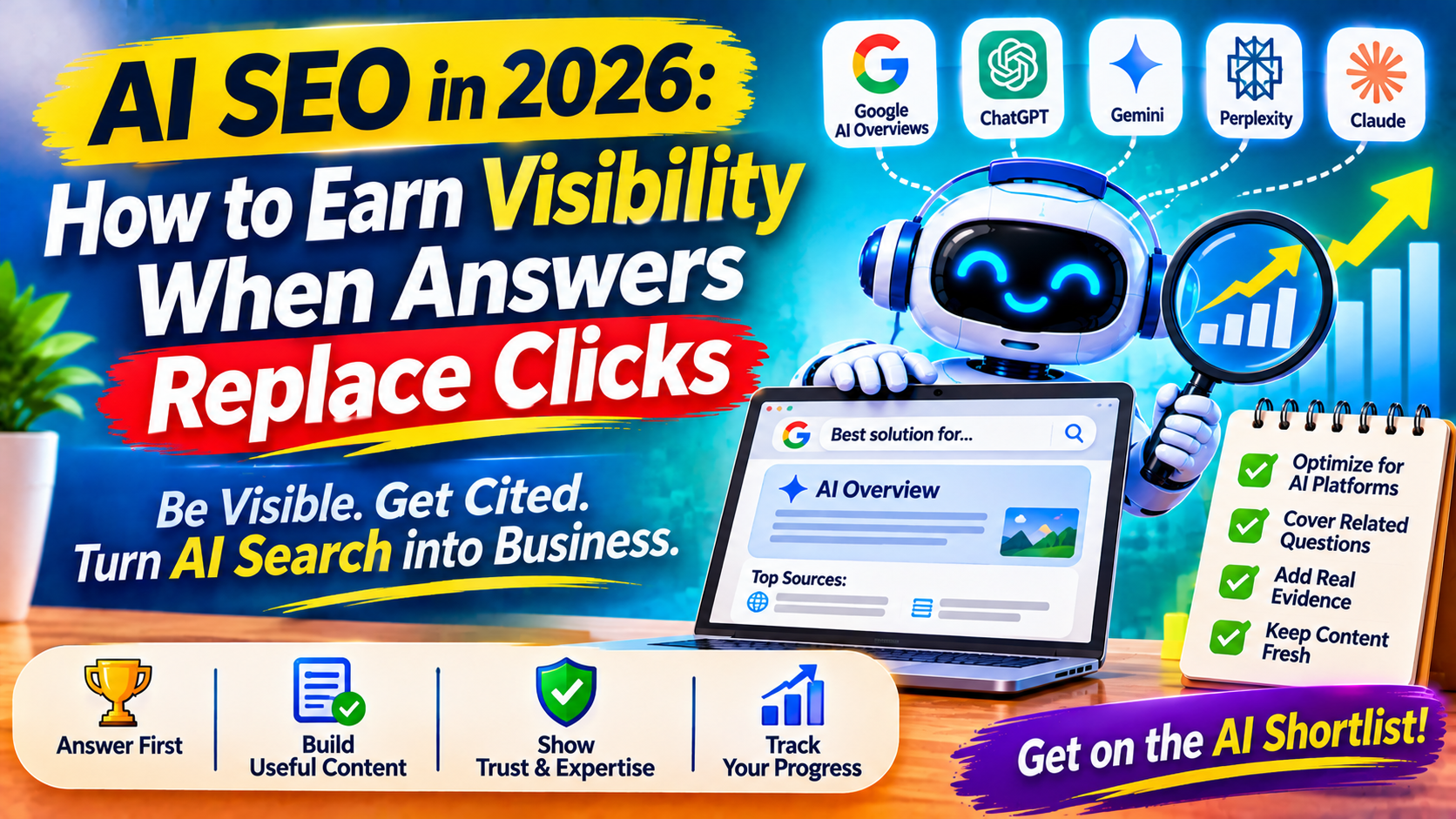
Search no longer ends at a list of blue links. On a growing share of queries, Google writes the answer first, ChatGPT and Perplexity assemble their own, and the websites behind them become footnotes. AI SEO is the practice of making your content easy to find, easy to understand and trustworthy enough to be chosen as one of those footnotes, and compelling enough that readers click anyway.
What AI SEO Actually Means
AI SEO means optimizing for two outcomes at once: ranking in traditional search results, and being cited or recommended inside AI-generated answers from Google AI Overviews, AI Mode, ChatGPT, Perplexity, Gemini and Claude. You will also see it called generative engine optimization or answer engine optimization. The labels differ; the work overlaps heavily.
Google’s own guidance is reassuring on one point. It says AI Overviews and AI Mode run on the same ranking and retrieval systems as regular Search, and that no special schema markup or extra technical requirements are needed to appear. AI SEO is therefore not a replacement for good SEO. It is good SEO held to a higher standard of clarity, evidence and distribution.
Why the Old Scorecard Is Failing
Rankings used to be a reliable proxy for traffic. That link has weakened. Ahrefs compared 300,000 keywords between December 2023 and December 2025 and found that top-ranking pages earned a 58% lower average click-through rate when an AI Overview appeared.
Yet the same shift contains an opportunity. Seer Interactive’s data, reported by Search Engine Land in April 2026, put click-through at roughly 3.3% when no AI Overview appeared, about 2.1% when an Overview cited the page, and only about 0.9% when it did not. Being cited more than doubled clicks compared with being ignored. Seer also saw click-through on AI Overview queries recover from a low of 1.3% in December 2025 to 2.4% by February 2026.
These studies use different datasets and methods, so treat them as direction rather than forecast. The direction is clear: position matters less than being included in the answer.
How AI Engines Choose Sources
Retrieval comes first. A 2026 academic study of more than 158,000 generative answers found that every page ChatGPT cites is one its own search retrieved. If a page cannot be retrieved, it cannot be cited, no matter how well it is written.
Engines also disagree with each other. A synthesis of Profound’s citation research found Wikipedia leading ChatGPT’s most-cited sources while Reddit led for Perplexity, and estimated that only about 11% of domains are cited by both. Winning in one assistant does not guarantee winning in another.
Placement on the page matters too. Kevin Indig’s analysis of 1.2 million ChatGPT answers found that 44.2% of citations came from the first 30% of the content.
A Practical AI SEO Framework
At Sarkar SEO, we think about AI visibility as five jobs rather than a checklist of tricks.
- Put the answer before the story. Open each section with a direct, self-contained statement that could be lifted out and still make sense. Definitions, thresholds and comparisons are easy for an engine to quote; scene-setting is not.
- Build for query fan-out. Google describes AI Mode as splitting a question into subtopics and running multiple related searches. A page that answers only the headline question loses to one that also handles cost, risks, alternatives and next steps. Cover the neighbouring questions in a connected cluster instead of a single bloated page.
- Publish what a model cannot invent. Language models are fluent at summarizing consensus. What earns a citation, in our judgment, is something specific: original measurements, documented tests, screenshots, named authors with real credentials, and clearly dated updates. This is an editorial inference rather than a proven ranking factor, so test it on your own pages.
- Earn mentions away from your site. Because engines draw heavily on forums, encyclopedias, review platforms and trade publications, your brand’s presence in those places shapes whether you are recommended.
- Keep technical access clean. Pages must be indexed and eligible for snippets to qualify as supporting links in Google’s AI features. Check that important content renders without heavy scripting, loads quickly and is not blocked by robots rules you did not intend.
How to Measure Progress
Clicks alone will undersell your results, so add visibility measures.
Build a prompt set of 25 to 40 real questions your customers ask, covering informational, comparison and buying intent. Run it monthly across Google, ChatGPT, Perplexity, Gemini and Claude. Record whether you are cited, merely mentioned, or absent, and note which competitors appear. Because AI answers vary from run to run, repeat each prompt several times before drawing conclusions.
Pair this with analytics: branded search demand, direct visits, referrals from AI assistants and assisted conversions. Sarkar SEO recommends reviewing these together each month, since a rise in branded searches often follows increased AI exposure even when organic clicks look flat. That relationship is a working hypothesis, not a guarantee.
Mistakes That Waste Budget
Mass-producing generic AI copy. If your page says what ten others already say, an engine has no reason to prefer it.
Optimizing every engine identically. Citation patterns differ, so decide which two or three platforms your buyers actually use and prioritize those.
Ignoring freshness. Seer Interactive’s analysis, as summarized by Risely Digital, found a strong recency bias, with Perplexity favouring current-year content. Review and date your most important pages regularly.
Where to Start This Quarter
Begin with an honest audit. List your ten highest-value topics, test each in the major assistants, and note where you are invisible. Rewrite the weakest pages so the answer leads, add one piece of original evidence to each, and strengthen the supporting cluster around them.
AI search will keep changing. What lasts is the discipline of being clear, specific and verifiably useful. If you want a structured review of how your brand appears across AI answers, Sarkar SEO can help you prioritize the gaps that matter most and build a plan you can measure.
