



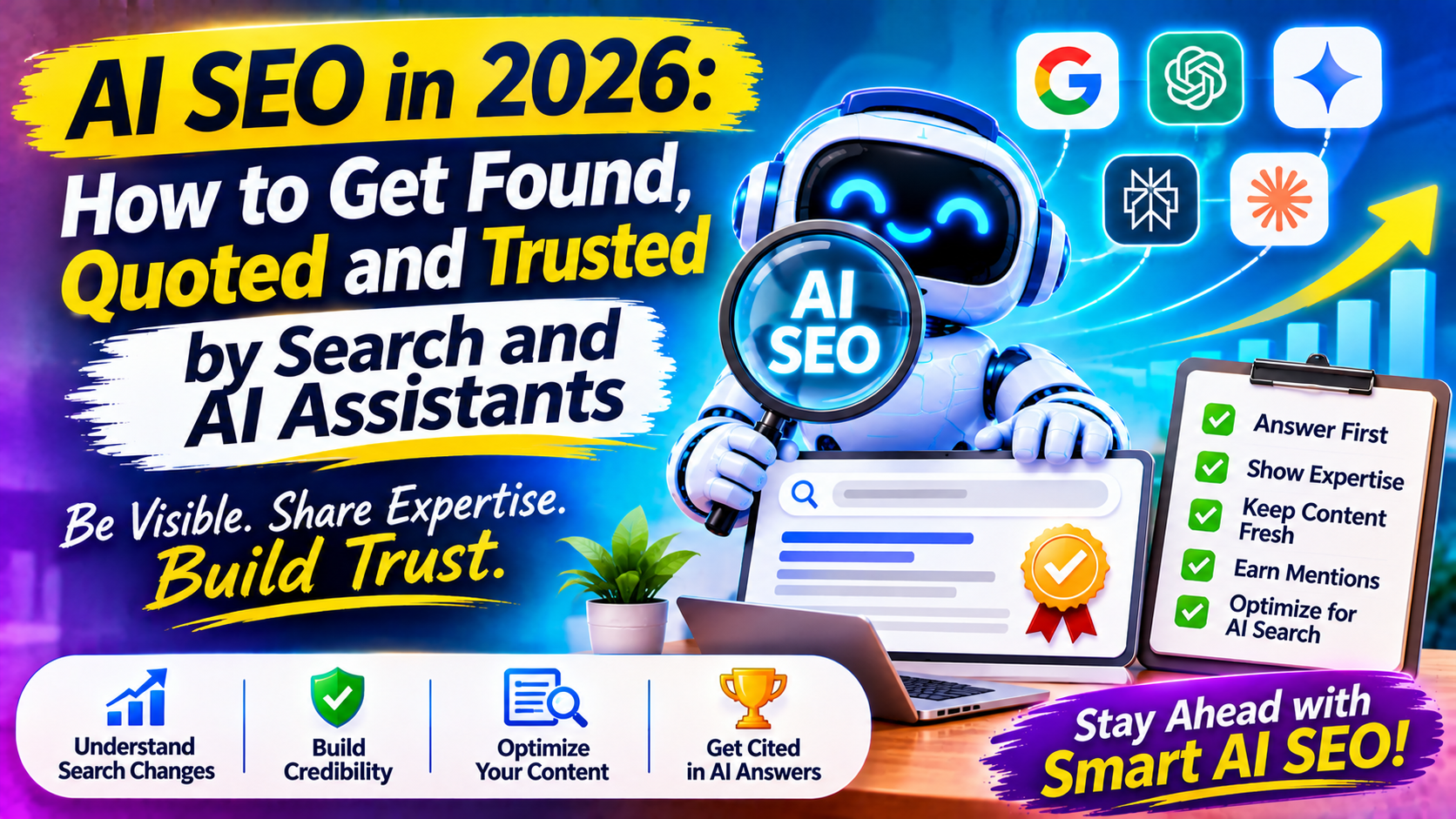
Search used to reward the page that ranked first. Now a growing share of searches end before anyone clicks anything. AI SEO is the practice of making your content easy for search engines and AI assistants to find, understand, quote and trust. It does not replace classic SEO, and it is not a trick. It adds one more question to every page you publish: if a machine had to answer this in two sentences, would it use yours?
Google Says It Is Still SEO
In May 2026, Google Search Central published its first dedicated guidance on generative search features. Its position is plain: AI Overviews and AI Mode run on the same crawl, index and ranking systems as regular Search. There is no special markup, no AI-only schema and no secret file that unlocks citations. The floor is simple eligibility: your page must be indexable and allowed to show snippets.
That is good news and a warning. Good, because you cannot be locked out by a missing trick. A warning, because nothing will rescue a page that was never worth quoting.
The Click Cost Is Real, But Uneven
Ahrefs studied 300,000 keywords and found that the top-ranking page earned 58% fewer clicks when an AI Overview appeared. Pew Research reported that users clicked an organic result 8% of the time with an AI Overview present, against 15% without one.
Yet the picture is not a straight line downward. Seer Interactive reported that organic click-through rates on AI Overview queries rebounded 85% across the first two months of 2026, after a long decline. Informational queries suffer most, while branded queries hold up far better.
The lesson: stop reading one headline number. Split your queries into branded, informational and commercial groups, then judge each on its own. At Sarkar SEO, this segmentation is the first thing we look at, because a site full of how-to posts and a site full of product pages face completely different risks.
Ranking in the Top Ten Is No Longer Enough
Ahrefs found that only 38% of pages cited in AI Overviews also ranked in the top ten, down from 76% seven months earlier. Citations are drifting deeper into the index.
The reason is query fan-out. Google splits a complex question into several smaller searches, retrieves pages for each, and merges the results into one answer. A page ranking tenth for the main query can still be quoted for answering one sub-question better than anyone else.
So write passages, not just pages. Each section should be able to stand alone as a correct, complete answer to one specific question.
Every Answer Engine Has Its Own Taste
One large citation analysis found only 11% overlap between the domains cited by ChatGPT and Perplexity. Perplexity tends to lean on community sources such as Reddit, plus fresh content, while ChatGPT cites fewer sources and absorbs them more deeply. Being visible in one tells you little about the other.
A recent academic study of more than 158,000 AI answers adds a useful correction to the folklore. Pages cited more often had titles and paragraphs that closely matched the questions people really ask. FAQ blocks, structured data and summary boxes showed their effect between websites, not between pages of the same site. Treat them as good hygiene, not magic.
A Practical AI SEO Playbook
- Answer first. Put the direct answer in the opening 100 to 150 words. Practitioners studying Perplexity report that concise openings get extracted more often than long warm-ups. This is observation, not a guarantee, so test it on your own pages.
- Map the sub-questions. Before writing, list the five to ten follow-up questions a reader or an AI would ask next, then give each its own clearly headed section. This directly mirrors how fan-out retrieval works.
- Add something only you have. Original data, a documented process, real screenshots, a named author with verifiable credentials. AI systems can summarize the consensus without you. They need a reason to cite you specifically.
- Earn mentions beyond your own site. Industry analyses suggest that brand mentions across trusted sources influence AI citations, sometimes more than raw backlink counts. Treat those claims cautiously, since methods vary. Google itself says chasing inauthentic mentions is less helpful than it might seem. Real participation, real expertise and real coverage work. Manufactured ones do not.
- Keep dates honest. Freshness matters most for news, pricing and fast-moving topics. Update pages when the facts change, show the update date, and cite primary sources such as official documentation and original studies.
- Measure prompts, not only positions. Google has begun exposing generative search impressions inside Search Console, though not a clean split between AI Overviews and AI Mode. Supplement that by running a fixed list of real customer questions through each major assistant every month and recording who gets cited. Sarkar SEO recommends keeping this log simple: question, engine, cited sources, whether you appeared.
Common Mistakes to Avoid
Do not chase a separate “AI version” of your content, since Google says none is needed. Do not stuff pages with FAQ blocks purely for machines. Do not block crawlers you actually want citing you without understanding the trade-off. And do not abandon technical basics: crawlability, speed and clean internal linking still decide whether your page is even considered.
