



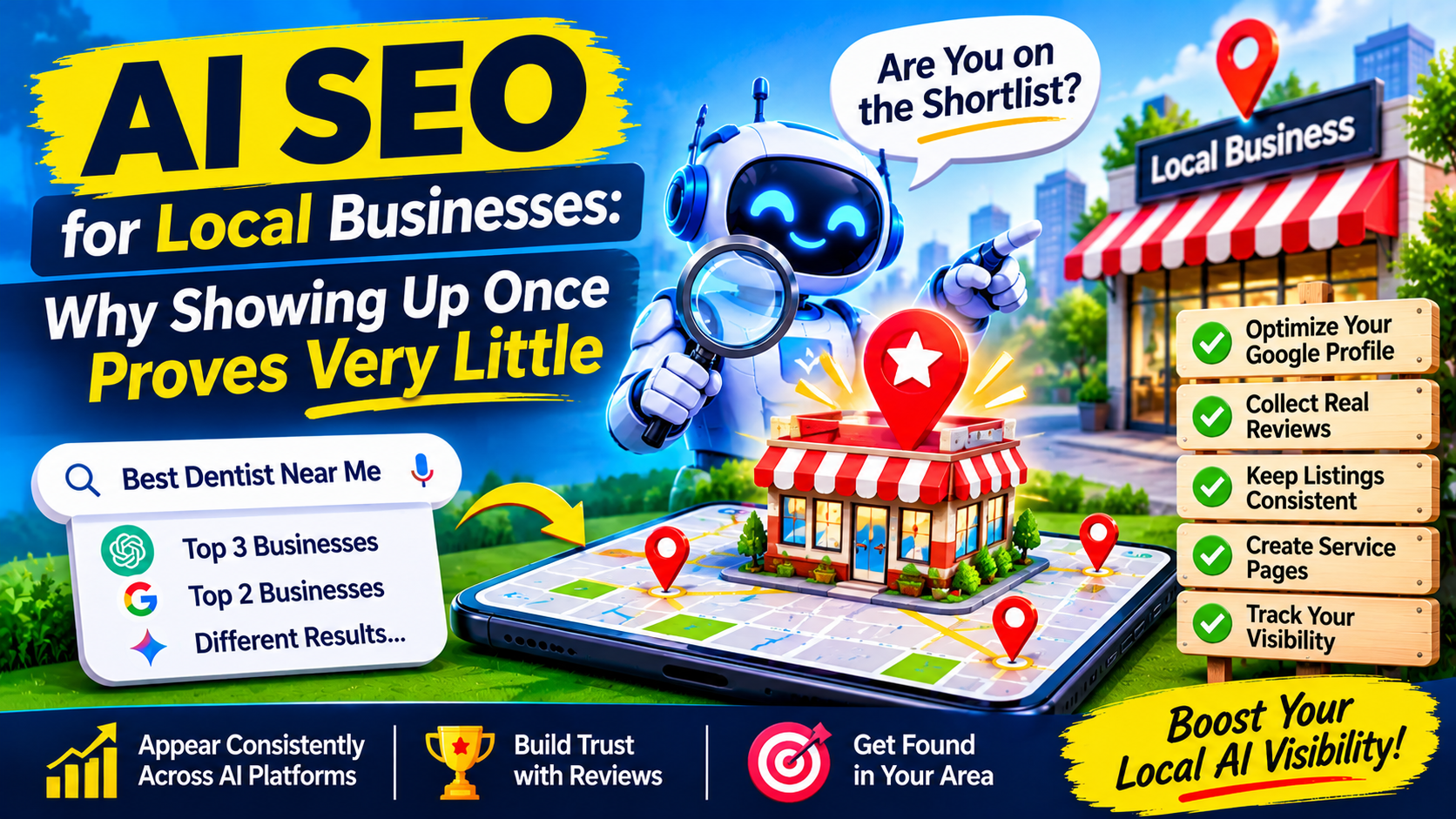
Ask an assistant for “the best dentist near me” and it names two, three or four businesses. Ask again and the list often changes. For local companies, AI SEO is less about holding a rank and more about raising the odds that you are named, consistently, across many askings.
That reframing comes from the data. A large 2026 study found that between 71% and 80% of businesses appear in half of repeated attempts or fewer. Sarkar SEO wrote this guide to explain what drives those odds, what a local business can influence, and what it cannot.
Customers Are Asking, and Still Checking
BrightLocal’s 2026 consumer survey of 1,002 US adults reports that 45% have used AI for local business recommendations, up from 6% a year earlier. ChatGPT was the most used tool at 31%, followed by Google’s AI Mode at 23%. Among those who use AI this way, 63% trust its recommendations.
Trust has limits. Only 23% said they rely on the AI summary alone, while 59% go on to check review profiles. The survey is US-only, self-reported and published by a vendor of local SEO tools, so treat the numbers as directional. The behaviour is still clear: the assistant shortlists, and your reviews and website close the sale.
The Volatility Problem
BrightLocal’s September 2026 visibility study tracked about 200,000 localized searches across roughly 1,300 business locations on ChatGPT, Google AI Mode and AI Overviews. Three findings stand out:
- Tracked businesses appeared in 66% of Google Maps searches but only 32% to 38% of AI answers.
- Repeat result sets overlapped by just 20% to 33%.
- A business that appeared once showed up again in only about half of later runs.
The report notes some inconsistent figures between sections, so check exact numbers against the full study. The direction is not in doubt. Appearing in one test tells you almost nothing; appearing in a high share of tests means something.
As an illustration, imagine a plumber who checks one assistant on Monday, sees the business listed, and declares victory. If the true chance of appearing is 50%, the next check is a coin toss. Ten checks across a month would give a far better estimate.
What the Assistants Draw On
The same study counted about 1.9 million citations. Business websites accounted for 42% of them, Google Business Profile for about 28.5% and Yelp for roughly 9.5%, with Facebook, Tripadvisor, OpenTable and MapQuest also appearing. An earlier, smaller BrightLocal test of 20 searches across 10 niches found that assistants lean on industry directories as well, such as legal and dental listings.
Both studies come from a company that sells listing and visibility services, and the earlier one was small and undated. Even so, the pattern is practical. Your own site, your Google profile and a handful of trusted third-party listings do most of the work, and they must agree with each other.
What You Control
Your Google Business Profile. Treat it as a primary source. Complete every field, choose accurate categories, list services, keep hours current and add recent photos.
One page per service and area. A page titled “Services” cannot answer “emergency boiler repair in Leeds.” Give each core service its own page stating what you do, where you work, typical timeframes and how to book. Write the facts plainly enough that a model can quote them without guessing.
Consistent listings. Match your name, address, phone number and hours across directories. Contradictions give a system a reason to skip you.
Reviews with substance. Ask customers to mention the specific service, not only a star rating, and reply to every review. Since most shoppers check profiles after reading a summary, your replies are part of your sales page.
Clear service areas. In the study, storefront businesses had a mention rate of 33.6% against 29.4% for service-area businesses. If you travel to customers, name the towns or districts you cover on your site and profile.
What You Cannot Control
Proximity matters. Across the study, 53% to 59% of recommended businesses sat within 5km of the searcher, and about three-quarters were within 10km. Results also varied by location within the same town, with overlap between points as low as 36% for ChatGPT.
You cannot move your premises, so aim for the searchers you can reach. Build visibility inside your real service radius first, then widen.
The study also found that ChatGPT’s picks stretched much further than Google’s, with a radius covering 90% of its results of roughly 287km. Reports differ on the Google figures, so the safe reading is that ChatGPT casts a wider net, and for Google’s surfaces, proximity to the searcher remains a strong factor.
A Practical Test Routine
- List five questions a local customer would ask, such as “who fixes cracked phone screens near the station.”
- Run each on two or three assistants, from the area you serve.
- Repeat weekly for a month, recording whether you appear, who else does and which sources are cited.
- Calculate your appearance rate per question, not a single yes or no.
- Fix the weakest source first, whether that is a profile gap, a thin service page or an outdated listing.
Sarkar SEO suggests keeping this log in a simple spreadsheet and reviewing it alongside your call, booking and direction-request numbers, because visibility only matters when it produces enquiries.
The Honest Summary
No tactic guarantees a place in an assistant’s shortlist. What you can do is make your business easy to verify: accurate profile, specific pages, consistent listings and reviews that describe real work. These raise your odds without relying on tricks.
