



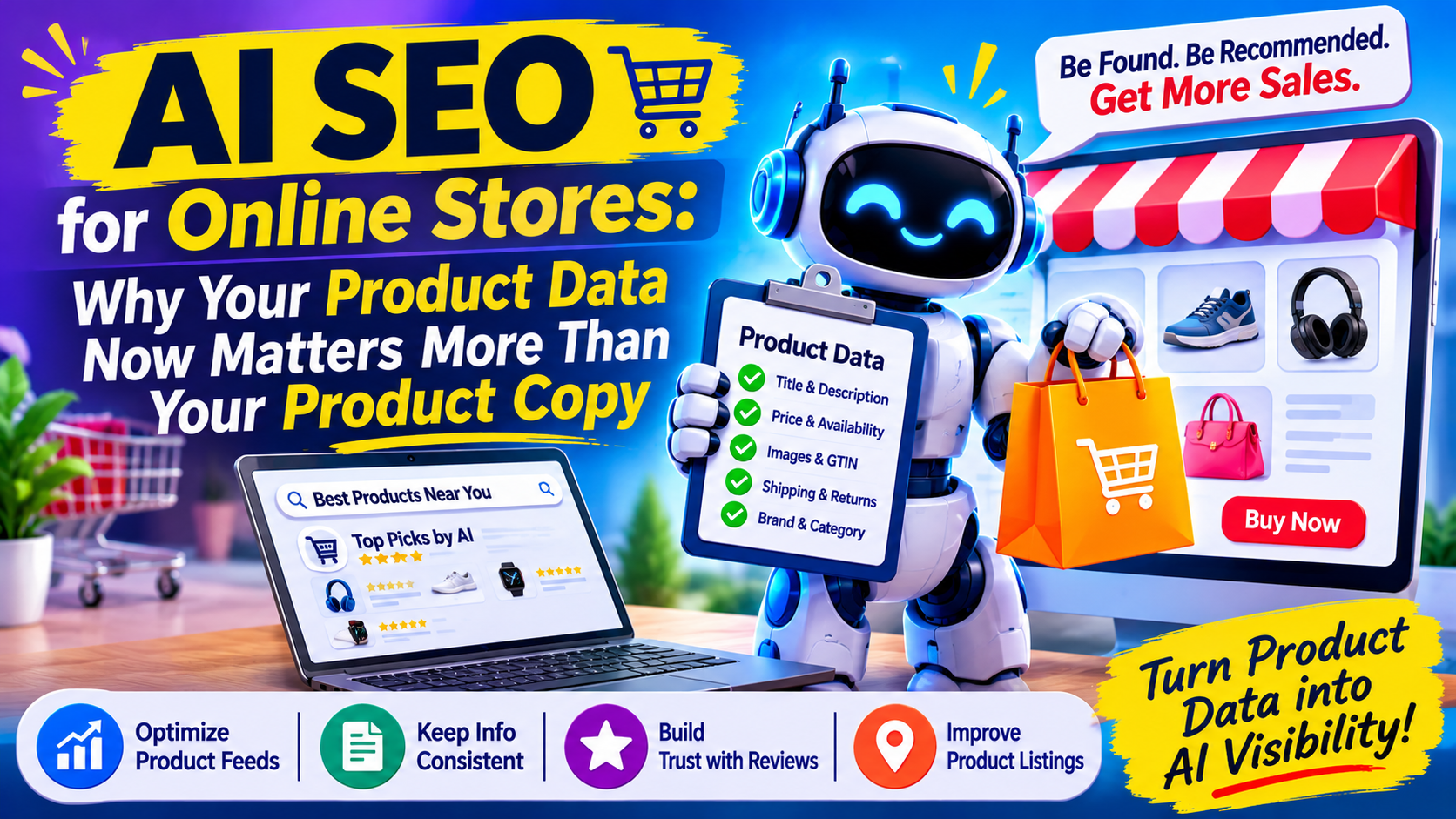
For an online store, AI SEO has a twist that blog publishers never face: the customer may never see your product page. An assistant compares products, summarizes reviews and, increasingly, helps complete the purchase. What it reads is your product data.
The short answer: in AI shopping, structured, consistent and current product data is the entry ticket. Persuasive copy and reviews decide who gets recommended once you are in.
Shoppers Are Already Using AI, With Caveats
LDWW, a marketing agency, surveyed 2,000 US adults and reported nearly 7 in 10 use AI to shop. Almost two-thirds said AI influenced a recent purchase, and 30% had used it to complete one. It is an agency survey, self-reported, with no fieldwork date given.
One finding matters for merchants: more than half of respondents said they check the citations AI provides. Your claims still face scrutiny after the assistant repeats them.
Adobe’s retail analysis, covering over 1 trillion US retail visits, shows the traffic side. Generative AI referrals were up 4,700% year over year in July 2025, though Adobe warns the 2024 baseline was tiny, so percentages overstate the trend. The source remains smaller than paid search or email.
AI Shoppers Behave Differently From Search Shoppers
Adobe found AI-referred visitors stayed 32% longer and bounced 27% less than non-AI visitors. Yet in July 2025 they were 23% less likely to convert. That gap had narrowed from 38% in April and 49% in January.
This contradicts the very high AI conversion rates some software companies report from their own sites. The difference is context. Retail visitors may use AI for research and return later through another channel. So judge AI traffic in your own analytics, and do not assume it will be a premium channel.
Three Platforms, Three Doors Into Your Catalog
The routes differ, and several are changing. A BigCommerce merchant guide summarizes them, and statements below are labeled as platform-sourced or the guide’s own advice.
Google. The Shopping Graph is built on Merchant Center feeds and free listings, not on Shopping ads, according to a Google statement quoted in the guide. If your feed is thin or has errors, your products are weakly represented in AI Mode shopping.
ChatGPT. Merchants apply through OpenAI’s portal and submit a feed with required fields: ID, title, description, link, image link, availability, price and brand, plus GTIN or MPN where relevant. The guide reports OpenAI retired its standalone Instant Checkout button in March 2026, so most journeys now redirect to the merchant’s checkout. That is press-reported, so confirm current terms with OpenAI.
Perplexity. It runs a free merchant program accepting Google Shopping-formatted feeds. Its one-click checkout was in beta for US Pro subscribers.
Checkout Is Moving Into the Assistant
In January 2026 Google announced the Universal Commerce Protocol at the National Retail Federation conference, an open standard covering discovery, cart, checkout and post-purchase. Shopify, Etsy, Wayfair, Target and Walmart co-developed it, with more than 20 other companies endorsing it. Eligible US retailers can offer checkout inside AI Mode and the Gemini app, with merchants keeping control of pricing, inventory and fulfillment. The guide describes it as early access, and OpenAI’s separate Agentic Commerce Protocol continues.
The takeaway is practical, not predictive. End-to-end in-chat buying is not live everywhere, but your catalog data is the layer every one of these systems reads.
The Original Idea: Audit Your Three Copies
Every product has up to three versions of its facts: the feed, the page markup, and the visible page. Mismatches are the quiet failure point. A price that differs between feed and page, or availability that updates in one place only, gives any system a reason to distrust you. The BigCommerce guide advises driving all three from one source of truth.
Sarkar SEO suggests an audit that takes an afternoon. Pick 20 best-selling products and compare price, availability, shipping cost, return window and GTIN across the three copies. Count the mismatches. That number is your first priority list.
What to Fix First
- Complete the feed attributes, not only the required ones. Identifiers, brand, size, color, material and condition help assistants match products to questions.
- Add shipping and returns data to markup and the visible page. Shoppers ask about both, and assistants cannot answer without them.
- Write comparison-ready product copy. State who the product suits, what it is not for, and how it differs from your similar items. Plain specifics beat adjectives.
- Protect review quality. Respond to complaints and use detailed prompts that invite specifics such as fit, durability or sizing.
- Allow the right crawlers. For ChatGPT visibility, the guide’s advice is to allow OAI-SearchBot, since blocking GPTBot affects training, not shopping.
- Refresh daily. Stale stock levels create bad recommendations. The guide advises at least a daily full feed snapshot.
Sarkar SEO treats product detail pages as reference documents first and sales pages second, because an assistant extracts facts before it weighs enthusiasm.
What Remains Uncertain
None of the sources reviewed for this article shows that a particular schema property or copy style makes an assistant recommend your product. Platform rules, fees and checkout programs are changing, and several are beta. Confirm requirements in each platform’s own documentation before you commit engineering time.
