



The hardest question in AI SEO isn’t technical. It’s this: if search results answer more questions directly, why would anyone still visit your website?
Plenty of articles tell you how to get cited. Fewer deal with the commercial reality that being cited and being visited are different things. This guide looks at what the click data actually says, which pages are most exposed, and how to build a content plan that still produces business results.
What the Click Data Says
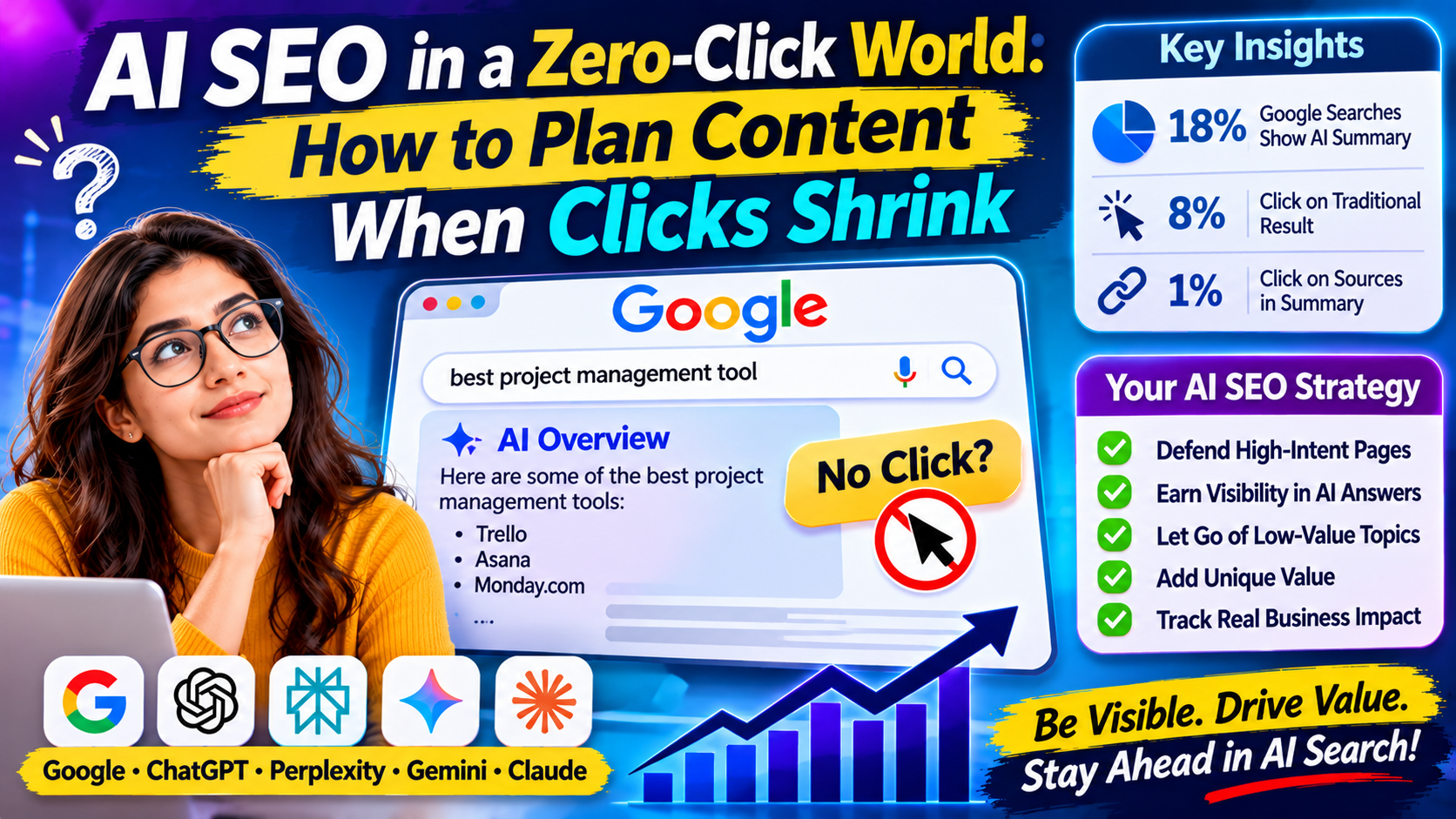
The most credible public evidence comes from Pew Research Center, which analyzed browsing activity from 900 U.S. adults in March 2025. In its dataset, around 18% of Google searches produced an AI summary. When one appeared, users clicked a traditional result link in 8% of visits, compared with 15% when no summary appeared. Clicks on the sources cited inside the summary were rarer still, at just 1% of visits. www.pewresearch.org +2
Two cautions before you panic. First, this is a snapshot of one country and one month, and AI features have kept evolving since. Second, Pew also found that nearly two-thirds of people either kept searching on Google or left without clicking a result, whether or not a summary was present. Zero-click behavior existed before AI Overviews. AI has simply widened it.
The practical conclusion is neither “SEO is dead” nor “nothing has changed.” Some kinds of searches now send less traffic, and your plan should reflect that.
Which Pages Are Most Exposed
Not every query is equally affected. Pew’s data suggests summaries appear far more often on longer, conversational searches. One summary of the study reports that only 8% of one- or two-word searches triggered an AI summary, versus 53% of searches with ten or more words.
That pattern matches intuition. Questions with a settled, factual answer are easiest for a system to summarize. These are the pages most at risk:
- Simple definitions and “what is” explainers
- Quick factual lookups, such as conversions, dates and basic specs
- Generic how-to steps with no distinctive angle
- Listicles that repeat what a dozen other sites say
Pages that depend on a unique asset, such as proprietary data, a tool, a community or a strong opinion, are harder to flatten into one paragraph.
A Query Triage Framework
Rather than guess, sort your target topics into three buckets. This is a planning framework, not a measured rule, so adjust it to your market.
Defend. These are high-intent searches where the reader must evaluate, compare or buy: “best accounting software for freelancers,” “agency vs in-house SEO,” pricing and comparison pages. Summaries can’t fully replace judgment, trust and proof. Invest heavily here.
Earn visibility. These are mid-funnel questions where an AI answer will often appear, but your brand can be the named source. You may not win the click, yet you can win recognition. Make these pages quotable and distinctive.
Let go, or repurpose. Basic definitions that bring little revenue even when they rank. Don’t delete them blindly, but stop spending your best resources there. Fold them into richer pages rather than publishing thin standalone ones.
At Sarkar SEO, this kind of triage comes before any keyword list, because a topic that can’t connect to a business outcome is a poor use of a content budget regardless of volume.
Build Reasons to Click
If a summary delivers the basic answer, your page needs something it can’t. Consider what a reader gains by visiting:
- A calculator, template or checklist they can use immediately
- Original data, even a small survey or a documented experiment
- Decision support, such as a framework that helps choose between options
- Real examples, with screenshots or anonymized results
- A point of view, argued clearly enough that people remember who said it
Notice the pattern: each one adds something a summary can only point to, not reproduce.
Win Where Summaries Pull From
Pew found that sources cited in AI summaries skew toward certain sites. Per coverage of the study, Wikipedia, Reddit and YouTube together accounted for about 15% of sources found in the AI summaries Pew examined, with government sources at 6%. That doesn’t mean you should chase those platforms mindlessly, but it does suggest that visibility is partly shaped by where credible discussion and explanation live. yahoo
Smaller brands can respond by:
- Publishing helpful video explanations that match their written pages
- Taking part in genuine community discussions without spamming links
- Earning mentions from reputable industry sites and publications
- Keeping their own business details clear, so people recognize the name later
The goal is repeated, positive exposure, so that when someone is ready to decide, your brand is already familiar.
Measure Business Impact, Not Just Sessions
If clicks fall on informational pages, a traffic chart alone will mislead you. Track what the business actually needs:
- Branded search growth. Are more people searching for your company name over time?
- Conversion rate and lead quality. Fewer visits can still mean better ones.
- Assisted conversions. Did informational content appear earlier in the buyer’s journey?
- Direct and returning visitors. These often rise when brand awareness improves.
- Email sign-ups and other owned channels. These reduce dependence on any single platform.
Revenue per visit is often a more honest measure than visits alone.
Own Your Audience
The deepest lesson of zero-click search is concentration risk. If most of your leads come from one search feature you don’t control, any interface change can hurt you. Build a newsletter, a community or a recurring resource that gives people a reason to return directly. Search then becomes one doorway among several, rather than the only one.
