



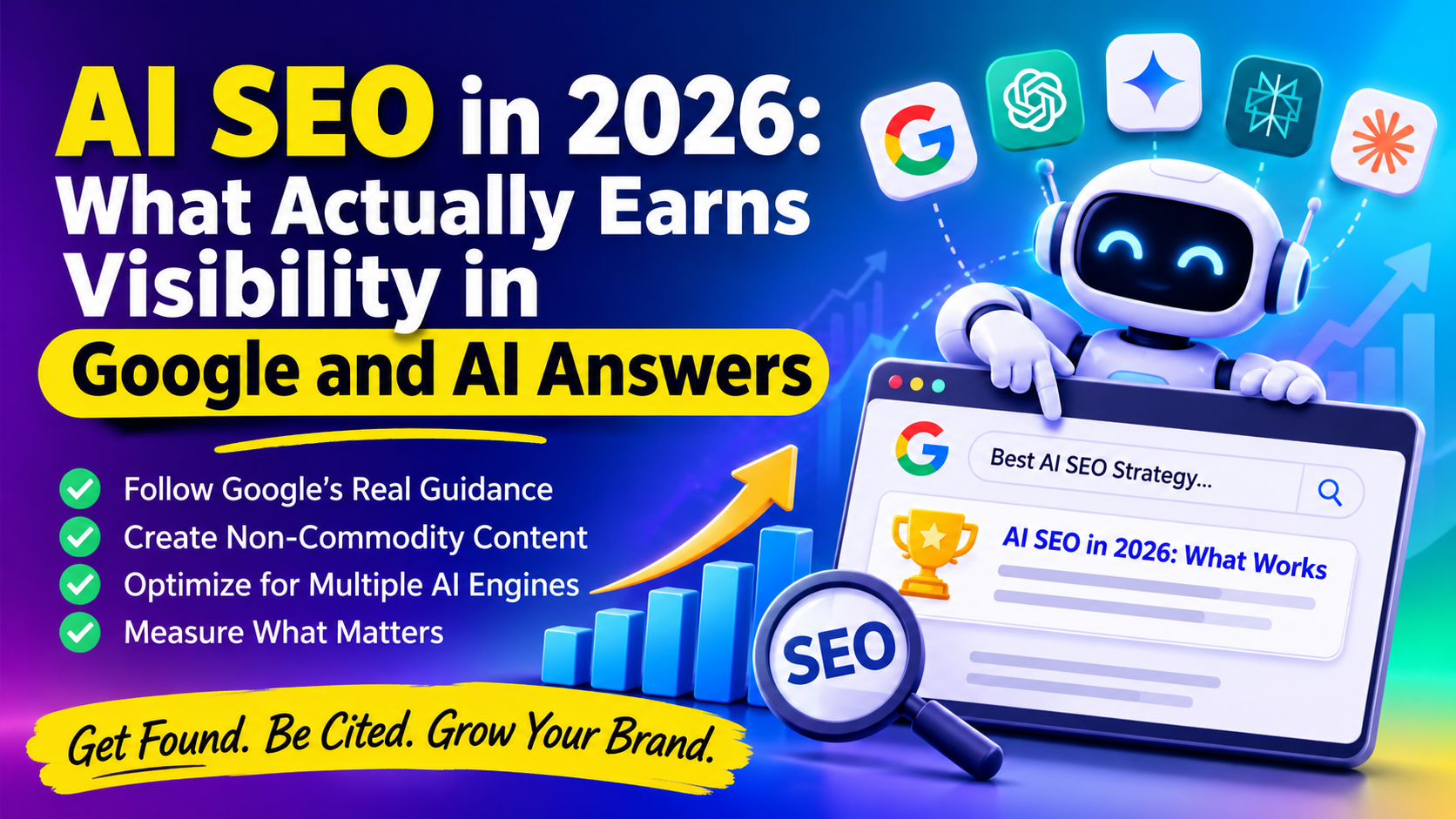
Search no longer ends at ten blue links. A buyer might read a Google AI Overview, ask a follow-up in AI Mode, then check ChatGPT or Perplexity before visiting a single website. AI SEO is the work of making your pages findable, trustworthy and quotable across all of those places.
Much of the advice on the topic is noise, so this guide separates what is documented from what is hype.
What AI SEO Really Means
AI SEO is optimizing your content and brand so they appear in AI-generated answers as well as traditional rankings. It covers Google AI Overviews, AI Mode, ChatGPT, Perplexity, Gemini and Claude.
The label is new, but the core job is not. At Sarkar SEO, we treat it as classic search discipline extended to a world where answers are assembled rather than listed.
What Google Has Said
On May 15, 2026, Google published a guide to optimizing for generative AI features in Search. It says its AI features are rooted in core Search ranking and quality systems and use retrieval-augmented generation and query fan-out to pull content from the Search index. Query fan-out means the system breaks one question into several sub-searches, so a page can be pulled in for a subtopic you never targeted directly. searchenginejournal
Google also addressed the jargon. It defines AEO and GEO, then says that from Google’s perspective, optimizing for generative AI search is still SEO.
The mythbusting section is the most useful part. Google says you don’t need llms.txt files, special AI markup, content chunking, AI-specific rewriting or special schema to appear in its generative features. It also says pursuing inauthentic mentions isn’t as helpful as it looks. Those points cut against what many GEO sellers promote.
Schema is not worthless, though. Keep it for rich result eligibility. Just don’t expect it to unlock AI citations on its own. An Ahrefs study published May 11, 2026 found no meaningful citation lift after 1,885 pages added schema.
Google Is Not the Whole Picture
Google’s guidance covers Google only. Other assistants behave differently, and the evidence shows it.
Ahrefs found that only 12% of URLs cited by AI assistants rank in Google’s top 10 for the original prompt, and that AI Overviews follow the SERPs while assistants do not. Ahrefs-based figures cited by secondary sources suggest the assistants differ from one another too. Perplexity’s citations overlapped with Google’s top 10 about 43.5% of the time, versus 6.5% for ChatGPT. Treat these as directional, because they come from a 2025 study reported through a third-party summary.
Two practical lessons follow:
- One strategy won’t fit every engine. Overlap in cited domains between ChatGPT and Perplexity is reportedly low, around 11% according to some analyses.
- Traffic is still mostly Google. Ahrefs’ Q1 2026 benchmark reports that Google sends 190 times more traffic to websites than ChatGPT. AI visibility builds brand presence, but it hasn’t replaced organic traffic. businesswire
The Real Differentiator: Non-Commodity Content
Google’s guide stresses what it calls non-commodity content. It contrasts a generic “7 Tips for First-Time Homebuyers” with a first-person piece about waiving an inspection and what a sewer line revealed. The first can be summarized from a hundred other pages. The second has information only its author holds.
AI systems have little reason to cite a page that repeats what they already know. Pages earn citations by adding something:
- Original data, even a small internal survey or audit sample
- Real screenshots, test results or before-and-after outcomes
- A clear opinion backed by evidence
- Local, industry or regional detail that generic articles skip
Many AI SEO articles fail here. They define terms and list tips, but contain nothing a model couldn’t produce itself.
A Practical AI SEO Checklist
- Secure the basics. Pages must be crawlable, indexed and eligible for snippets to appear in Google’s AI features. Google recommends crawling best practices, semantic HTML, sound JavaScript SEO, good page experience and less duplicate content.
- Answer first, then go deep. Open sections with a direct answer, then add nuance. This helps readers and extraction alike, with no need to chop pages into fragments.
- Cover the fan-out. Map the follow-up questions a searcher would ask next, such as costs, comparisons and risks, and answer them within a connected cluster of pages.
- Show real authorship. Name the author, state their experience and keep facts verifiable.
- Build earned mentions honestly. Original research, expert commentary and useful tools attract genuine references. Fake mentions are the tactic Google warns against.
- Refresh what matters. One analysis reports AI-cited content is about 25.7% fresher than content that only ranks organically. That is a secondary-source figure, so use it as a nudge rather than a rule.
- Prepare for agents. For commerce and local businesses, Google points to Merchant Center feeds and Business Profiles, plus early guidance on agent-friendly sites. Google labels that part optional for now.
How to Measure AI SEO Progress
Rankings alone no longer tell the story. Track a fixed set of 20 to 50 priority prompts and check monthly whether your brand is cited, mentioned or absent in each engine. Pair that with Search Console data, branded search growth and referral traffic from AI platforms.
Expect noise. AI answers vary between sessions, so look at trends over months, not single screenshots. Any vendor promising guaranteed citations is overselling.
Is AI SEO different from SEO?
For Google, Google says no. For other assistants, the signals may differ, so test rather than assume.
Do I need llms.txt?
Not for Google, per its own documentation. Adding one is low-cost, but don’t expect it to drive results.
Should I stop writing how-to content?
No. But generic how-tos are the easiest content for AI to replace, so add experience and evidence that sets yours apart.
