



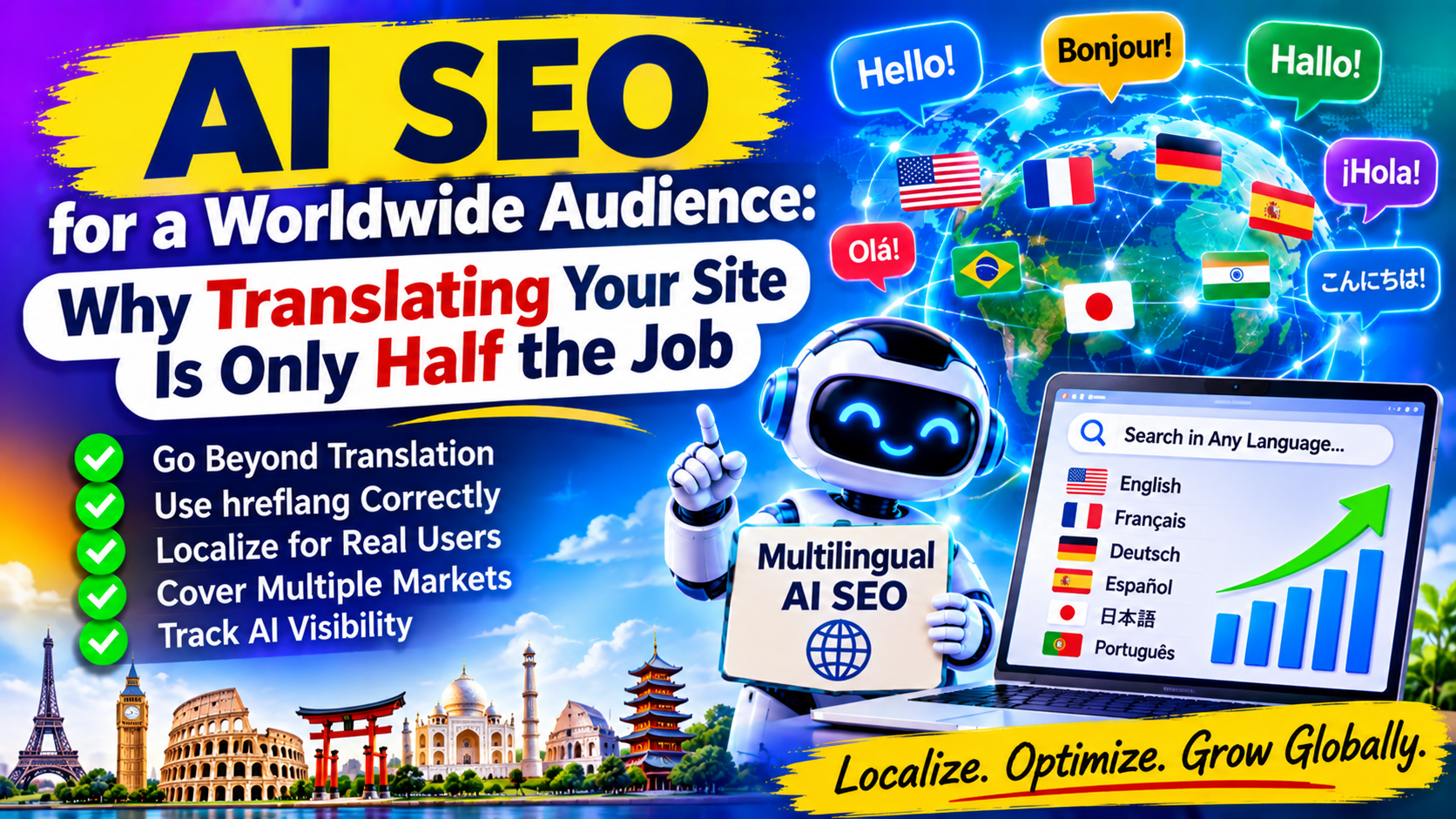
If your customers speak more than one language, AI search creates a problem that classic SEO never fully solved. A person in Germany, Brazil or Indonesia can ask an assistant a question in their own language and be answered with facts pulled from an English page. Your carefully translated version may be ignored, or your English page may be shown to someone who cannot read it.
This guide explains how multilingual AI SEO differs from the international SEO most teams already know, and gives a practical plan for businesses selling across borders.
The Rules Have Not Disappeared, but They Have Loosened
For years, international SEO meant hreflang tags, country-specific domains, localised keywords and regional links. That toolkit still matters. One practitioner describes hreflang as the routing layer that stops translated pages competing against each other or appearing in the wrong market.
But AI systems do not always follow that routing. One commentary notes that language models can bypass language barriers, pulling facts from an English source to answer a query in German. The same piece claims a significant share of citations in non-English AI Overviews come directly from English sources. I could not trace that to a primary study, so treat it as a plausible pattern, not a measured figure. neuronwriter
What One Experiment Revealed
The clearest evidence I found is a set of tests by SEO consultant Glenn Gabe, reported by Stan Ventures. Gabe checked how different platforms treat translated content. For the query tested, AI Overviews did not appear. AI Mode surfaced both Spanish and English URLs, ChatGPT did the same, and Perplexity and Claude returned the English page.
That is one query, in one language pair, on one date, so it proves a possibility rather than a rule. It still illustrates something important: the same question can send users to different language versions depending on the platform. Your hreflang setup governs Google’s classic results far more reliably than it governs a chatbot’s choice.
Language Support Is Uneven
Google’s AI features now reach a very wide audience. One guide states AI Overviews expanded to over 200 countries and territories and more than 40 languages by May 2025. Wide reach does not mean equal quality. A separate guide says capability varies by language, with English showing the highest sophistication, and that the language of the query rather than the user’s location determines which tier applies. Those are vendor write-ups, so verify the details for your own markets. digitalthriveaistackmatix
Google has also kept widening AI Mode. Engadget reported its first expansion beyond English. The practical lesson is that your non-English markets may see AI answers sooner than your team expects.
The Evidence for Translating, and Its Limits
Several sources cite a Weglot analysis of 1.3 million AI citations. It reportedly found translated sites got 327% more visibility in AI Overviews for non-English queries than untranslated ones. Weglot sells translation software, so it has an interest in that conclusion. The direction is believable, since a page in the searcher’s language is easier to cite, but the exact percentage should be treated cautiously.
There is also a more hopeful reading. AI systems trained mostly on English data often have weaker citation patterns for non-English content, which gives brands that invest in quality content in underserved languages a chance to build authority with less competition. That claim comes from an agency, so consider it a hypothesis worth testing in your sector.
A Five-Part Plan
- Choose markets by revenue, not by ambition. Translating into ten languages at once usually produces ten mediocre sites. Pick the two or three markets where you already have customers, enquiries or a delivery capability, and do them properly.
- Localise, do not just translate. A machine-translated page keeps the English structure but loses the local detail that makes it useful: currency, units, date formats, legal terms, payment methods, local examples and how people actually phrase the search. One source warns that context lost in translation can lead AI to produce confident nonsense about your business. Have a native speaker review anything that states prices, terms or claims.
- Keep the facts identical across languages. If your English page says a service takes four weeks and your French page says six, an AI system may quote either. Build one source of truth for prices, specifications, policies and contact details, then check each language version against it.
- Maintain every version. International sites that update English content regularly while letting other languages stagnate lose AI citation opportunities. Set a review schedule for each market, starting with pages that cover changing information such as pricing, regulations and availability.
- Get the technical basics right. Use hreflang correctly, give each language its own clean URL, and make sure the translated text sits in the page’s HTML rather than being swapped in by a browser script. Do not rely on automatic browser translation, because crawlers will not see that output.
Do Not Forget Platforms Beyond Google
A complete international strategy has to account for AI systems other than Google, because different systems dominate different markets. Before investing, find out which assistants and search tools your buyers in each country actually use. Ask local customers, check your analytics and test the main questions yourself.
How to Test Your Own Visibility
Take ten real customer questions per market, written the way a local would ask them. Ask each one in Google, ChatGPT, Perplexity and Claude, using a clean browser session. Record which language version appears, whether your brand is mentioned and whether the facts are right. Repeat monthly. This costs a few hours and gives you more reliable guidance than any general benchmark.
Where Sarkar SEO Fits
Most international sites fail quietly: pages exist in every language, but nobody has checked whether they agree, rank or get cited. At Sarkar SEO, we start multilingual reviews by comparing what each language version actually says, then check how the key pages appear in search and AI answers. The gaps are usually inconsistent facts, stale translations and missing local detail, not a lack of volume.
