



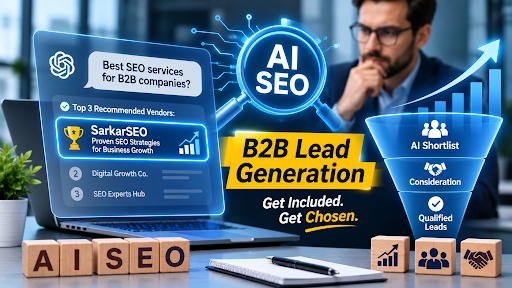
A prospect who once searched Google, opened ten tabs and compared vendors over weeks may now type one detailed question into an AI assistant. The answer is a shortlist. If your company isn’t on it, you may never learn the deal existed.
For B2B and service businesses, this is the strongest argument for AI SEO. It is less about traffic and more about being considered.
What the Buyer Research Shows
The best recent data comes from G2’s March 2026 survey of 1,076 B2B software buyers and decision-makers. It found 51% of buyers now start their research with AI chatbots. Chatbots ranked as the top influence on shortlists at 54%, ahead of review sites at 43%, vendor websites at 36% and peers at 33%. demandgenreportg2
The influence is not cosmetic. 69% of buyers said they chose a different software vendor than they initially planned, and comparing vendor strengths and weaknesses was the top chatbot use case at 41%.
Treat these numbers with care for three reasons:
- They cover software buyers. Extending them to consultancies, agencies or manufacturers is reasonable as a direction, not as a measured fact.
- They are self-reported. What people say they do can differ from what they do.
- The publisher has a stake. G2 runs a review platform, so its conclusions may favor third-party validation. Other sources point the same way, which adds some confidence.
Broader surveys support the trend. According to secondary summaries, Forrester’s Buyers’ Journey Survey put AI use among business buyers at 94%, and Gartner found 69% of buyers use sales reps to validate AI-generated insights. I couldn’t open these original reports, so confirm the figures before quoting them publicly.
The Counterweight: Humans Still Close Deals
It would be wrong to say AI replaces the sales process. G2 itself noted that AI is not replacing the buying process, and 80% of buyers still use Google somewhere in their journey. The picture that emerges is a fork: AI shapes who gets considered, and people, demos, reviews and references decide who gets chosen.
That changes the job. Your content must first earn inclusion in the shortlist, then survive scrutiny when a buyer checks you out.
What AI Needs to Recommend You
Assistants answer comparison questions by drawing on what they can find about your category, your pricing, your strengths and your reputation. Gaps in that picture lead to vague mentions, or to a competitor getting the slot. Build these assets deliberately.
- A clear category statement. Say plainly what you do, for whom, and where. “We help mid-sized logistics firms reduce billing errors” is easier to match to a buyer’s question than “innovative end-to-end solutions.”
- Comparison-ready pages. The top use case is comparing vendors, so help buyers do it honestly. Publish pages such as “X versus Y,” “alternatives to,” and “how to choose a provider.” Include who each option suits, including cases where you’re not the best fit. That candor builds the trust assistants and humans both reward.
- Transparent pricing signals. You needn’t publish every quote, but ranges, packages and what drives cost give assistants something concrete to repeat. Silence often produces guesses.
- Specific proof. Case studies with the client’s problem, your approach and a measurable result carry weight. Use only results you can document, with permission.
- Third-party validation. Since buyers trust outputs anchored to sources they already respect, reviews, directories, industry awards and independent mentions matter. Earn them honestly. Never buy reviews or invent testimonials.
- Expert-led content. Guides written by named practitioners, with real experience and clear opinions, stand out from generic explainers that any assistant could write itself.
A Shortlist Readiness Test
This is a practical exercise, not an industry benchmark. Run it monthly and keep notes.
- Write ten prompts a real buyer would use, such as “best [service] providers for [industry] companies” and “how do I choose between [option A] and [option B].”
- Run them across the major assistants your audience uses.
- Record whether you’re named, how you’re described, which competitors appear and which sources are cited.
- Note any inaccuracies, such as outdated services or wrong locations.
- Fix the causes: unclear pages, missing proof, stale listings, thin third-party presence.
Do not treat one run as a verdict, because answers vary between sessions and tools.
Equip Your Sales Team for the Verification Stage
If buyers arrive with an AI-generated view of you, sales conversations change. Prospects may ask sharper questions or cite claims you never made. Prepare for it:
- Check what assistants say about you and brief your team on common errors.
- Provide a one-page comparison sheet that is honest about strengths and limits.
- Make references and demos easy to request.
- Ask new leads how they found you. Add “AI assistant” as an answer option in forms, and train reps to ask.
Attribution will stay imperfect, because AI recommendations often show up later as direct visits or branded searches. Track those alongside form fills.
