



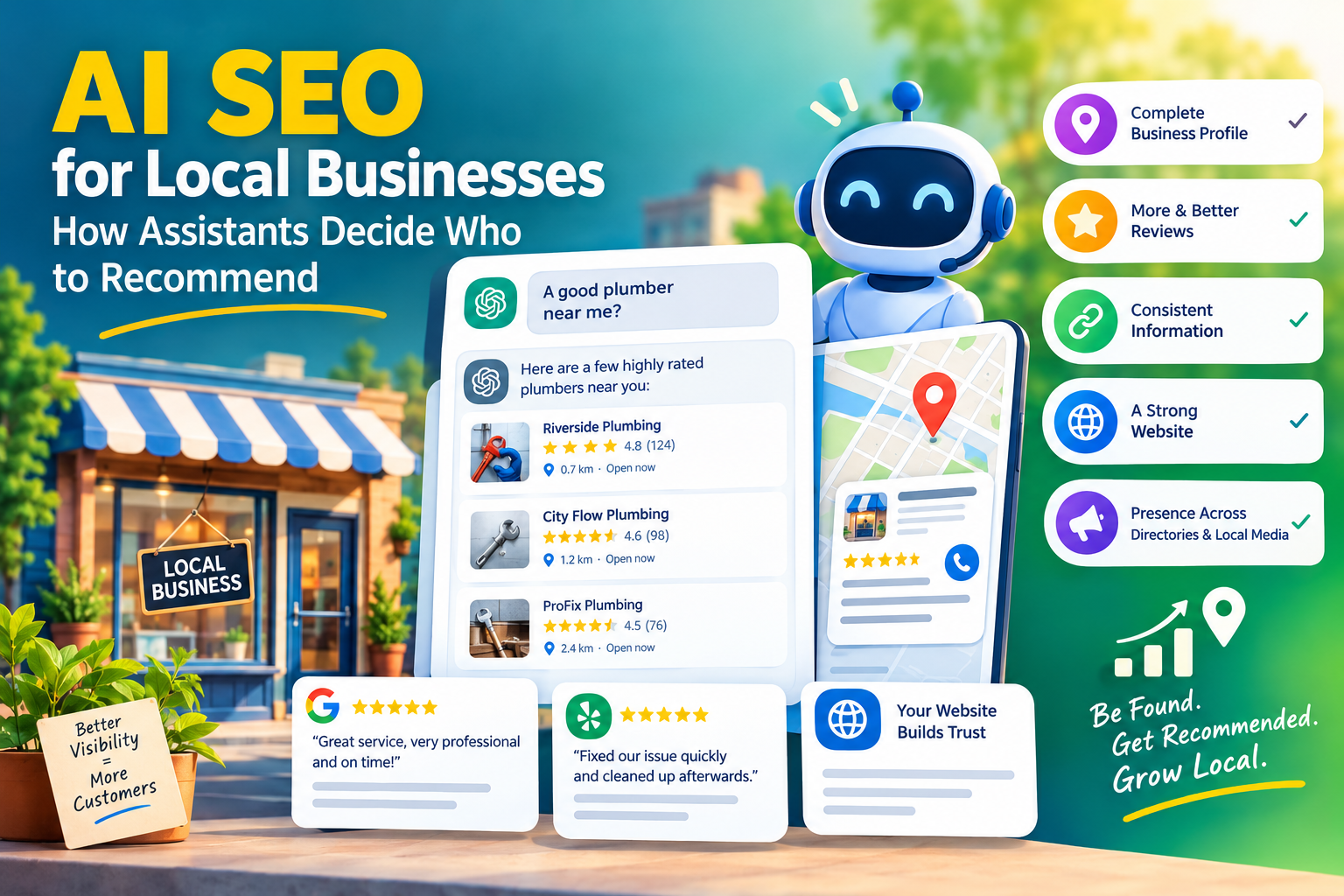
When someone asks an assistant for “a good dentist near me” or “a reliable electrician in my city,” the answer usually names two or three businesses and nothing else. There is no page of results to browse. You are either in that short list or you are not.
For local businesses, that makes AI SEO less about articles and more about proof of existence: who you are, where you operate and what customers say about you. This guide explains what the evidence says, how much of it to trust, and what a small business can do this month.
Local Search Is Changing, but Not Collapsing
Do not assume the old system has vanished. Whitespark’s 2026 Local Search Ranking Factors report describes local search as insulated from the AI disruption hitting informational publishers, because people looking for a business still mostly use Google’s local results and Maps.
Yet behaviour is shifting. BrightLocal’s 2026 Local Consumer Review Survey found consumer use of AI tools for local recommendations rose from 6% to 45% in a year, with ChatGPT used by 31% and Google’s AI Mode by 23%. The same summary says 64% of active AI users trust AI recommendations as much as they trust online reviews. Those are survey results reported through an agency page, so check the original report before quoting them.
The Shortlist Is Brutally Short
Here is the uncomfortable part. Local Falcon compared 189,905 ChatGPT results with Google local results for restaurant queries and found 83% of restaurants were invisible in ChatGPT, against 14% in Google. SOCi’s 2026 Local Visibility Index, covering more than 350,000 locations, found ChatGPT recommends only 1.2% of them. Entrepreneuremulent
These figures come from company studies of specific categories, mostly in the United States, so they will not match every country or trade. The direction is still clear: appearing in an AI shortlist is harder than appearing somewhere in a map listing, which means small differences in your online evidence can decide who gets named.
Where the Evidence Comes From
AI systems cannot visit your shop. They assemble a picture from public records. Local Falcon’s January 2026 analysis found AI-generated local recommendations often drew on public information from Google Maps, reviews, ratings and Business Profiles, though the same source cautions that a profile does not directly cause a recommendation. Entrepreneur
Different assistants lean on different data. One source argues that ChatGPT search relies mostly on Bing’s index and, since July 2026, on licensed Yelp reviews, while Gemini and Google Maps use Google’s own place and review data. That is a single publisher’s claim, so confirm it before building a strategy on it. The practical point is that no single directory is enough. One analysis argues a business with a strong Google profile and nothing elsewhere is weaker than one with moderate presence across Google, Yelp, industry directories and a few editorial mentions.
What Separates the Named From the Ignored
Several studies point to the same differences, though all come from vendors with local-marketing products to sell.
Review volume and recency. In one study of 10,000 local businesses, those recommended by ChatGPT and Perplexity averaged 133 Google reviews, while those ignored averaged 11. Treat the numbers as illustrative, not as a target. Correlation does not show that more reviews cause recommendations.
What the reviews say. According to SOCi figures relayed by a local agency, ChatGPT references reviews in 58% of local responses and Perplexity in all of them. Assistants read the text, not just the stars. A review saying “replaced our boiler in one day and cleaned up afterwards” tells a system what you actually do. Five stars with no words tells it very little.
Consistent business details. SOCi found only 68% of contact information surfaced by ChatGPT and Perplexity matched the Google Business Profile. If your phone number, hours or address differ between listings, a system has reason to doubt you.
A complete profile and a real website. One whitepaper reports that a business’s own website appears in 72% of AI answers studied, ahead of directory listings at 35 to 39%. Your site is not optional, even for a one-location trade.
A Practical Plan for This Month
Week one: fix the facts. Search your own name, phone and address and open the first twenty results. Correct every wrong detail, then standardise how you write your business name and address everywhere you control. Be specific about services. One guide suggests naming the actual work, such as residential HVAC repair, installation and maintenance, rather than a vague category like home services.
Week two: complete your Google Business Profile. Fill every section: categories, services, hours, photos, service area and a plain-language description. Update it regularly, because stale details undermine trust.
Week three: collect better reviews. Ask recent customers, soon after the job, and prompt them to mention what was done and where. Do not offer rewards. Google has tightened its review policies against bulk solicitation, incentivised reviews and coordinated campaigns. Reply to reviews in a normal, human tone, since replies add more specific context.
Week four: strengthen your website. For each service and area, write one real page: what you do, who it suits, typical timescales, honest pricing guidance and photos of actual work. Add contact details in plain text on every page.
Then spread your evidence. Claim listings on the one or two directories your trade really uses, and look for local press, community sponsorships or supplier pages that mention you accurately.
How to Check Progress
Ask ChatGPT, Perplexity, Gemini and Google the same five questions a customer would ask, replacing the city and service with yours. Record who is named and what is said about you. Answers vary between runs, so track the same prompts over time rather than judging on one result. Add a “How did you find us?” line to your enquiry form with an AI option.
Where Sarkar SEO Fits
Most local businesses do not lack effort; they lack consistency. At Sarkar SEO, we begin local AI SEO work by comparing every public record of a business side by side, because mismatched details and thin reviews are found far more often than clever technical problems. Fixing those usually costs little and removes reasons for a machine to skip you.
