



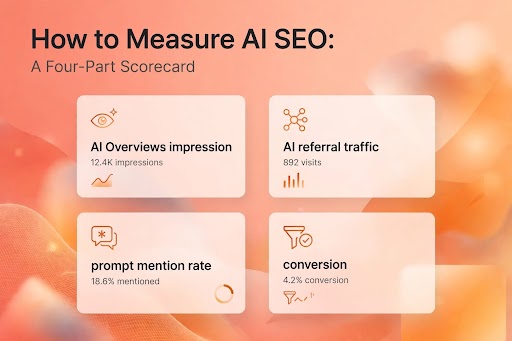
Ranking reports answer a simple question: what position is this page in? Measuring AI SEO is messier. Answers change between runs, some traffic arrives unlabeled, and Google’s own reporting covers only part of the picture. The fix is not one perfect metric but four imperfect ones read together. Here is what each can and cannot tell you.
Instrument 1: Search Console’s Generative AI report
Google launched dedicated Search Generative AI performance reports on June 3, 2026, with separate views for Search and Discover. The Search view covers AI Overviews and AI Mode and breaks impressions down by page, country, date and device.
The limits matter more than the features. The report shows impressions only, with no click-through rate or position, and it cannot separate AI Overviews from AI Mode. It also cannot reveal the queries or locations behind those impressions. Clicks from these features still land in the Organic Search channel in GA4. Use the report to see which pages Google’s AI features surface and to track direction over time. Do not use it to calculate click-through rate.
Instrument 2: AI referral traffic in GA4
Analytics defaults were written before assistants sent meaningful traffic. Reports say Google added an AI Assistants channel to GA4’s default grouping on May 13, 2026, but sources disagree on which assistants it captures. One says it skips Perplexity and any session without a referrer. Check your own data instead of trusting any published list.
Visits from mobile apps often arrive with no referrer and fall into Direct, and AI Overview clicks stay inside Organic Search. Treat identified AI referrals as a floor, not a total. A custom channel group built on assistant referrer domains is the usual workaround.
Instrument 3: Prompt sampling
SparkToro’s December 2025 study of 2,961 runs across ChatGPT, Claude and Google’s AI features found the same brand list in fewer than 1% of repeat runs, and the same list in the same order less than 0.1% of the time. The research was done with an AI-tracking vendor, a link the author disclosed.
Two lessons follow. A single check, such as asking ChatGPT about your brand once, proves nothing. And your position inside an AI answer is too unstable to report like a ranking.
Tools add their own noise. Graphite notes that API, logged-out and logged-in answers can differ, so tracker data is directional and worth supplementing with manual checks. One vendor test by Meikai found that a single daily run per prompt and platform produced the same pooled ten-day signal as ten runs. That suggests breadth across many prompts matters more than hammering one, though it is a single company’s finding. The metric to report is mention rate: the share of sampled answers that name or cite you, always shown with its sample size.
Instrument 4: Business outcomes
Volume is small, and estimates vary. SE Ranking, studying 101,574 sites, put AI platforms at 0.32% of web traffic for January to April 2026. Conductor, covering 13,770 domains, measured 1.08%. The methods differ, so expect your own figure to land anywhere in or beyond that range. SE Ranking also found AI-referred visitors spend 68% more time on site than organic search visitors.
Judge this channel by enquiries and revenue per visit, not session counts. A small, engaged stream can matter more than its share suggests, but only your own conversion data can show that.
A 90-day baseline
Here is a lightweight starting protocol. It is a practical suggestion, not a published standard, and the sample sizes are starting points you should adjust.
- Month one: Choose 15 questions your customers genuinely ask. Run each three times on each assistant you care about, logged out and logged in. Record how often you are named or cited, with the denominator.
- Month one, also: Build the custom GA4 channel group and note today’s identified AI visits as your floor.
- Monthly: Export the Generative AI report by page, and note which pages gain or lose impressions.
- Month three: Repeat the question test. Treat a change as real only if it exceeds the run-to-run spread you saw in month one.
If you want help setting this up, Sarkar SEO can build the baseline with you.
What to take away
AI SEO measurement rewards humility. Report ranges, not points. Show the sample size beside every mention rate. Admit that referral counts are a floor. Then anchor everything to the outcome that pays the bills. Sarkar SEO’s view is that an honest, slightly fuzzy scorecard beats a precise-looking dashboard built on one unstable number.
