



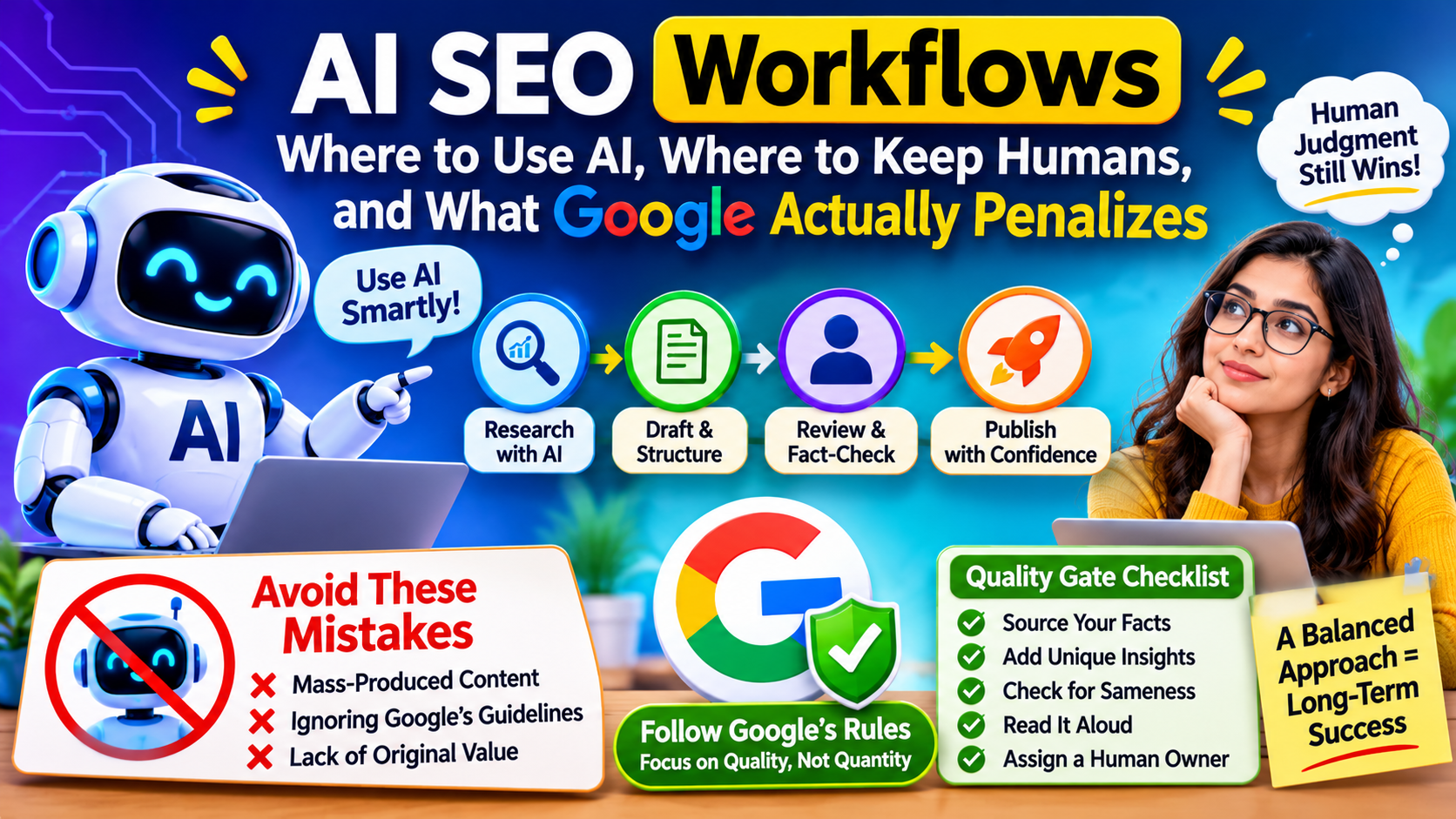
Most advice on AI SEO asks how to get cited by chatbots. This article asks a different question: how should an SEO team use AI to do the work itself? The short answer is that AI is acceptable for research, structure and first drafts, as long as a person owns accuracy, originality and the final decision. Google’s policy does not ban AI content. It penalizes mass-produced pages with little value, whoever or whatever wrote them.
What Google’s Rules Say About AI-Written Content
Google’s scaled content abuse policy, introduced on March 5, 2024, targets pages produced in volume mainly to manipulate rankings. According to PPC Land’s reporting, a Google spokesperson said it applies whether automation, humans or a combination are involved. The same report notes that Google’s earlier 2023 guidance already accepted AI use when it serves people and not rankings. Violations can lead to demotion or removal from Search, and Google has published no page-count threshold that triggers them.
The practical reading is simple. The test is purpose and value, not the tool. Fifty AI-generated city pages that differ only by place name fail it. Fifty pages that each contain distinct local facts, original photos and real answers do not fail it merely because AI helped draft them.
PPC Land also reports that in May 2026 Google said its spam policies extend to generative responses in Search, so thin, manipulative content now carries risk on more surfaces than the blue links.
How SEO Teams Actually Use AI Today
A January 2026 survey by Keyword.com offers a useful picture, with limits. It drew 97 usable responses, mostly from small teams, and the publisher sells rank-tracking software, so treat it as a snapshot and not an industry census. Its findings:
- 87% of respondents use AI regularly or as a core part of delivery, while only 1% describe their work as fully automated.
- The most common tasks were content briefs and outlines (77%), keyword research and clustering (68%), and drafting (66%).
- Respondents kept human control over writing (58%) and link building (51%).
- 57% held tasks back because output quality was not good enough, and 36% did not trust the accuracy.
The pattern is telling: teams lean on AI for work that organizes information and hold back where credibility and relationships matter.
A Task-by-Task Split
The table below is Sarkar SEO’s own working judgment, not research data. It is a starting point you should adjust to your risk tolerance.
The Quality Gate Before Anything Publishes
AI drafts fail in predictable ways: confident but wrong figures, invented sources, generic phrasing, and advice that sounds plausible but ignores context. A simple gate catches most of it.
- Source every number. If a statistic has no named origin you have opened and read, cut it.
- Add something a model cannot know. That might be your own test results, customer questions, screenshots, pricing you have verified, or an interview.
- Check for sameness. Search your target query and ask whether your page says anything the top results do not. If not, it is not ready.
- Read it aloud. Repeated openers, vague claims and filler transitions become obvious.
- Assign a named owner. One person signs off on accuracy, and that accountability should be visible on the page through an author bio.
What the Ranking Data Does and Does Not Show
A 2024 study by Graphite examined the top 20 Google results for 2,200 non-branded keywords, using Originality.ai to score paragraphs. About 3% of results were purely AI-generated and roughly 12% had more than half AI content. Human-written pages reached the top five about half the time, while purely AI pages more often sat on the second results page. The authors warned that they could not isolate AI as the cause, and AI detectors are imperfect. The study is also two years old, so use it as context, not as a verdict.
The honest takeaway is modest. Pages that are mostly unedited AI text appear to do worse on average, but the data does not prove that AI use causes poor rankings. Thin content, weak sources and sameness are the more likely culprits.
Common Mistakes
- Publishing at volume because production is cheap, then discovering that indexing and trust do not scale the same way.
- Letting a model choose the keywords without checking real search behavior in Search Console.
- Using AI-written outreach emails that recipients recognize immediately.
A Sensible Rollout
At Sarkar SEO, we advise starting small. Pick one repeatable task, such as keyword clustering, and run it with AI for a month while a human reviews every output. Record the errors you catch, because that list becomes your review checklist. Expand to briefs next, then to drafting with strict editing rules. Keep writing and outreach personal for as long as errors cost you credibility.
