



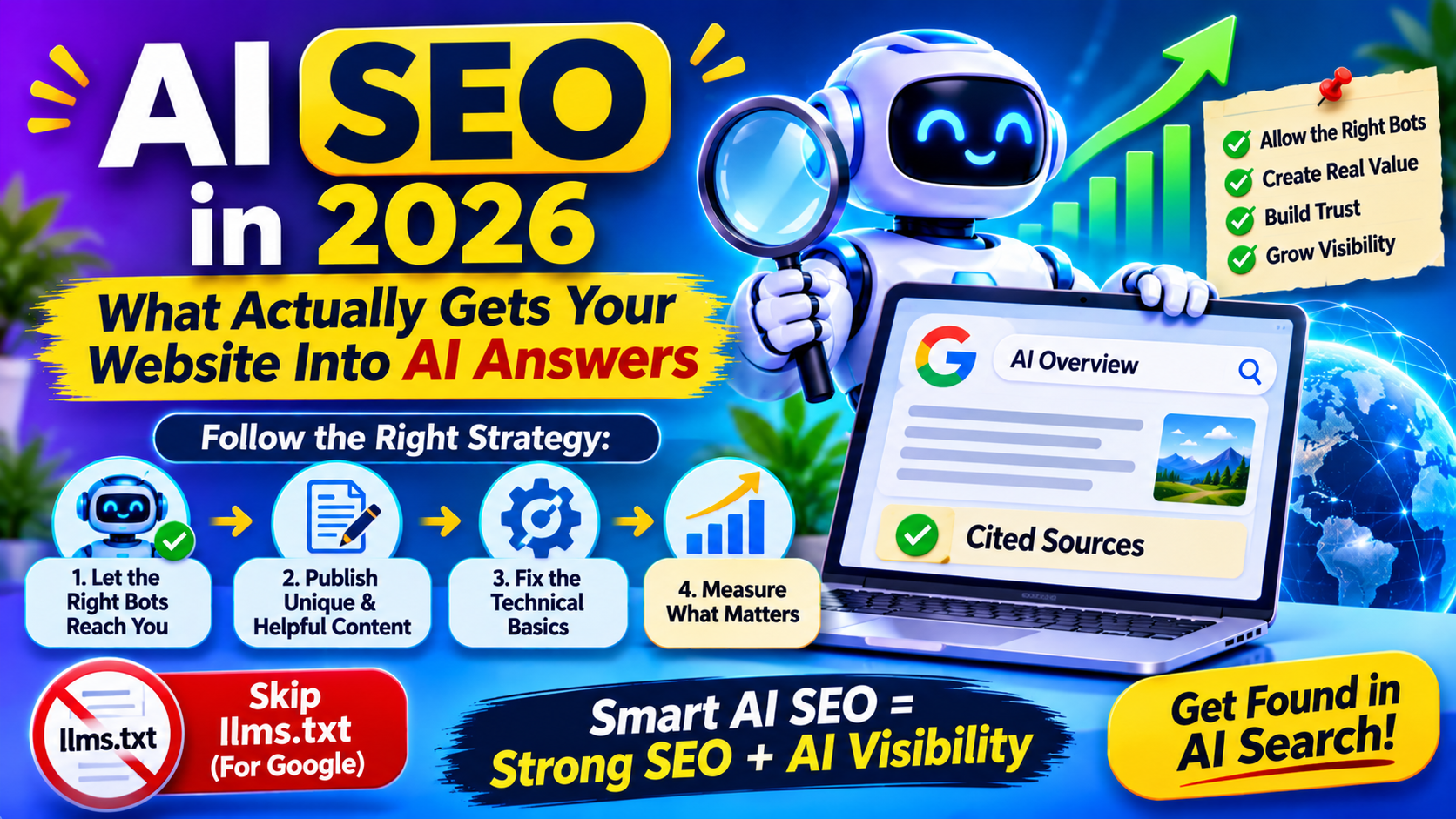
Search no longer ends with ten blue links. Google’s AI Overviews and AI Mode, ChatGPT search, Perplexity, Gemini and Claude now answer questions directly and cite a handful of sources. For website owners worldwide, AI SEO is the practice of making sure your pages are among those sources.
A lot of noise surrounds the topic. Some of it is useful and some is expensive nonsense. This guide separates the two.
What AI SEO Really Means
AI SEO is not a secret new discipline. It means making your content easy for search systems to access, understand and trust, then giving those systems something worth citing. The difference from a few years ago is where the visibility happens. Your page may be summarised inside an answer before anyone clicks.
What Google Says
Google has now published its first official guide to optimizing for generative AI search. It states that optimizing for these features is still SEO, and it explicitly rejects AEO and GEO as distinct disciplines.
The guide also names several things site owners can skip for Google Search. These include llms.txt files, chunking content and special schema. Google adds that AI systems understand synonyms and general meaning, so you don’t need to capture every long-tail variation or write in a particular way for generative search. searchenginejournalsearchenginejournal
Google’s site owner documentation makes the same point: there are no additional requirements to appear in AI Overviews or AI Mode, and no special optimizations are necessary.
Note the scope. Google’s guidance covers Google Search only, while Bing, Copilot, Perplexity and ChatGPT Search use different retrieval architectures. Treat Google’s advice as authoritative for Google and verify everything else.
Step One: Make Sure the Right Bots Can Reach You
Many sites lose AI visibility through a careless robots.txt file, not weak content. The crawlers do different jobs, and blocking by brand name is a common mistake.
- Search crawlers build the index behind AI answers. OAI-SearchBot, Claude-SearchBot and PerplexityBot all work this way.
- Training crawlers collect data for models. GPTBot is OpenAI’s training control, and Perplexity says PerplexityBot is not used for training.
- Googlebot is the one that matters for Google’s AI features, because robots.txt directives for Googlebot are the control site owners use to manage how Google crawls their sites for Search.
The practical consequence is this: blocking GPTBot does not hide your site from ChatGPT search, but blocking OAI-SearchBot removes you from its answers. If you want to stay out of model training but remain citable, you can block the training bots and allow the search bots. Decide this deliberately, then check your server logs to confirm the crawlers actually arrive. Robots.txt works on an honor system, so logs are the proof. therankmasters
Step Two: Publish Content That Is Not a Commodity
Generic summaries are the easiest thing for an AI system to produce without you. Google’s guide tells site owners to create valuable, non-commodity content, meaning AI search does not need more generic summaries of what everyone already knows.
In practice, that means adding something a model cannot invent:
- Original data. Survey your customers, analyse your own campaign results, or publish benchmarks from your industry.
- Firsthand experience. Document what you tested, what failed and what you would do differently.
- A clear point of view. Take a position and defend it with evidence. Neutral overviews blur into every other overview.
- Direct answers. Put the answer to the main question near the top of the page, then add depth below it.
Structured data is a smaller lever than many vendors claim. Google says it is not required for generative AI search, and no special schema.org markup is needed for AI features. Standard markup that accurately describes your page is still good hygiene.
Step Three: Fix the Foundations
The technical basics decide whether any of your content gets considered at all. Google points site owners back to technical requirements, crawling best practices, JavaScript SEO, page experience, duplicate content reduction and Search Console. A page that cannot be rendered, indexed or loaded reliably will not be cited, however well written it is.
For an international audience, add a few checks of your own. Make sure each language version has a clean, crawlable URL. Write for local usage rather than machine-translating from English. Avoid near-duplicate pages across regions unless the offer genuinely differs.
Step Four: Measure What Matters
AI visibility can feel invisible, but you have more data than you think. Sites appearing in AI Overviews and AI Mode are included in the overall search traffic in Search Console. You will not get a separate AI report, so watch for patterns instead:
- Rising impressions on question-style queries with flat clicks, which often signals citation without a visit.
- Branded search growth, which can follow repeated exposure inside AI answers.
- Conversion rate per visit, not just raw sessions.
That last point matters. Google has said AI Overviews drive higher-quality clicks. That claim comes from Google, so test it against your own conversion data before you rely on it.
Where Sarkar SEO Fits
At Sarkar SEO, we treat AI search as an extension of strong SEO, not a replacement for it. The work that earns citations is the same work that has always earned rankings: accessible pages, trustworthy authorship and content with real substance.
When Sarkar SEO audits a site for AI visibility, we begin with crawl access and indexability, then look for the pages where original insight is missing. Those gaps are where competitors are easiest to beat. If your content reads like everyone else’s, no technical trick will rescue it.
A Simple Checklist
- Allow the search crawlers you want to appear in, and separate that decision from training permissions.
- Confirm in logs that those crawlers reach your key pages.
- Rewrite thin, generic pages with original data or firsthand detail.
- Lead each page with a clear, direct answer.
- Fix rendering, speed and duplicate content before anything else.
- Track conversions and branded demand, not only clicks.
- Skip llms.txt, content chunking and “AI-only” schema for Google.
