



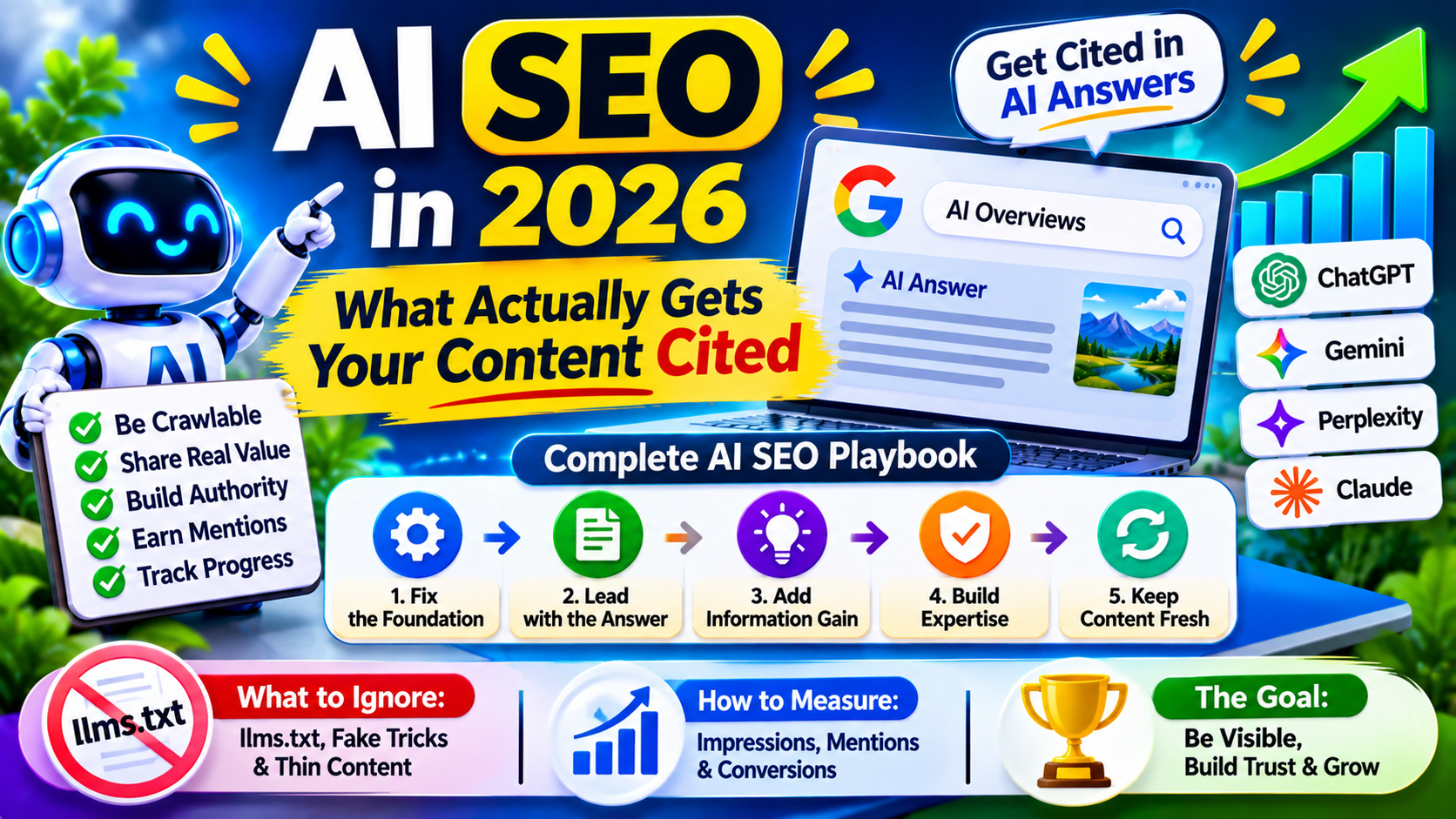
Search no longer ends with ten blue links. AI Overviews summarize answers at the top of results, and AI Mode is a conversational experience that researches answers in multiple steps and links its sources. Marketers have responded with a flood of new acronyms and expensive promises. This guide separates what matters from what doesn’t.
What AI SEO Really Means
AI SEO is the practice of making your content easy for search engines and AI assistants to find, understand, trust, and cite. It covers visibility in Google’s AI SEO features, and it also covers assistants such as ChatGPT, Perplexity, Gemini, and Claude.
The key point is that it is an extension of SEO, not a replacement. Sarkar SEO treats it as one discipline with a wider set of surfaces, and Google’s own guidance backs that view.
What Google Has Said
On May 15, 2026, Google published its guide to optimizing websites for generative AI features in Search, covering AI Overviews, AI Mode, and related features. Its message was reassuring. Google stated that optimizing for generative AI search is still SEO, and the guide rejects AEO and GEO as distinct disciplines. pagesthekeyword
Three practical takeaways follow:
- Eligibility is simple. A page must be indexed and eligible to appear in Search with a snippet to be a supporting link in AI Overviews or AI Mode. A stray noindex or nosnippet directive can quietly remove you.
- There is no separate index. AI features draw on the same Search foundation, so pages that struggle in classic search should not expect special treatment.
- Schema isn’t a shortcut. There is no special schema for AI Overviews, and no need to break articles into artificial chunks for Google.
Why Query Fan-Out Changes Content Planning
One mechanism does change how you should plan content. AI Overviews and AI Mode can use query fan-out, where Google runs several related searches across subtopics before building an answer.
A person asking “is AI SEO worth it for a small business?” may trigger hidden searches about cost, timelines, measurement, and risks. If your page answers only one of those, you compete for a fraction of the response. If your site covers the whole cluster with depth, you have more chances to be retrieved.
This is a good reason to build topic clusters instead of isolated posts. Map the questions around a subject, answer each one properly, and connect them with clear internal links.
A Practical AI SEO Playbook
- Fix the foundation first. Check crawlability, indexation, canonical tags, and snippet settings on your most valuable pages. Heavy client-side rendering can hide content from crawlers, so confirm your key text appears in the HTML.
- Lead with the answer. Put a direct, self-contained answer near the top of each section, then add nuance. This helps readers, and it gives answer engines a clean passage to retrieve.
- Add information gain. Generic summaries are everywhere, and AI systems have no reason to cite one more. Original data, real case notes, screenshots, expert commentary, and clear opinions give a page a reason to exist. If you have no firsthand evidence, say so and don’t invent any.
- Build visible expertise. Use real author names, credentials, and an about page that explains who stands behind the content. Trust signals matter more as machine-written text floods the web.
- Strengthen your entity. Keep your brand name, descriptions, and profiles consistent across your site and the wider web. Mentions on credible third-party sites help both people and machines recognize who you are.
- Keep content fresh and accurate. Update statistics, name dates, and remove outdated advice. Retrieval systems tend to favor sources that look maintained.
What to Ignore
Much of the advice sold as “GEO” is noise. Reports on Google’s guidance note that Google does not treat llms.txt as a requirement for AI Overviews or AI Mode. Be equally skeptical of anyone offering to “inject” your brand into AI answers.
Manipulation also carries risk. Google updated its spam policies to state that its spam rules apply to generative AI responses in Search, including AI Overviews and AI Mode. Fake mentions and scaled, low-value pages aimed at fan-out queries are the kind of tactic to avoid.
Beyond Google
Google’s guidance covers Google. Coverage of it points out that Microsoft, Anthropic, and Perplexity have not issued matching guidance, and Google’s advice did not address how other engines surface citations. For those platforms, the safe approach is to stay crawlable, publish clear and well-sourced content, and earn mentions from reputable sites. Check your robots.txt rules deliberately, because blocking AI crawlers can reduce your exposure on some platforms.
Treat any claim about exactly how ChatGPT or Perplexity ranks sources as unproven unless the vendor documents it.
How to Measure Progress
Measurement is still imperfect. Google has confirmed that AI Mode and AI Overviews traffic is included in Search Console’s “Web” search type data, which means it is not cleanly separated in standard reports. Google has also begun rolling out reporting on generative AI features to a subset of websites, so availability will vary. varnjorijn
A workable tracking routine includes:
- Search Console impressions, clicks, and queries for your priority topics
- A fixed list of 20 to 30 target questions, checked monthly across AI platforms
- Whether your brand is mentioned, whether you are linked, and which competitors appear
- Referral traffic from AI platforms in your analytics, plus branded search growth
Record results in a simple spreadsheet. Trends over months matter more than any single screenshot.
Common Mistakes
- Chasing AI-specific tricks while indexation problems go unfixed
- Publishing dozens of thin pages to cover every possible fan-out query
- Rewriting competitors’ answers without adding anything new
- Treating citations as the only goal, when leads and revenue are what count
- Ignoring brand reputation, which shapes how often others mention you
