



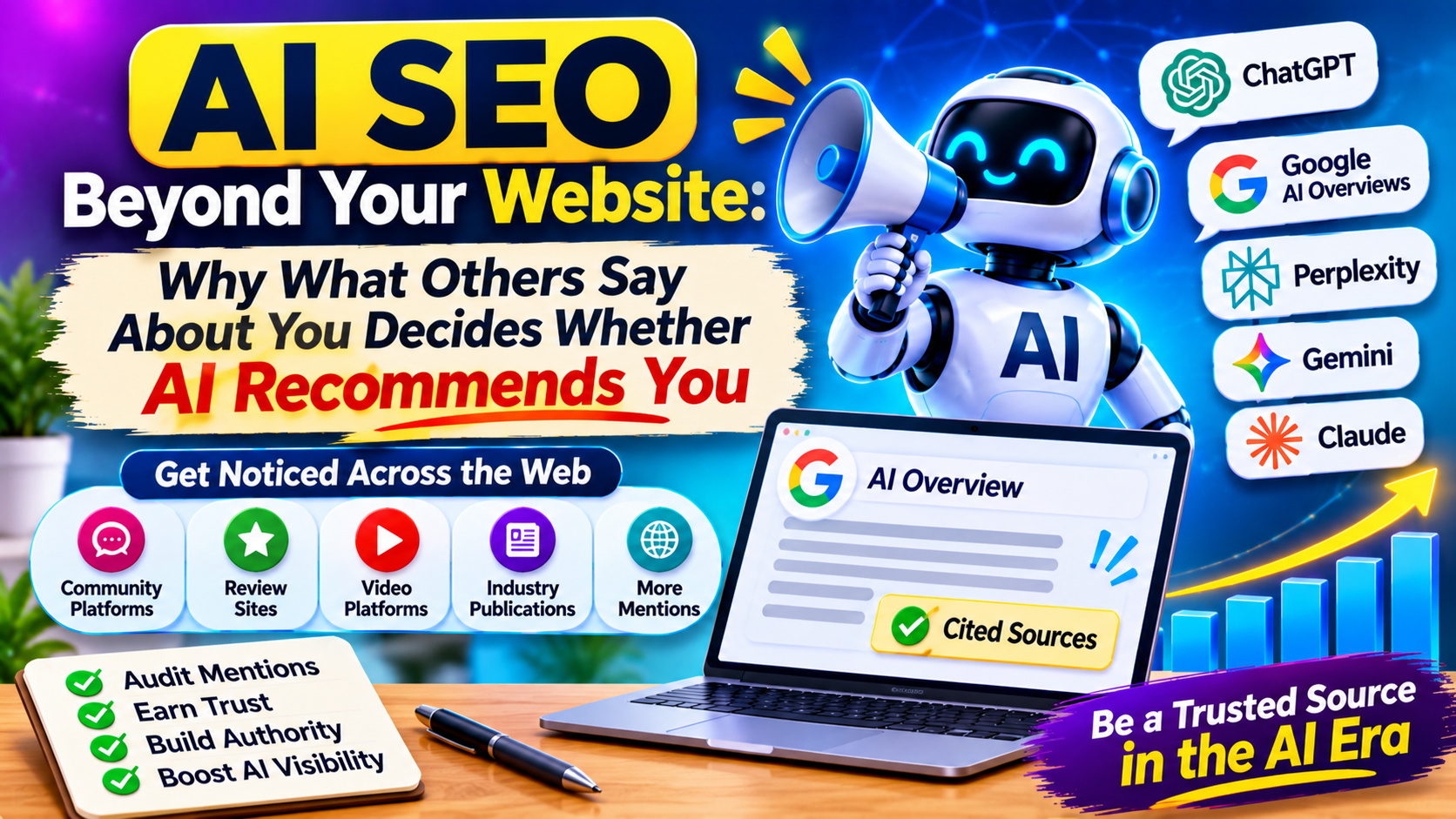
You can publish the best page on the internet and still never be named by ChatGPT, Perplexity or Google’s AI answers. The reason is uncomfortable. These systems rarely rely on what you say about yourself.
Most AI SEO advice focuses on your own pages. Recent citation studies point somewhere else: the wider web’s opinion of your brand. This article explains what that means and how to act on it, wherever your customers are.
Your Website Is the Minority Voice
AirOps’s 2026 State of AI Search report, as summarised by Ziptie, found that 85% of brand mentions in AI-generated answers come from external sources, and that 80% of AI-cited sources don’t appear in Google’s top 10 organic results. A separate analysis reported that LLMs draw on Trustpilot, Reddit and social platforms rather than the brand’s own site. Even for questions about functionality and integrations, which are the most “owned” topics, brand content appears only about half the time. AI Search as a Discovery Channel: When AI Introduces Brands Users Never Heard Of +2
The takeaway is not that your website is worthless. It is the evidence behind the claim that AI visibility is an earned media challenge as much as a website optimization one. Your pages still matter, but they are only one input.
Mentions Appear to Beat Backlinks
For two decades, SEO rewarded link building. AI search seems to reward something looser: being talked about. Secondary coverage of an Ahrefs study of roughly 75,000 brands reports that branded web mentions correlate with AI citations at 0.664, while total backlink count correlates at only 0.10.
Treat that figure carefully. It is a correlation, and I read it through summaries rather than the original study. It does not prove that mentions cause citations. It does fit a sensible explanation, though. As one analysis put it, a brand mention tells AI search who you are and whether several credible sources agree on that. Agreement across independent sources is a trust signal a single website cannot manufacture.
Each Engine Draws From a Different Well
There is no single AI search to optimize for. A Qwairy study of 118,101 AI answers, reported by Whitehat SEO, found that only 11% of cited domains overlap between platforms, and that Perplexity cites 21.87 sources per answer against ChatGPT’s 7.92. The same report shows Wikipedia, Reddit and YouTube carrying very different weights depending on the engine. For example, Wikipedia accounts for 7.8% of ChatGPT citations but 18.4% of AI Overviews. whitehat-seowhitehat-seo
A brand that is visible in one engine can be absent in another. That is why a single “AI ranking” is a myth, and why measuring each engine separately matters.
Where Mentions Actually Come From
The data points to a short list of places:
- Community platforms. In an SE Ranking analysis cited by Contently, domains with millions of brand mentions on Reddit averaged 7 ChatGPT citations, against 1.8 for domains with minimal presence. Quora showed a similar effect.
- Review sites. Trustpilot and G2-style platforms feature repeatedly in the sources above.
- Video. Google AI Overviews cite YouTube heavily.
- Reference pages and industry publications, such as Wikipedia where you genuinely qualify, and trade media in your field.
None of these can be faked sustainably. Each reflects what real people say about you when you are not in the room.
A Practical Off-Site AI SEO Plan
- Audit what AI already says. Ask each major engine a dozen category questions your buyers would ask, such as “best [service] for [type of business]”. Record whether you are mentioned, cited, or absent. Repeat monthly, because answers vary between runs.
- Find the gaps in the source pool. Look at which sites the engines cite when they answer your category questions. These are your target platforms, and they will differ by country and language.
- Earn mentions with something quotable. Journalists, bloggers and community members mention brands that give them something to say: original data, a named framework, a strong opinion, or a useful free tool. Generic press releases rarely do this.
- Participate in communities honestly. Answer questions on Reddit, Quora and industry forums as a real practitioner. Disclose affiliations. Promotional posting tends to be removed and can damage trust.
- Manage reviews and consistency. Invite genuine reviews, respond to criticism, and keep your brand description identical across profiles. Inconsistent naming makes it harder for systems to connect mentions to one entity.
- Keep your own site cite-ready. One source suggests pages linking to five or more authoritative external sources were cited more often by Perplexity. That claim comes from a single vendor’s testing, so run your own experiment before restructuring anything.
What to Be Skeptical About
Much of the data behind this topic comes from AI-visibility tool vendors who sell monitoring. Sample sizes, prompt sets and definitions of “mention” differ between studies, and results shift as the engines change. One 2026 comparison found Perplexity named brands more often than ChatGPT, while another dataset ranked the engines differently. Use these numbers to understand the direction, not to promise outcomes to a client or a boss.
How Sarkar SEO Approaches This
At Sarkar SEO, we treat off-site presence as part of search strategy, not as a separate PR exercise. When a client asks why a competitor keeps appearing in AI answers, Sarkar SEO starts with the source pool: which platforms the engines cite, and where the competitor is mentioned that the client is not.
That reframes the problem. Instead of publishing more blog posts, the priority becomes earning credible references in the places AI systems already trust. Sarkar SEO builds that plan around the client’s market, language and budget, because a plan for the United States will not map neatly onto India, Europe or Southeast Asia.
