



Your rankings are steady, yet your traffic is slipping. If that sounds familiar, you are not imagining it, and you are not alone. AI-generated answers now sit above the traditional results for many queries, and they change how people behave.
This article does not repeat the usual checklist. It tackles the harder question behind AI SEO: if clicks are shrinking, what should you target, what should you measure, and where is the opportunity?
What the Click Data Shows
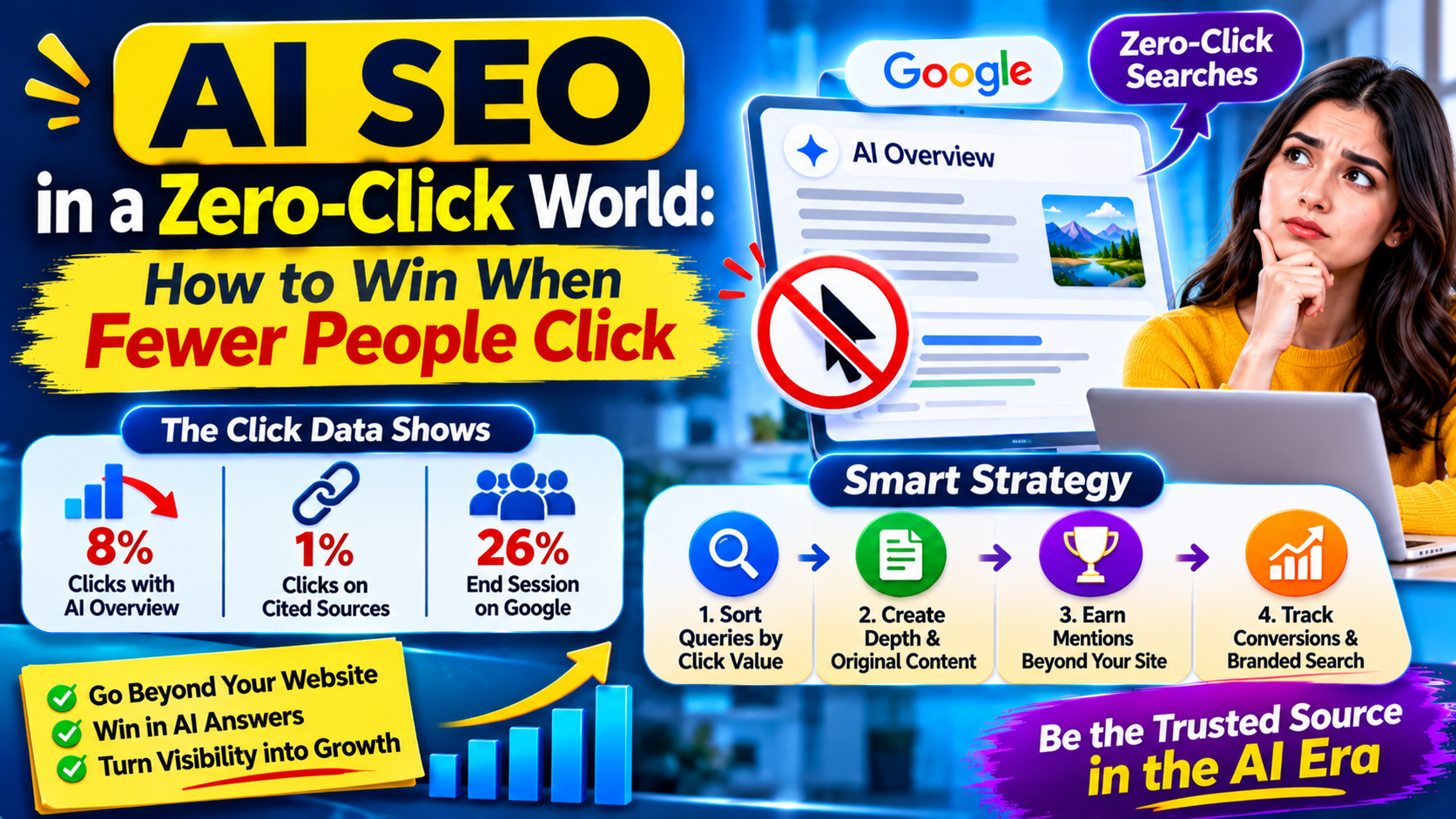
The best-known evidence comes from Pew Research Center. It tracked the browsing of 900 US adults, covering 68,879 unique searches, of which 12,593 (about 18%) produced an AI Overview. The gap in behavior was large:
- Users clicked a traditional result link 8% of the time when an AI Overview appeared, against 15% when it did not.
- Only 1% of visits included a click on a source cited inside the AI Overview.
- 26% of users ended their session on Google after seeing an AI Overview, compared with 16% for standard results. the-decoder
Other studies point the same way. An Ahrefs analysis of 590 million searches found AI Overviews on about 9.46% of desktop keywords and reported a 34.5% reduction in clicks.
Read This Data With Care
Three caveats matter before you restructure your strategy.
It is a snapshot. Pew’s data covers March 2025 and US users only. AI features have expanded since then, so your numbers may differ.
Google disputes it. A Google spokesperson called the study’s methodology flawed and its query set skewed and not representative of Search traffic. Google also argues the clicks it does send are better. In its guidance, Google says people run more queries in AI Mode, but the clicks are higher quality. That claim is Google’s own and I found no independent proof, so test it on your own data. searchenginelandsearchenginejournal
Averages hide the real story. AI Overviews do not appear on every query. They are more likely on longer, more complex questions, so the impact varies sharply by topic. Your own query mix matters more than any headline figure.
Where the Clicks Go
If you cannot count on the click, you need to know who wins it. In Pew’s data, Wikipedia, YouTube and Reddit were the most cited sites and accounted for 15% of links in the summaries. The same report found government sites made up 6% of links in AI summaries versus 2% in standard results.
The pattern suggests AI answers lean toward sources that feel authoritative or experience-based. A small business cannot become Wikipedia, but it can become the specialist source on a narrow topic.
A Practical Framework: Sort Queries by Click Value
Most advice treats every keyword the same. A better approach is to sort your queries into three groups and treat each differently.
- Answer queries. These ask for a fact or a definition (“what is hreflang”). AI can answer them completely, so expect fewer clicks. Publish these pages to build recognition and citations, and do not expect them to drive volume.
- Decision queries. These involve comparison, cost or risk (“how much does an SEO audit cost for an ecommerce store”). People still need detail, proof and a trusted voice. Invest most here, with original pricing logic, examples and honest trade-offs that a summary cannot compress.
- Action queries. These show intent to buy, hire or sign up. They are the most valuable and often the least affected. Make sure the landing page converts, because a smaller audience makes each visit count more.
Audit your top 50 pages and label each one. You will often find that your traffic is concentrated in group one, which is exactly the group most exposed to AI answers.
Change What You Measure
If clicks no longer tell the whole story, your reports need to evolve. One SEO commentator argued that impressions are now more important than ever. That is a reasonable view, with a caveat: impressions alone do not pay the bills.
A more useful dashboard includes:
- Conversions per organic visit, not sessions. Fewer, better visitors can raise revenue even as traffic falls.
- Branded search volume. If AI mentions are building awareness, people should search for you by name afterward.
- Impressions on decision queries, tracked separately from answer queries.
- Citation checks. Ask the major AI engines your key questions monthly and note whether you are named.
Remember that Google does not give you a separate AI report. Sites appearing in AI Overviews and AI Mode are included in the overall search traffic in Search Console. You will need to infer the effect from query-level patterns.
Make the Click Worth Earning
When a searcher does click past an AI answer, they already know the basics. Do not make them read the basics again. Open with what the summary could not tell them: your data, your method, your price range, your verdict. Then give them an obvious next step, such as a calculator, a template, a comparison table or a consultation.
How Sarkar SEO Handles This
At Sarkar SEO, we begin client reviews by separating traffic into the three query groups above, since one blended number hides where the damage and the opportunity sit. Sarkar SEO then rebuilds reporting around conversions and branded demand, so a client is not judged on sessions that were never going to convert.
The aim is not to defend old traffic at any cost. It is to concentrate effort on queries where being the chosen source still pays. Sarkar SEO applies this across different markets, because AI Overview coverage and user behavior vary by country and language.
