



Ask ten marketers whether AI SEO Overviews are hurting organic traffic and you’ll get ten confident answers. The studies disagree with each other, and the headlines often hide why. This guide untangles the evidence and turns it into decisions you can act on.
The Short Version
Clicks fall when an AI Overview appears. The size of the fall depends on the query type, the study method, and your brand’s position. A few findings are consistent enough to plan around.
What the Studies Found
Measured drops vary a lot because researchers measure different things.
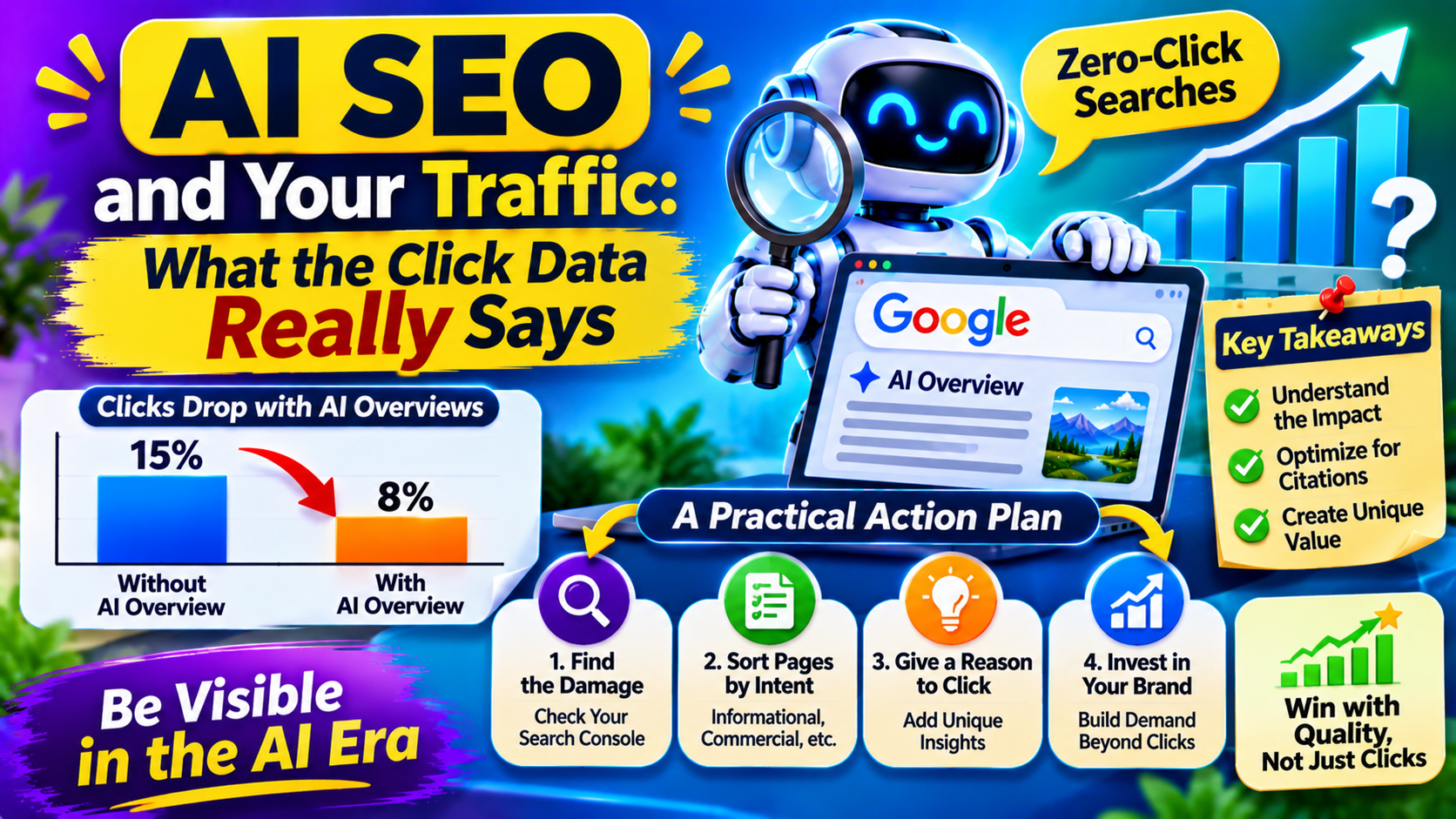
- Pew Research found that users click 8% of the time with AI Overviews, compared to 15% without.
- Ahrefs analyzed Search Console data and reported a 58% drop in click-through rate for top-ranking pages when AI Overviews appeared. An earlier Ahrefs calculation put the position-one reduction at about 34.5%. searchenginejournalahrefs
- Seer Interactive studied 53 brands and found organic CTR of 0.61% on queries with an AI Overview versus 1.62% on queries without one.
Most of these are correlational. One experiment took a different route: it randomly assigned users to see AI Overviews or not, isolating the causal effect. On queries where an overview would show, hiding it lifted organic clicks per search from 0.37 to 0.62 and cut the zero-click rate from 0.73 to 0.54.
The numbers differ, but the direction does not. AI answers keep some searchers on the results page.
Why the Numbers Disagree
Three factors explain most of the gap:
- Method. Panel studies, Search Console data, and randomized tests each capture different behavior.
- Query mix. One report notes that the distribution is heavily skewed toward informational intent. A site full of how-to and definition pages will see more damage than one built around purchase queries.
- Timing. Seer’s later update found that the decline in click-through rates with AI Overviews present had slowed, and organic CTR rebounded 85% in the first two months of 2026. That is a rebound from a very low base, so it is not a return to the old normal.
Who Is Most Exposed
Reports from agencies describe traffic declines of 30% to 70% for informational-heavy sites between late 2024 and early 2026. Treat that as a signal and not a universal rate, since it comes from agency-reported portfolios.
Exposure looks lower in some places. One dataset found branded queries lost only 3%, and commercial-query traffic held up better because researching users still click through. Another analysis says transactional queries and complex research hold up better, because users still click when ready to purchase or need to verify sources. visionary-marketingsuperlines
Be careful about turning click data into revenue claims. One analysis points out that these figures measure clicks, traffic, or CTR, not an automatic revenue loss, which depends on your search mix, margins, conversion rate, and brand demand. Bain’s widely cited estimate puts the effect of zero-click behavior at 15% to 25% of organic website traffic.
The Upside Most Articles Skip
Being cited changes the picture. Seer’s data showed that cited brands earned two to five times the organic click-through rate of uncited brands on AI Overview searches during 2025. The goal is to be the source the summary draws on, which is a different goal from simply ranking number one.
Clicks from inside the summary are rare, though. One review puts it at only 1% of visits clicking a source inside the AI summary. The benefit shows up as brand recall and stronger clicks on your regular listing, not as a flood of referrals from the overview box.
A Four-Step Response Plan
At Sarkar SEO, we suggest starting with your own data before changing strategy.
Step 1: Find the damage. Open Search Console, filter queries with at least 100 impressions, and sort by CTR ascending. One rescue guide recommends this approach, and the worst offenders at the top are your rescue list. Look for queries where impressions are stable but clicks are falling.
Step 2: Sort pages by intent. Mark each affected page as informational, commercial, or transactional. Pages that only answer simple questions are the most vulnerable, because a summary can replace them.
Step 3: Give people a reason to click. If a summary can fully answer the query, your page must offer something it can’t: a calculator, template, original dataset, comparison, tool, or expert opinion. Rewrite thin explainer pages around that extra value, or merge them into stronger ones.
Step 4: Invest in demand you own. Branded searches held up best in the data above. Newsletters, communities, direct relationships, and a recognizable name all reduce your dependence on any single click path.
Update How You Report Success
Sessions alone no longer tell the whole story. Sarkar SEO tracks a wider set of signals for clients, and you can do the same:
- Impressions versus clicks, split by query intent
- Branded versus non-branded search growth
- Conversions per visit, not just visits
- Whether your brand appears when you ask AI tools your core questions
- Referral traffic from AI platforms, however small
On quality, one source claims ChatGPT referrals convert at 11.4% versus 5.3% for organic search. That is a single-source figure and may not match your site, so test it on your own analytics before relying on it. Volume from AI referrals remains small for most sites.
What Not to Do
- Don’t panic-delete content. Check intent and conversions first.
- Don’t chase every statistic. A 58% figure and a 30% figure can both be accurate for different datasets.
- Don’t abandon classic SEO. Cited pages still need to rank, as covered in other guides.
- Don’t assume paid search is a safe harbor. Some analyses suggest sponsored clicks are less affected, but that is no reason to raise budgets without testing.
