



A blog post you published two years ago may still rank. The question is whether an AI assistant will cite it. Freshness has become one of the most debated levers in AI SEO, and the evidence is more nuanced than “update everything constantly.”
This article looks at what the data actually shows, where it conflicts, and how to build an update routine that is honest, efficient and worth the effort.
What the Biggest Study Found
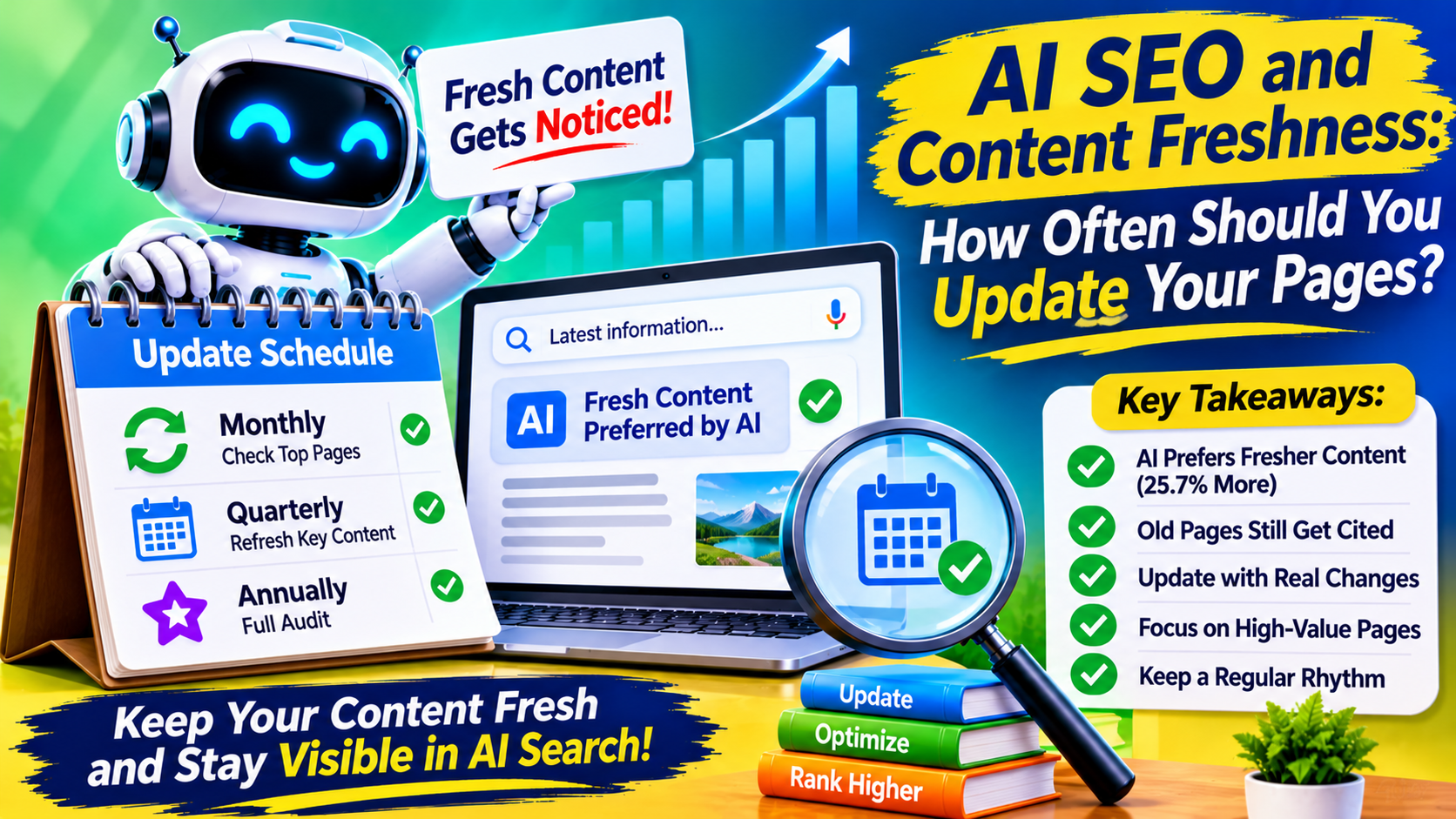
Ahrefs analysed about 17 million citations across seven search platforms. Its headline result: AI assistants cited content that is 25.7% fresher on average than Google’s organic results. Measured by publication date, the average cited URL was 1,064 days old, or 2.9 years. Measured by last update, the gap was smaller: 909 days for AI assistants against 1,047 for the organic SERP, a difference of 13.1%. New Study: AI Assistants Prefer to Cite “Fresher” Content (17 Million Citations Analyzed) +2
Two details deserve attention.
First, the preference is uneven. ChatGPT showed the strongest preference for fresh content, and Perplexity and ChatGPT order their in-text references from newest to oldest.
Second, Google’s AI Overviews go the other way. Ahrefs found they cite content that is 16 days older on average than organic results. This makes sense, since AI Overviews draw on Google’s core ranking systems. Ahrefs’s own conclusion was that Google is the least influenced by content freshness, and Google is still where the majority of searches happen.
A Second Dataset Points the Same Way
AirOps studied more than 4,000 pages cited by ChatGPT across 900 high-intent queries in 15 industries. It reported that over 60% of commercial pages cited by ChatGPT had been updated in the past six months, and only one in five commercial citations went to content older than a year. Its conclusion was that the last-updated date mattered more than the original publish date.
Both studies come from companies that sell AI-visibility tools, and both are correlations. Pages that get updated may also be better maintained in other ways, so freshness may be a symptom of quality, not a separate cause. Still, two independent datasets agreeing on direction is worth acting on.
What the Data Does Not Say
Freshness is not a magic switch. Several caveats keep the advice honest:
- Old pages still get cited. In the Ahrefs data, the average cited page was nearly three years old. One summary put it plainly: AI doesn’t ignore older content, and evergreen quality still matters.
- Fake updates do not work. Ahrefs notes that Google’s John Mueller has warned against updating publish dates without corresponding changes in the page content.
- Daily tweaks will not rescue weak pages. Low-quality, irrelevant content that’s updated every day will not have a magic positive effect on visibility in AI search.
- Platform behavior shifts. One analysis notes that ChatGPT’s behavior has swung sharply across model releases and shouldn’t be treated as one stable number. nogood
Which Pages Deserve Updates First
Treat updates like a budget, not a ritual. Rank pages by value and decay speed.
Update quarterly or sooner:
- Pricing, tool comparisons and “best of” lists
- Statistics roundups and trend pieces
- Anything involving regulations, platform features or software versions
Update every six to twelve months:
- How-to guides tied to a changing process
- Service pages with outdated proof, screenshots or case examples
Leave alone unless something changes:
- Genuinely timeless explainers, such as core principles or definitions
Within each group, start with pages that already earn impressions or conversions. A fresh date on a page nobody reaches helps no one.
What Counts as a Real Update
A real update changes something a reader or an AI system would notice. Use this checklist:
- Replace outdated facts. Swap old statistics for current ones, and name the year and source.
- Fix what is now wrong. Remove features that no longer exist and correct stale advice.
- Add something new. A new example, a section on a recent development, or fresh data from your own work.
- Re-check every link and claim. Broken sources undermine trust.
- Update the visible date and the modified date together, and only after meaningful edits. A short changelog line, such as “Updated November 2026: revised pricing and added a section on X,” helps readers and shows your work.
Keep the original URL. Moving content to a new address throws away the history that gave the page its authority.
Build a Simple Maintenance Rhythm
- Monthly: review your top 20 pages for accuracy and drops in impressions.
- Quarterly: refresh your fastest-ageing pages and publish one piece built on new data.
- Annually: audit the whole site. Merge duplicates, update or remove pages that have lost their purpose.
Original data is a particularly efficient route, because new numbers refresh a page and add something rivals do not have.
How Sarkar SEO Approaches Freshness
At Sarkar SEO, we start with a decay audit: which pages are losing impressions, which carry facts that have expired, and which are still performing well and should be left alone. Sarkar SEO then sorts pages into the three update tiers above, so effort goes where it earns something.
We are cautious about promising results from freshness alone. When Sarkar SEO refreshes a page, we change substance first and dates second, and we record each change so the impact can be checked later. The right cadence depends on your industry and how quickly your information goes stale.
