



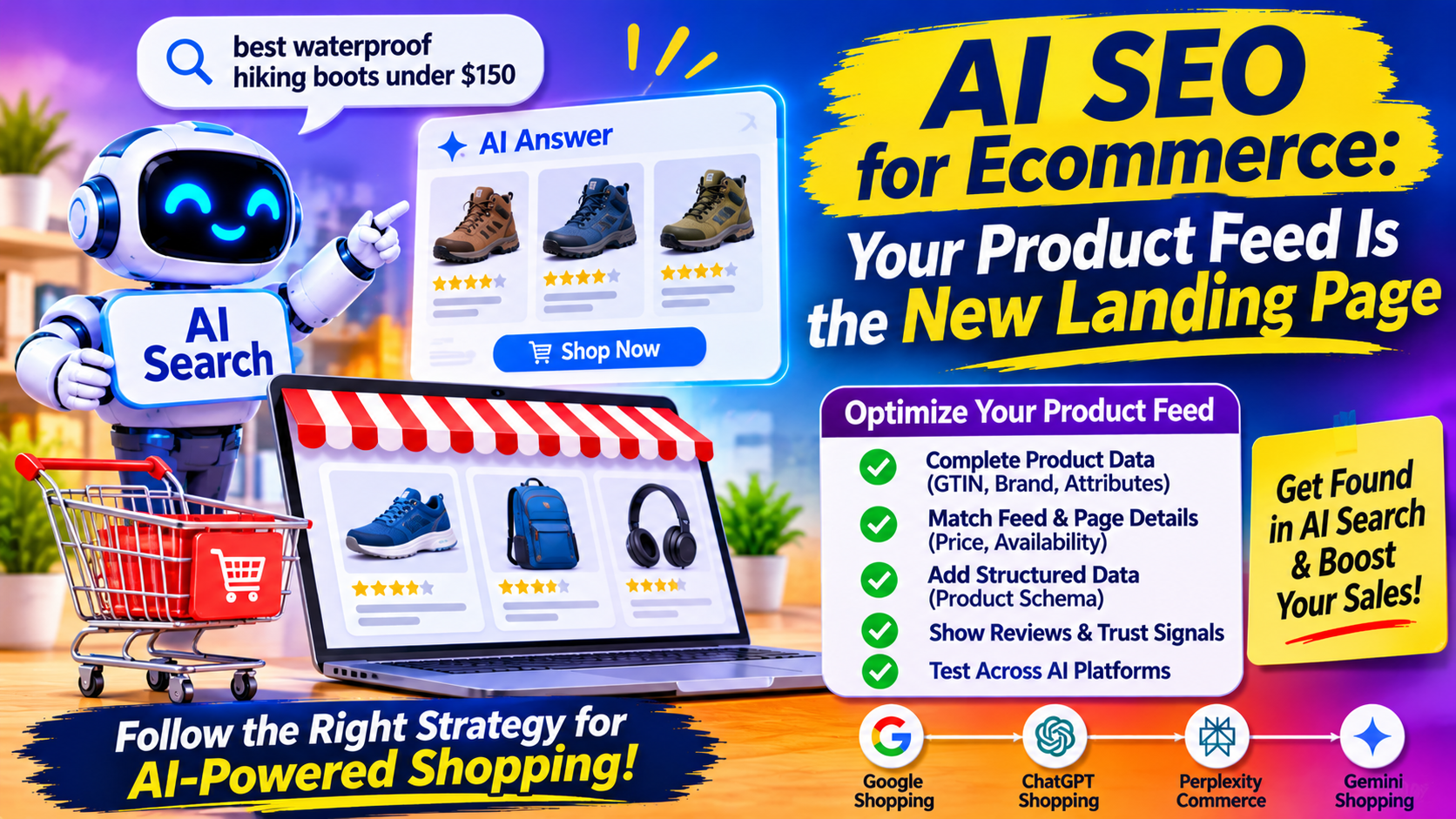
A shopper types “best waterproof hiking boots under $150” into an AI assistant. It returns three products, a comparison, and a buy button. The shopper never sees your carefully written product page.
That scenario is becoming ordinary. For online stores, AI SEO is as much a data problem as a content problem.
What Is Different About Ecommerce
Most industries are still learning what AI visibility means. Ecommerce feels it sooner, because the path from recommendation to purchase is short. One analysis describes the emerging pattern as “discover in AI, buy on your site,” so the feed and the checkout are equally critical.
The same source says online stores now work three surfaces at once: classic search results, Merchant Center listings, and AI answers such as AI Overviews, AI Mode, and ChatGPT. Classic ecommerce SEO still matters, because transactional queries still flow through organic search and product pages. The feed and AI answers are additions, not replacements.
Why Feeds Now Matter So Much
Google’s shopping data layer is the key link. According to one analysis, Google’s Shopping Graph, built from Merchant Center feeds, now helps ground product mentions in AI Mode, AI Overviews, and Gemini shopping answers.
A caution belongs here. The same analysis notes that Google has not confirmed Merchant Center as a direct AI Mode ranking signal. Several vendors make stronger claims, including one saying researchers found base64-encoded Google Shopping parameters in ChatGPT’s source code, suggesting a pipeline between Merchant Center feeds and ChatGPT recommendations. That is a vendor’s reading of a third-party report. It is plausible but unproven, so treat feed quality as a sensible priority and not a guaranteed lever. alhenagetpassionfruit
OpenAI’s own statement is more measured. A 5W analysis says that OpenAI states ChatGPT shopping research uses merchant product data supplied through the Agentic Commerce Protocol alongside publicly available product information and other retail sources.
The Platforms Are Not Interchangeable
Enrollment differs by platform. One comparison notes that ChatGPT uses the Agentic Commerce Protocol, Perplexity requires its Merchant Program, and Google AI Mode and Gemini both read your Merchant Center feed. That makes Google’s side the cheapest to cover first: if you run Shopping campaigns you’re already listed, and the work is feed quality, not enrollment.
Platform programs change quickly, and some claims about rollouts, fees, and automatic enrollment come from vendors who profit from adoption. Check each platform’s merchant documentation before you commit engineering time.
The Sarkar SEO Product Data Scorecard
At Sarkar SEO, we turn this into a quick scorecard you can run on your top 50 products. Score each item as pass, partial, or fail.
- Identifiers. Does every product have a valid GTIN, brand, and SKU? One guide tells merchants to audit GTIN coverage, clear Merchant Center disapprovals, and fill in material, dimensions, and color variants.
- Feed and page agreement. If your feed says “in stock” and your page says “sold out,” trust suffers. One analysis warns that this mismatch penalizes both Shopping visibility and AI grounding confidence. Price, availability, and shipping details should match everywhere.
- Attribute depth. Shoppers ask specific questions: “vegan,” “fits wide feet,” “works with iPhone 16.” If those facts are missing from your feed and copy, an AI has nothing to match.
- Structured data. Product markup on each page supports the feed. Sources agree that the shopping surfaces draw from overlapping Schema.org Product attributes, GTIN completeness, and Google Merchant Center feed quality.
- Policies. AI agents choose an offer, so trust signals matter. The 5W piece asks why shipping, returns, and merchant policies matter, since agentic shopping involves AI agents choosing an offer and a product. Clear, easy-to-find policy pages help both machines and humans.
- Reviews beyond your site. One guide says third-party review volume on sites ChatGPT cites, like Trustpilot and Reddit, matters alongside feed quality and clean Product schema. Reviews on your own pages help too, but independent platforms carry extra weight.
A score below 80% on any of the six is a sign of where to start.
New Features Worth Watching
Google is adding measurement and checkout. A Merchant Center report rolling out through 2026 benchmarks your share of voice on AI surfaces against comparable brands and flags missing product attributes from your feed. Google’s Universal Commerce Protocol is expanding too: products using the native_commerce attribute will display a checkout button in Google AI Mode and the Gemini app, with rollout happening “over the coming months.” lengowsearchenginejournal
Availability varies by country, so confirm eligibility in your market before planning around it. Since the audience here is worldwide, remember that many of these programs launched in the United States first.
Paid Placement Exists Too
Organic discovery is only one route. One source reports that sponsored product cards can now run through ChatGPT’s Ads Manager, generated from the same Shopify or Merchant Center feed, available since May 2026. The same feed quality supports both paid and unpaid visibility, so fixing data is rarely wasted effort.
Mistakes to Avoid
- Treating the feed as an operations chore. It is now part of your search presence.
- Writing for keywords instead of answers. Product pages should state who the item is for, what it is made of, and how it compares to alternatives.
- Ignoring returns and shipping detail. These often decide which offer an agent picks.
- Chasing every new platform at once. Perfect your core feed first, then expand.
- Trusting conversion claims without testing. One report says AI shopping traffic now converts better than non-AI traffic, but results depend on your products, prices, and market, so measure your own.
