



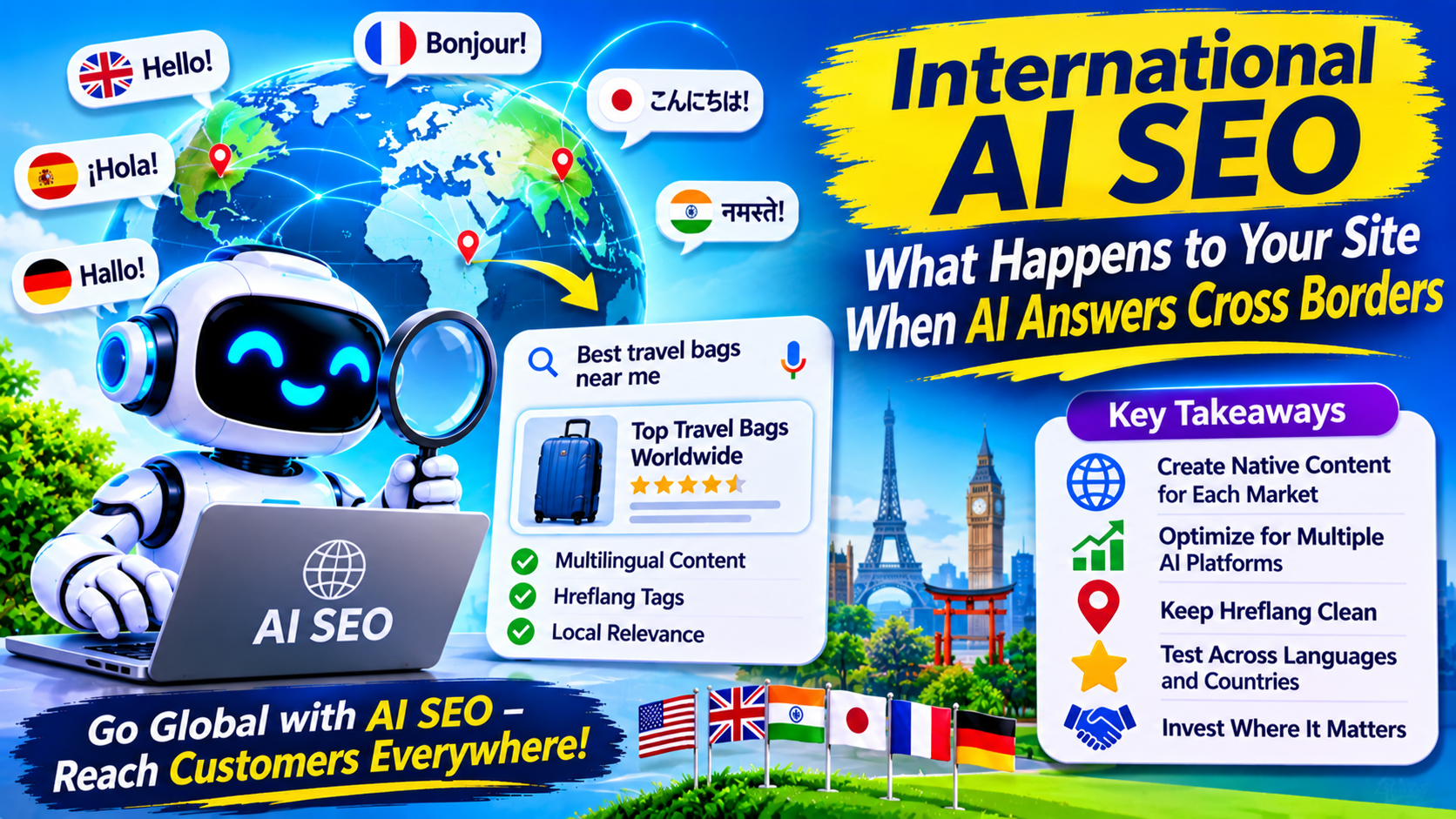
Traditional international AI SEO had a clear model: one URL per language or country, hreflang tags to connect them, and a search engine that routed each searcher to the right version. AI answers don’t work that way. They assemble a response, and your carefully labeled page may or may not be part of it.
This guide explains what is known, what isn’t, and how to test your own markets.
AI Search Is Now Truly Global
Google’s expansion has been fast. One report says that after AI Mode launched, Google announced availability in more than 35 new languages and over 40 new countries and territories, bringing AI Mode to more than 200 countries and territories in total. Languages added included Hindi, Indonesian, Japanese, Korean, and Brazilian Portuguese.
Numbers for AI Overviews vary by source, from over 40 countries to 120+ countries with support for 40+ languages to 200+ countries and territories. The figures reflect different dates and counting methods, so check Google’s own availability lists for your target markets before planning around any of them. International SEO Meets GEO: Ranking in AI Overviews Across 40+ Languages +2
Availability also doesn’t mean uniform behavior. One analysis notes that availability doesn’t guarantee consistent appearance across query types, and that English-language queries generally show the most sophisticated AI Overview responses.
The Honest Gap: No One Documents Language Targeting
Here is something many guides skip. A review of vendor documentation concluded that as of October 2026, no AI vendor documents a way for a site owner to target a language or country in AI answers, and Google publishes only lists of where the features are available. The same review found that Google’s spam policies contain no standalone rule about machine translation.
In plain terms, nobody has published rules for how AI answers pick between your English page and your Spanish page. Anyone promising a proven formula is guessing, and this article treats the topic the same way: patterns observed, not guarantees.
What One Multilingual Test Showed
Glenn Gabe tested how major AI tools handle multilingual content, using documentation from Google and Cloudflare. As reported by Stan Ventures, the results were uneven:
- AI Overviews didn’t appear for the query.
- AI Mode surfaced both Spanish and English URLs, and so did ChatGPT.
- Perplexity and Claude returned the English page.
It is a small test, not a benchmark. Still, it shows the key point: the same multilingual setup can behave differently across assistants. The report’s practical advice was to search for your content across different countries and languages and compare results in multiple AI tools.
Does Hreflang Still Matter?
Yes, with limits. Sources disagree on how far its value extends, so here is the balanced picture.
For classic search, it still helps. One source says Google and Bing generally show the correct language version when hreflang is in place, and that AI Overviews and AI Mode often get it right, but not always. Remember that Google treats hreflang as a hint, so other signals must agree with it. tests reveal gaps in how ai tools handle multilingual queries 6034.md +2
For AI answers, it is not enough. One analysis argues that hreflang is less relevant for AI Overviews and generative engines, because these systems synthesize answers across languages rather than routing users to specific URLs. Search Engine Land adds a warning: a market-specific page can be indexed, valid, and hreflang-correct and still never appear in AI Overviews or AI Mode.
The sensible position is to keep hreflang clean for traditional search and not expect it to deliver AI visibility on its own.
The Sarkar SEO Language-Matrix Test
At Sarkar SEO, we suggest replacing assumptions with a simple grid. You can build it in an afternoon.
- Choose three to five priority markets and the main language of each.
- Write five buyer questions in each language, using native phrasing rather than translated keywords.
- Run each question in AI Mode, ChatGPT, and Perplexity, ideally from a browser set to that country.
- Record three things: whether you appear, which language version is cited, and which competitors dominate.
- Look for patterns, such as an English page being cited for non-English questions, or no citation at all.
The pattern tells you where to invest. If AI tools keep citing your English page for German queries, your German content may be too thin to compete.
Practical Priorities for Global Sites
Write for each market, don’t just translate. Google’s own messaging for AI Mode draws a sharp line between multilingual content and translated content. Another source advises to create native-language content rather than relying on translation, and research keywords in target languages directly. A three-step process of professional translation, cultural review by local marketers, and an SEO technical audit is a sound baseline. Google’s AI Mode Expansion Puts Multilingual Search Into Faster Motion +2
Make each version genuinely different. Market-specific pages should reflect local prices, regulations, examples, units, and support details. Search Engine Land lists market-scoped URLs with real differences as a fundamental that still wins.
Be clear about who you are in each market. Keep your brand name, address, and entity details consistent across languages, so machines connect your versions to one business.
Prioritize by opportunity. One guide suggests investing in native-speaker content for the biggest language tiers and evaluating whether AI Overview opportunity justifies the investment for smaller ones. Don’t translate everything at once.
Mind speed and delivery. Slow pages in far-away regions hurt crawling and user experience. A content delivery network is often a worthwhile fix.
Mistakes to Avoid
- Machine-translating hundreds of pages. Thin translations risk being treated as low-value content under existing quality policies.
- Trusting hreflang as a complete strategy. It organizes traffic, but it doesn’t earn citations.
- Ignoring local review and community sites. Off-site reputation often differs by country.
- Testing only in English. Results in your largest market tell you little about the others.
- Citing unverified statistics. Large visibility-lift claims for translated sites circulate widely, but I could not trace them to a primary study, so I have left them out.
