



Suggested meta description: AI SEO explained through Google’s own guidance. Learn what to focus on, which popular tactics Google says are unnecessary, and how to measure visibility when clicks are falling.
Search has become a conversation, and your page may be quoted in an answer rather than clicked in a list. That is the real meaning of AI SEO, and most advice about it is louder than it is accurate. Here is what the evidence supports.
What AI SEO Actually Means
AI SEO is the work of making your content findable, trustworthy and useful inside AI-generated search experiences: Google’s AI Overviews and AI Mode, plus assistants such as ChatGPT, Perplexity, Gemini and Claude. You will also see it called GEO (generative engine optimization) or AEO (answer engine optimization).
The labels matter less than one fact. Google’s May 2026 guide for site owners says that, from Search’s perspective, optimizing for generative AI search is optimizing for the search experience, and so is still SEO. The same report notes that Google’s AI features are rooted in core ranking and quality systems, using retrieval-augmented generation and query fan-out to pull from the Search index. In plain terms, the AI answer is built from pages Google has already indexed and judged. searchenginejournalsearchenginejournal
That doesn’t settle how ChatGPT or Perplexity weigh signals, and those platforms may differ. But the foundation is the same everywhere: a page nobody can crawl, trust or understand won’t be cited anywhere.
Why Visibility Now Matters More Than Rank
A top ranking no longer guarantees a visit. Pew Research found users click a result 8% of the time when an AI Overview appears, versus 15% without one. A randomized field study reported by Search Engine Journal went further, finding that AI Overviews reduced outbound organic clicks by 38% on triggered queries.
Treat these numbers with care. Different studies use different methods, and click-through estimates vary widely. Some reports find declines of 30% to 60%, depending on query type. Still, the direction is consistent, and informational queries are hit hardest. The practical lesson is that you should aim to be the source the answer draws from, not just a blue link beneath it. Clicks that do arrive from AI features may also be more valuable. Google states that clicks from results pages with AI Overviews are higher quality, with users more likely to spend more time on the site.
Tactics Google Says You Can Ignore
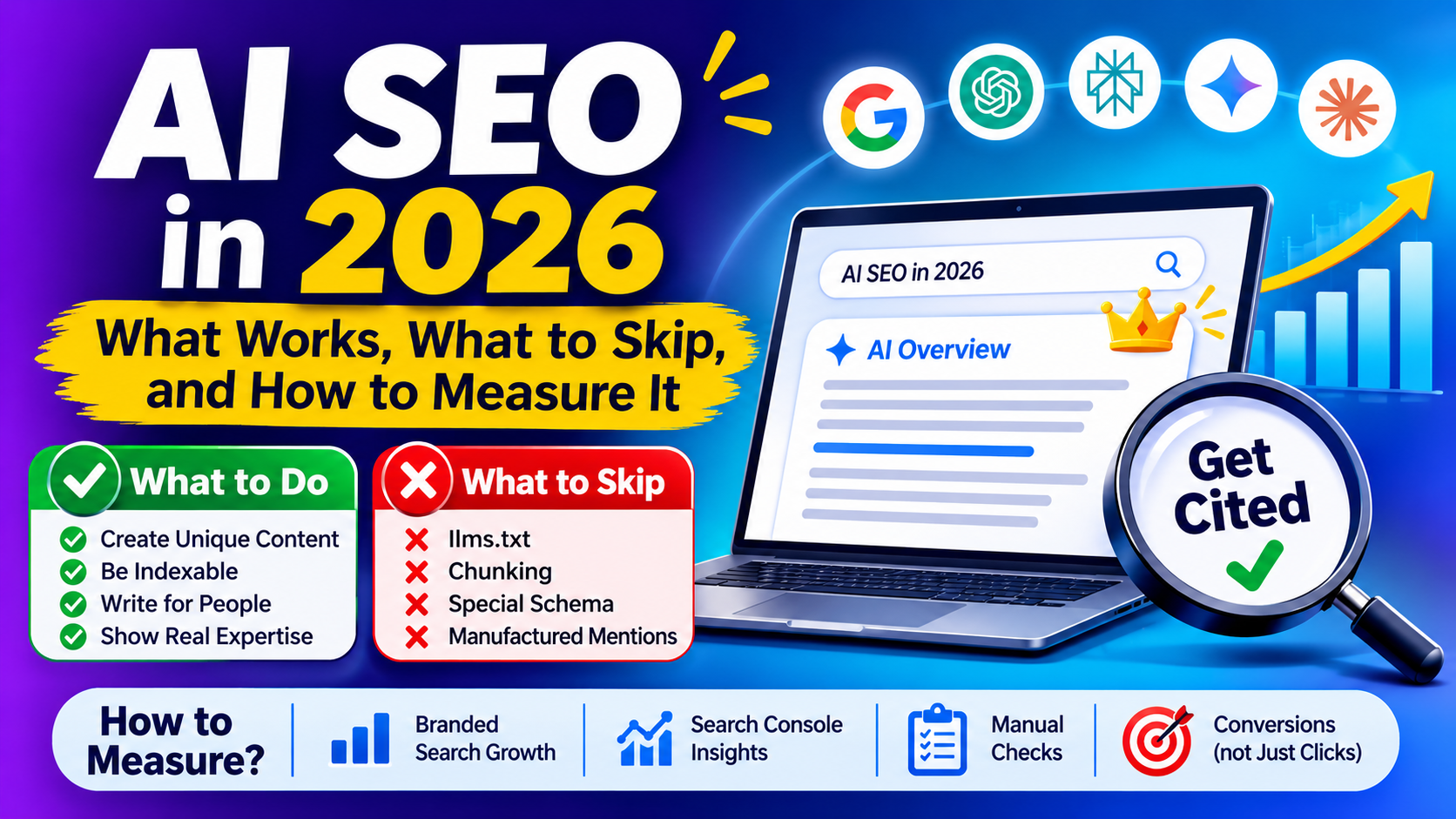
Much AI SEO advice is built on tricks. Google’s guide addresses several directly. According to Search Engine Journal’s summary of the guide, you do not need:
- llms.txt or other special files. Google says no machine-readable or AI-specific files are required, and indexing a file type doesn’t mean it gets special treatment.
- Chunking. There is no requirement to split content into tiny pieces, because Google’s systems can understand several topics on one page and surface the relevant part.
- Rewriting for AI. The systems understand synonyms and meaning, so you needn’t chase every long-tail variation.
- Special schema. Structured data isn’t required for generative AI search, and no special schema.org markup exists for it, though it remains useful for rich results.
- Manufactured mentions. Seeking inauthentic mentions across the web isn’t as helpful as it might seem, because quality systems and spam defenses are built to catch it.
If a vendor sells these as the secret to AI visibility, ask for proof. Google’s own documentation says otherwise for its search features.
What to Do Instead
Publish non-commodity content. Google’s guide separates generic content, like a list of common tips, from content that carries unique insight, such as a first-person account of a specific decision and its outcome. Anyone can produce the first kind, and AI can summarize it without your help. The second kind gives a system a reason to cite you. Original data, real case notes, clear opinions and named expertise all qualify, but only if they are real.
Protect eligibility. The guide names one technical gate: a page must be indexed and eligible to be shown in Google Search with a snippet. Check that robots.txt, your CDN and hosting aren’t blocking crawlers, that important text isn’t locked in images, and that internal links make key pages easy to reach. Also check that no snippet-limiting controls are suppressing pages you want quoted.
Write for people first. Clear headings, direct answers under question-style subheads and logical sections help readers, and machines benefit as a side effect. Don’t contort a page around an imagined algorithm.
Cover the business side. Local businesses should keep Business Profiles accurate, and sellers should keep Merchant Center feeds clean. Google also now offers early guidance on AI agents that browse and transact for users. It labels this as worth exploring if relevant and time allows, so treat it as a watch item rather than an emergency.
How to Measure Progress
Google says traffic from AI features is counted within your overall Search performance reporting, so there is no separate AI Overview report to rely on. That makes a few indirect signals more useful:
- Branded search growth. If people hear about you in an AI answer, some will search your name later.
- Query-level changes in Search Console. Watch impressions and clicks on informational queries separately from commercial ones.
- Manual answer checks. Run your target questions through several assistants monthly, record whether you’re cited, and note which competitors appear.
- Conversions, not sessions. With fewer but better clicks, leads and sales are a truer scorecard than raw visits.
At Sarkar SEO, we think this last point is where most teams go wrong. They celebrate traffic charts while the pipeline stays flat.
A Practical 30-Day Plan
Week one: Audit your ten highest-value pages. Mark each as commodity or non-commodity, and confirm each is indexed and snippet-eligible.
Week two: Rewrite the weakest pages around something only you can offer, such as your data, process or documented results. Remove padding.
Week three: Fix crawl and page-experience issues, and tidy internal links so important pages are easy to find.
Week four: Set a baseline. Record branded search volume, citation checks across assistants and conversion rate, then review them monthly. Sarkar SEO treats this baseline as the starting point for any AI SEO engagement, because without one you can’t tell whether changes worked.
