



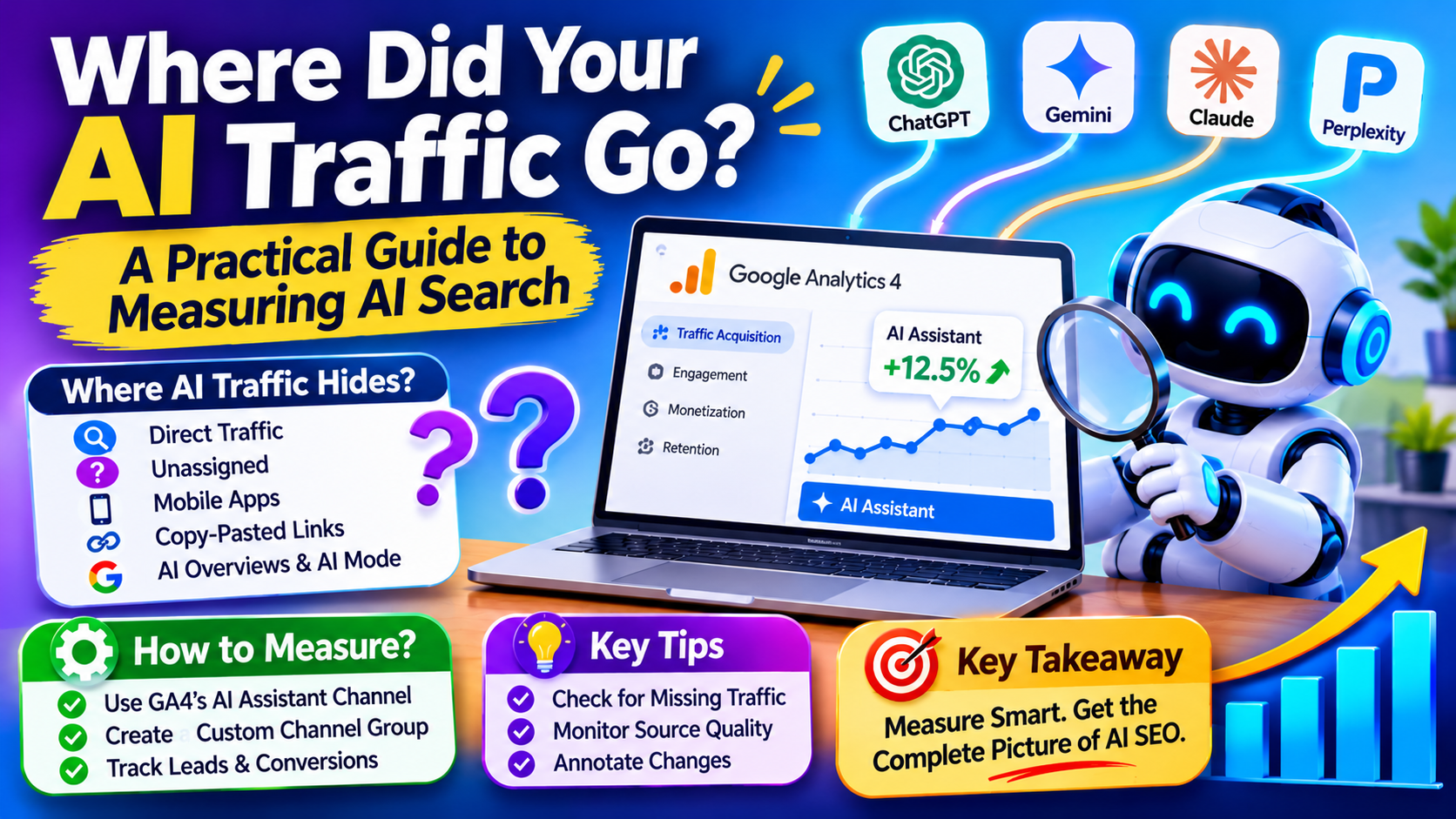
Many site owners open their analytics and see the same puzzle: they are being cited by AI assistants, customers mention ChatGPT on sales calls, and yet the reports show almost nothing. The visits are probably there. They are just filed in the wrong place. Measurement is the least glamorous part of AI SEO, but without it you can’t tell what’s working. Here is how to see more of what AI search actually sends you.
What Google Analytics Changed in May 2026
For a long time, GA4 had no category for AI assistants. Visits from chatbots landed in the general Referral bucket alongside forum links and random directories. That changed when Google added a native channel: GA4 now sorts visits from AI assistants into their own channel, named AI Assistant, added on May 13, 2026, with nothing for you to set up. Sessions that match also receive an automatic medium and campaign label, so they are easy to filter.
Two caveats matter. Historical data is not reclassified, so anything recorded as Referral before the change stays there. And the rule depends entirely on a referrer being present and being on Google’s list, which Google doesn’t publish. Coverage of individual assistants varies between reports, so check which of your actual sources land in the new channel instead of assuming.
Where the Rest of Your AI Traffic Hides
A visit only counts as AI traffic if the browser tells GA4 where it came from. Often it doesn’t. One analysis summarizes the problem: most chatbots either send no referrer at all or use inconsistent hostnames, so a large share of AI-driven traffic shows up in GA4 as Direct. The same source suggests treating whatever you can identify as a floor, not a full count.
Other common hiding places:
- Unassigned. Some ChatGPT links carry a source tag but no medium. One guide notes that when a link has utm_source but no utm_medium, GA4 may route the traffic to Unassigned. discoveredlabs
- Mobile apps. One guide reports ChatGPT’s mobile app traffic arrives as Direct because no referrer is passed, while desktop clicks are easier to trace.
- Copy-pasted links. A person who copies a URL out of an answer and pastes it into a new tab leaves no trail.
- Platform quirks. One blog reports ChatGPT referral tagging broke for about a week in October 2026, with clicks landing in Direct. I found this in a single source, so treat it as unconfirmed, but it illustrates why sudden dips deserve investigation before you panic.
Google’s Own AI Features Are a Separate Problem
Visits from AI Overviews and AI Mode don’t appear under the new channel. One guide lists AI Overviews traffic as arriving under Organic Search with no separation. Google’s documentation says that sites appearing in these features are included in the overall search traffic reported in Search Console. So for Google, watch impressions, clicks and conversions at the query and page level, and don’t expect a dedicated line item.
A Three-Layer Measurement Setup
A single report won’t capture all of this. Combine three layers.
Layer one: the default channel. Open Traffic Acquisition, scope the date range from mid-May 2026, and look for the AI Assistant row. This is your baseline.
Layer two: a custom channel group. Many practitioners recommend building one that matches known assistant domains, because it can catch sources the default list misses. Order matters. As Google’s own channel documentation puts it, traffic is included in the first channel whose definition it matches given the current order of channels in the group. Place your AI rule above Referral, or it will never fire. Sarkar SEO suggests keeping the custom group running alongside the native one for a few months, so you can compare the two and see the gap.
Layer three: signals analytics can’t see. Add a “How did you hear about us?” field to your contact and checkout forms, with options like “AI assistant” and an open text box. Review pages where direct traffic spikes right after you were cited. And pass the source into your CRM so it survives all the way to the sale. One practitioner guide recommends pairing a custom channel group with UTM parameters and a hidden form field for this reason. Self-reported answers are imperfect, but they catch what stripped referrers miss.
Read the Numbers Honestly
A few habits keep you from fooling yourself.
- Call it a minimum. Reported AI traffic is what you could attribute, not what happened.
- Don’t compare it directly with Organic Search. The tracking is far less complete, so the two aren’t measured on equal terms.
- Judge quality, not just volume. Compare engagement, enquiries and revenue per visit against your other channels. AI visits may be small but valuable. They may also be curious browsers. Your own data will tell you, and borrowed benchmarks won’t.
- Watch for definition changes. Google can update which referrers qualify, which can make a trend line jump without any real change in behavior. Annotate your reports when channel rules change.
Common Mistakes
Teams often delete their old custom channel group the day the native one appears. They treat a flat AI line as proof that AI search doesn’t matter. They tag links they don’t control, which does nothing. And they forget to measure leads, stopping at sessions. A session is not a result.
What to Do This Week
- Check whether the AI Assistant channel appears in your reports.
- Build a custom channel group above Referral and compare it with the default.
- Add a self-reported attribution question to your main forms.
- Pick five pages you know get cited, and log their direct and referral traffic weekly.
- Record the date of each analytics change so trends stay interpretable.
Sarkar SEO can help set this up properly if you’d like, including the channel rules and the CRM mapping. Good measurement won’t win you a single citation, but it will show you which of your efforts deserve more of your time.
