



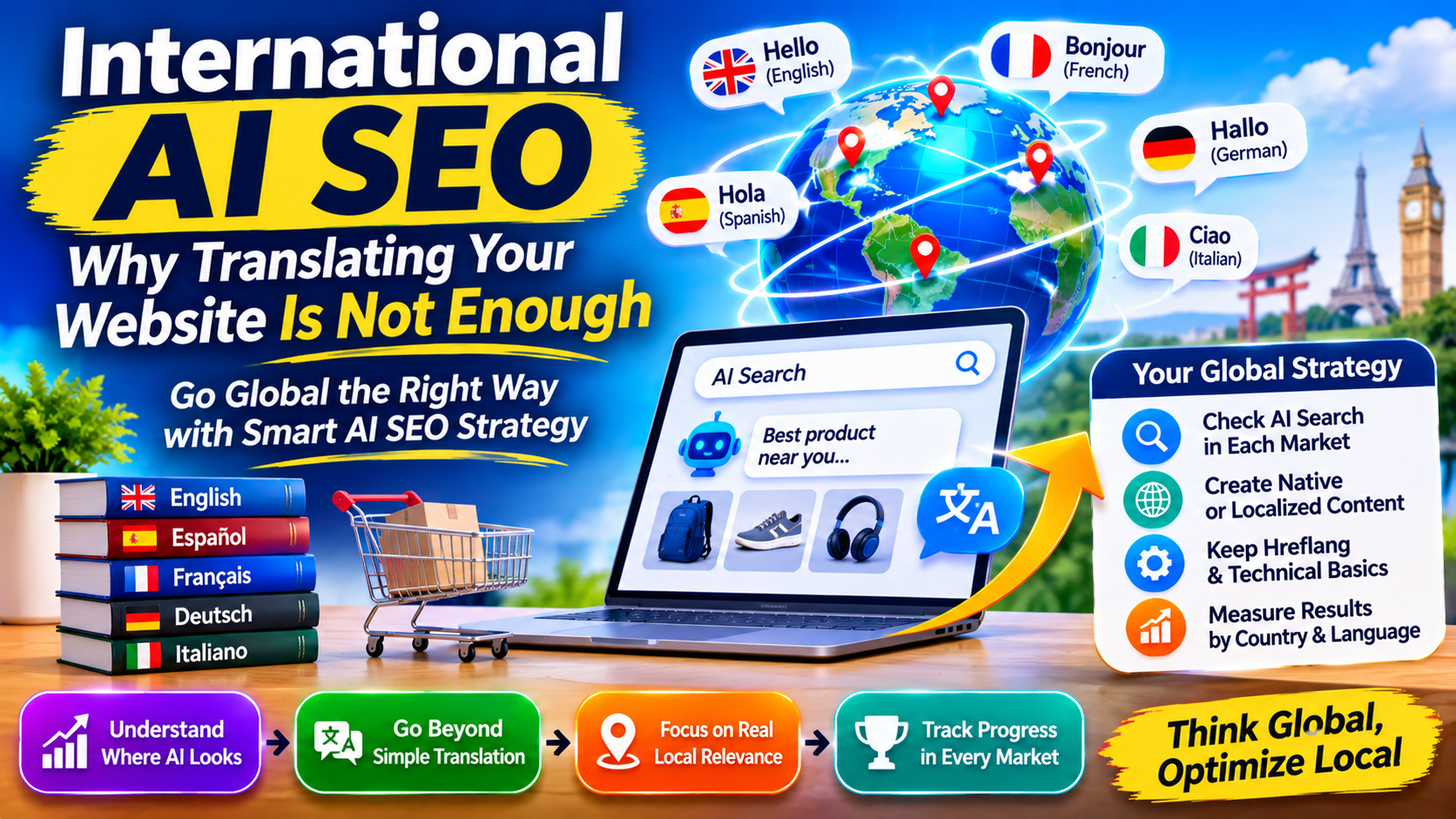
If your audience spans several countries, AI SEO search has changed the maths of going global. AI features are arriving in new languages faster than earlier Google features did, and they decide which pages to quote without asking you which language version you prefer. Many teams respond by running their English site through a translation tool and hoping for the best. The evidence suggests that is a weak plan. Here is what is known, what is still unclear, and how to decide where to invest.
AI Search Is Spreading Fast
Google has been widening AI Mode’s reach quickly. It announced AI Mode launching in more than 35 new languages and over 40 new countries and territories. A later report put the total at more than 200 countries and territories. Regional expansions have followed, including a July 2026 report on 13 African languages, among them Yorùbá, Hausa, Kiswahili, isiZulu, Afrikaans and Wolof.
Google’s Liz Reid explained the speed in an interview reported by Search Engine Journal: earlier features sometimes took months or even years to reach all countries and languages, but AI Mode’s multilingual models shortened that process. The same report adds that Google has not published a country-by-country timeline. searchenginejournal
The takeaway for site owners is that the gap between “AI search isn’t in my market yet” and “it is” may be short. Markets that were quiet last year can change quickly.
What Nobody Has Documented
Here is the uncomfortable part. A review published by eSEOspace states that as of October 2026 it found no AI vendor documentation of a way for a site owner to target a language or a country in AI answers. Google publishes lists of where its AI features are available, but I’m not aware of official instructions on how these features choose between language versions of a page. That absence matters. Anyone promising a guaranteed method for steering AI answers by region is going beyond the public evidence.
What Limited Testing Shows
One published experiment gives a flavor of the unpredictability. The tester asked multilingual questions across several platforms using documentation available in both Spanish and English. According to the write-up, AI Overviews didn’t appear for the query, AI Mode surfaced both Spanish and English URLs, and Perplexity and Claude returned the English page. Treat this as a single test, not a rule, because results will vary by query, date and market. Still, it shows that an answer in one language can link to a source in another.
A separate industry claim says a significant share of citations in non-English AI Overviews come from English-language sources. It is unquantified in the version I found, so I wouldn’t quote it as a statistic. It does suggest a possible opportunity: where local-language content is thin, a strong local page may face less competition.
The Hreflang Debate
Hreflang tags tell search engines which language or regional version to show. Opinions differ on whether they still matter for AI answers. One guide argues that generative systems synthesize answers across languages rather than routing users to specific URLs, so hreflang matters less for them. Another says correct implementation helps Google understand geographic relevance and avoid showing the wrong regional content in AI Overviews. These claims conflict, and I found no primary evidence settling it.
The safe position: keep hreflang correct, because it still organizes traditional search, but don’t expect it to control AI citations. Judge by what you observe in your own markets.
A Three-Question Market Test
Here is a method I’d suggest, which is my own framework rather than an industry standard. Run it for each target market before spending money.
- Is there demand? Check whether people in that market search for your topic, and whether you can serve them legally and practically.
- Does AI answer in that language? Ask ten real customer questions in the local language across Google’s AI features, ChatGPT and Perplexity. Note whether answers appear and what language they use.
- Whom does it cite? Record every source. Are they local sites, global English pages, forums or directories?
Then choose a path. If AI answers are rich and cite local sources, invest in native content. If answers exist but cite English pages, a high-quality adaptation may win. If AI answers barely appear, hold back and rely on conventional SEO.
Sarkar SEO uses this kind of market-by-market triage as a starting point, because blanket translation wastes budget in markets where AI answers haven’t matured and underinvests where they have.
Translation Versus Real Localization
Techwyse’s analysis draws a sharp line between multilingual content and merely translated content, and the distinction fits Google’s broader warning about commodity pages. A literal translation carries the original’s gaps and adds new problems:
- Examples that don’t travel. Prices, laws, units, holidays and customer habits differ by country.
- Search language mismatch. People rarely use the keywords a translator would choose.
- Stale versions. One guide warns that sites updating English content while neglecting other languages lose AI citation chances, and recommends a review schedule for each language.
- Missing proof. Local reviews, case studies and regulations are what make a page trustworthy to a local reader.
A workable model is professional translation, followed by review from a local marketer, then a technical audit. Machine translation can speed the first draft, but a native reviewer should check every page you intend to rank, in line with Google’s advice on fact-checking AI output.
Technical Basics That Still Apply
Make sure each language version is crawlable, indexable and linked from a clear structure. Use distinct URLs per language rather than serving translations dynamically in ways crawlers can’t see. Keep company details, product names and policies consistent across versions. And remember that different markets favor different AI products, so check which assistants your customers actually use.
How to Measure Progress
Repeat your ten-question test per market every quarter. Track branded searches in each language, enquiries by country and whether AI answers describe your business correctly. Sarkar SEO suggests adding a country and language field to lead forms, so you can see which markets convert rather than which merely get traffic.
