



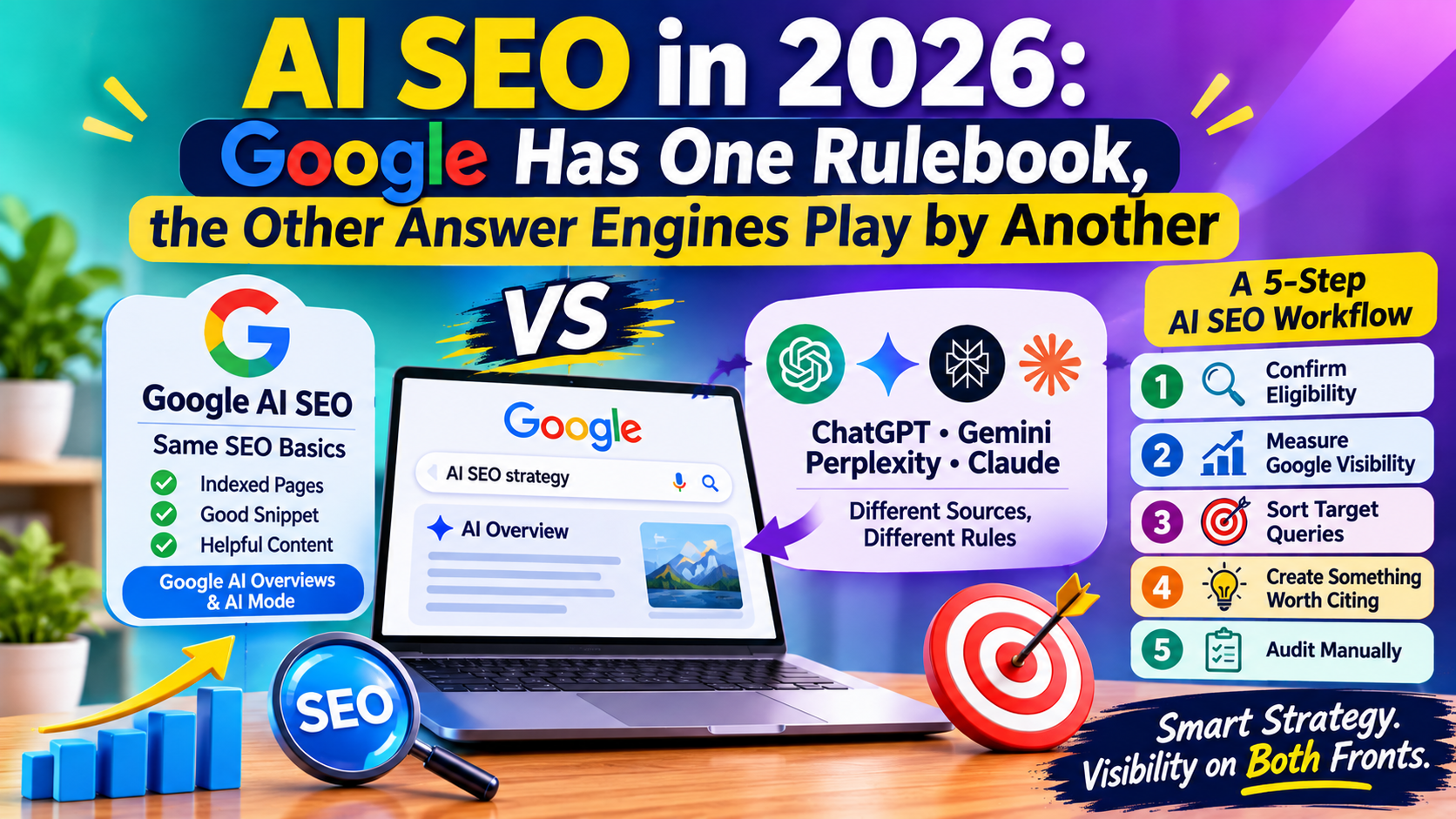
AI SEO is the work of making your content eligible to be found, understood and cited by AI-driven search. That includes Google’s AI SEO Overviews and AI Mode, ChatGPT, Perplexity, Gemini and Claude. Most advice treats these systems as one channel. The evidence points the other way. Google says its AI features run on its ordinary Search systems, while the standalone assistants appear to draw on a very different set of sources. A sound strategy handles both.
What Google says AI SEO requires
In May 2026 Google published its first official guide to generative AI search, titled “Optimizing your website for generative AI features on Google Search.” Its central message is that AI Overviews and AI Mode are rooted in Google’s core ranking and quality systems, so optimizing for them is, in Google’s framing, still SEO. The features use retrieval-augmented generation and query fan-out, which means splitting a question into related sub-searches, to pull content from the Search index.
Eligibility is plain: a page must be indexed and allowed to show a snippet. Google’s mythbusting section also calls several popular tactics unnecessary for its features. These include llms.txt files, splitting content into small “chunks,” rewriting pages specifically for AI, and adding special schema.
For Google, then, put your effort into crawlability, snippet settings and original, non-commodity content. AI-only formatting tricks don’t help.
Why that advice does not carry over to the assistants
Google’s guidance covers Google Search only. Independent research suggests the assistants behave differently. A University of Toronto study, presented at the EDBT/ICDT 2026 workshops, compared the domains cited by AI systems with Google’s top ten results. It used 1,000 ranking-style consumer queries. Average domain overlap with Google was 4.0% for GPT-4o, 11.1% for Gemini 2.5 Flash, 12.6% for Claude 4.5 Sonnet and 15.2% for Perplexity Sonar Pro. For GPT-4o, more than half of the queries had no overlap at all.
Two cautions apply. The queries were consumer “best of” questions, and the models were 2025 versions, so results in your niche may differ. Still, the direction is clear: ranking on page one does not reliably get you cited by an assistant.
The last column is our interpretation, not a finding of the paper. It still changes priorities. A brand that only publishes blog posts can be invisible on comparison queries, because independent reviewers are the ones doing the talking.
Freshness shows up in the data
The same paper measured the age of cited pages. In consumer electronics, the median cited page was 62.3 days old for Claude, 79.8 for GPT-4o and 90.4 for Perplexity, against 130.4 for Google. In automotive, the AI engines ranged from 148 to 217 days, versus 493 for Google. Publication dates could be extracted for only 43% to 93% of URLs depending on the engine and vertical, so treat these figures as indicators rather than proof.
The takeaway is to update pages when facts actually change and show the revision date. Never alter dates cosmetically.
A five-step AI SEO workflow
- Confirm eligibility. Check indexation, robots rules and snippet directives on the pages you want cited. Snippet restrictions can limit how your content appears.
- Measure Google visibility. Search Console now offers dedicated Generative AI performance reports covering impressions, pages, countries, devices and dates.
- Sort target queries by intent. Use the table above to give each query one job: own the answer, earn independent mentions, or perfect the product page.
- Create something worth citing. Original data, expert commentary and clear definitions give publishers and assistants a reason to reference you. Sarkar SEO’s view is that one genuinely new data point does more than ten reworded explainers.
- Audit manually. Each month, ask the same set of questions in each assistant and record the cited domains. Answers vary between runs, so look for patterns, not single results.
What to avoid
No one can promise citations. Be wary of any vendor guaranteeing placement in ChatGPT or Perplexity, because retrieval systems differ and change without notice. Don’t invent statistics or manufacture brand mentions. Google lists inauthentic brand mentions among the tactics site owners should ignore, and fabricated evidence erodes the trust every answer engine depends on.
Write for people first. Put a clear answer high on the page, define terms before using them, and attribute facts to their sources. These habits help readers, and they also make passages easier for any system to quote accurately.
