



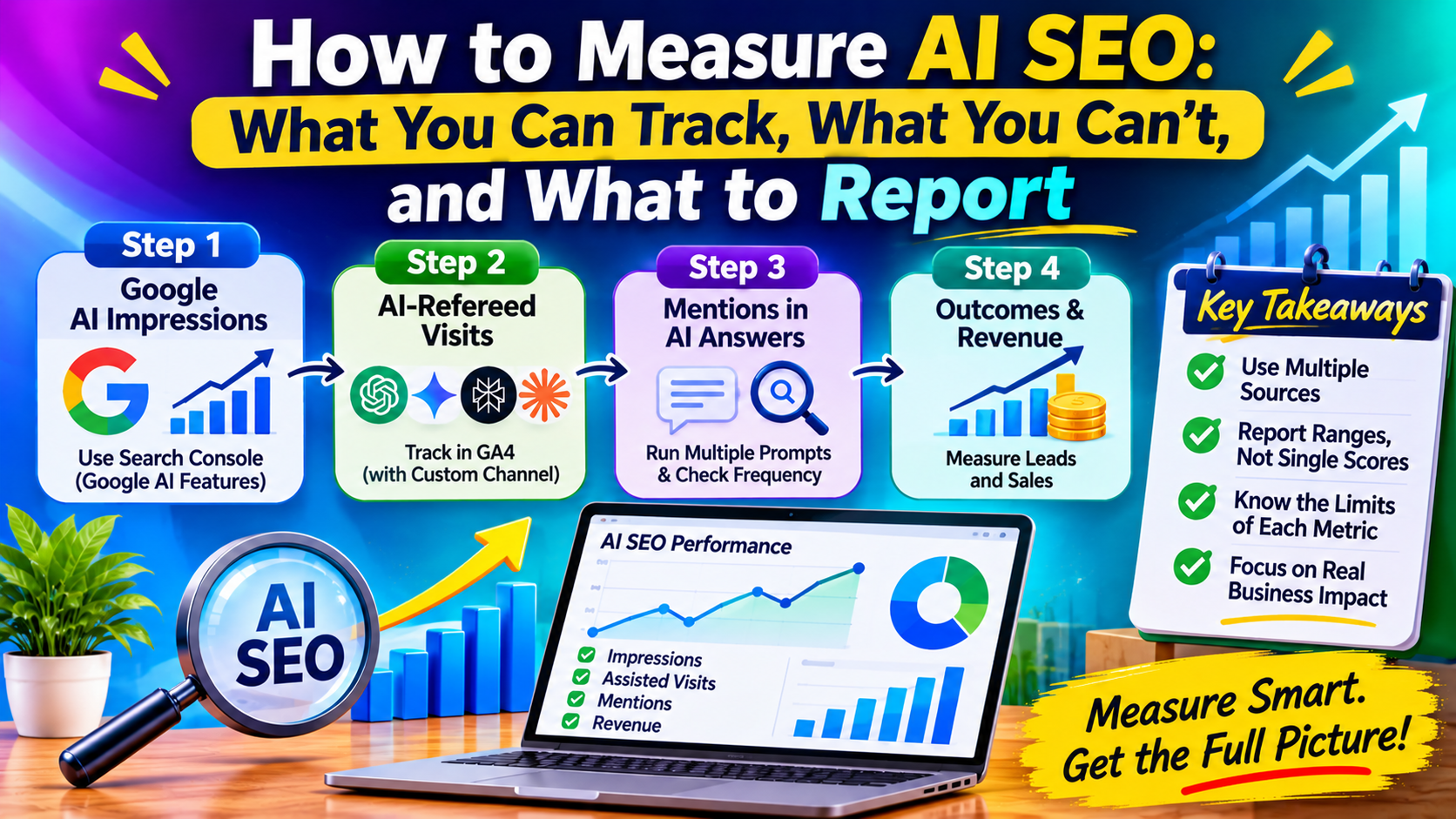
AI SEO can be measured in four steps, but only some of them have reliable tools. You can count your appearances in Google’s AI features, your visits from assistants, how often AI SEO answers mention you, and the revenue that follows. The common mistake is reporting all four with equal confidence. This guide shows what each step can and cannot tell you, so your numbers hold up in front of a skeptical reader.
Step one: appearances in Google
Google added generative AI performance reports to Search Console. Early data begins in May 2026, and the reports reached all sites worldwide on August 31. The data was already part of your overall Performance totals, and the new view breaks it out.
Two limits matter. The report groups AI Overviews and AI Mode together, so you cannot separate them. It also centers on impressions and has no click metric. Do not add these impressions to your Performance totals, because they are already inside them.
Treat this report as exposure, not traffic. Rising AI impressions with flat clicks could mean your pages are cited but not clicked, or simply that AI features expanded to more queries. The report alone cannot tell you which.
Step two: visits from assistants
GA4 can see part of this. Clicks from the web versions of ChatGPT, Perplexity and Claude generally arrive with the assistant’s domain as the referrer. But visits from mobile apps or copied links often land in Direct. One practitioner guide describes Claude’s referrer handling as inconsistent.
Google’s own AI features are a separate trap. Google’s default channel definitions place AI Overviews and AI Mode inside Organic Search, not in the AI Assistant channel.
Three practical steps follow.
- Build a custom channel group. Match chatgpt.com, perplexity.ai, claude.ai, gemini.google.com and copilot.microsoft.com.
- Call the result a floor. It is the minimum, not the total.
- Add a “How did you hear about us?” field to your forms. This is my suggestion, not a platform feature, but it catches visits analytics miss.
Step three: mentions in AI answers
This is the shakiest step, and the research explains why. A SparkToro and Gumshoe study from January 2026 ran each prompt 60 to 100 times per engine. Fewer than 1 in 100 repeat runs returned the same set of brands, and fewer than 1 in 1,000 returned the same order. Presence was steadier: leading headphone brands appeared in 55% to 77% of 994 responses. The study is not peer reviewed, and its authors disclose a commercial interest in AI tracking. A separate test of 12 B2B prompts, each run 100 times in logged-out ChatGPT, saw an average of 44 different brands per prompt.
Three lessons follow.
- Report frequency, not rank. “Mentioned in 40% of runs” is defensible. “Ranked third” is not.
- Know how your tool collects data. API-based collection can query a different model than consumers use, without web search or personalization. Results from APIs, logged-out accounts and logged-in accounts can differ significantly, so check a sample by hand while logged in.
- Sample enough, but test the cost. One vendor test found that a single daily run per prompt and platform gave the same pooled ten-day signal as ten runs. That is one test, not a rule.
Write your prompts from real customer language, such as sales calls, support tickets and search queries, not from your own service names. Sarkar SEO recommends reporting mention frequency as a range with its sample size, never as a single score.
Step four: outcomes, sized honestly
Published figures disagree. Studies put AI referrals between roughly 0.1% and 1.08% of website traffic. On conversion, Similarweb reported 11.4% for AI referrals against 5.3% for organic, while an earlier study from late 2024 found ChatGPT referrals converting worse than Google search. Ahrefs reported that 0.5% of its own traffic from AI sources produced 12.1% of its signups, which is one company, not a benchmark.
Don’t borrow someone else’s multiplier. Tag AI-referred sessions, pass them to your CRM, and compare lead quality and revenue against your own organic traffic. Match the time window to your sales cycle, since B2B leads may close months after the visit. Small volume with strong conversion can happen, but only your data can say whether it applies to you.
A one-page monthly report
- Google AI impressions: the trend from Search Console.
- AI-referred visits: labeled as a floor, plus self-reported discovery.
- Mention frequency: by engine, as a range with sample size.
- Leads and revenue: from tagged sessions.
Add a “known gaps” line stating what each number cannot see. Leave out single-run rankings, any visibility score without a method note, and Google AI clicks that were never separated from Organic Search. Sarkar SEO builds reports around this structure because it shows leadership what is counted and what is estimated.
Measure what you can defend
AI SEO measurement is less precise than classic rank tracking, but it is not guesswork. Use Search Console for exposure, GA4 and self-reporting for visits, repeated sampling for mentions, and your CRM for outcomes. If you want help setting up channel groups, prompt sampling and a monthly report, Sarkar SEO can build the framework for any market.
