



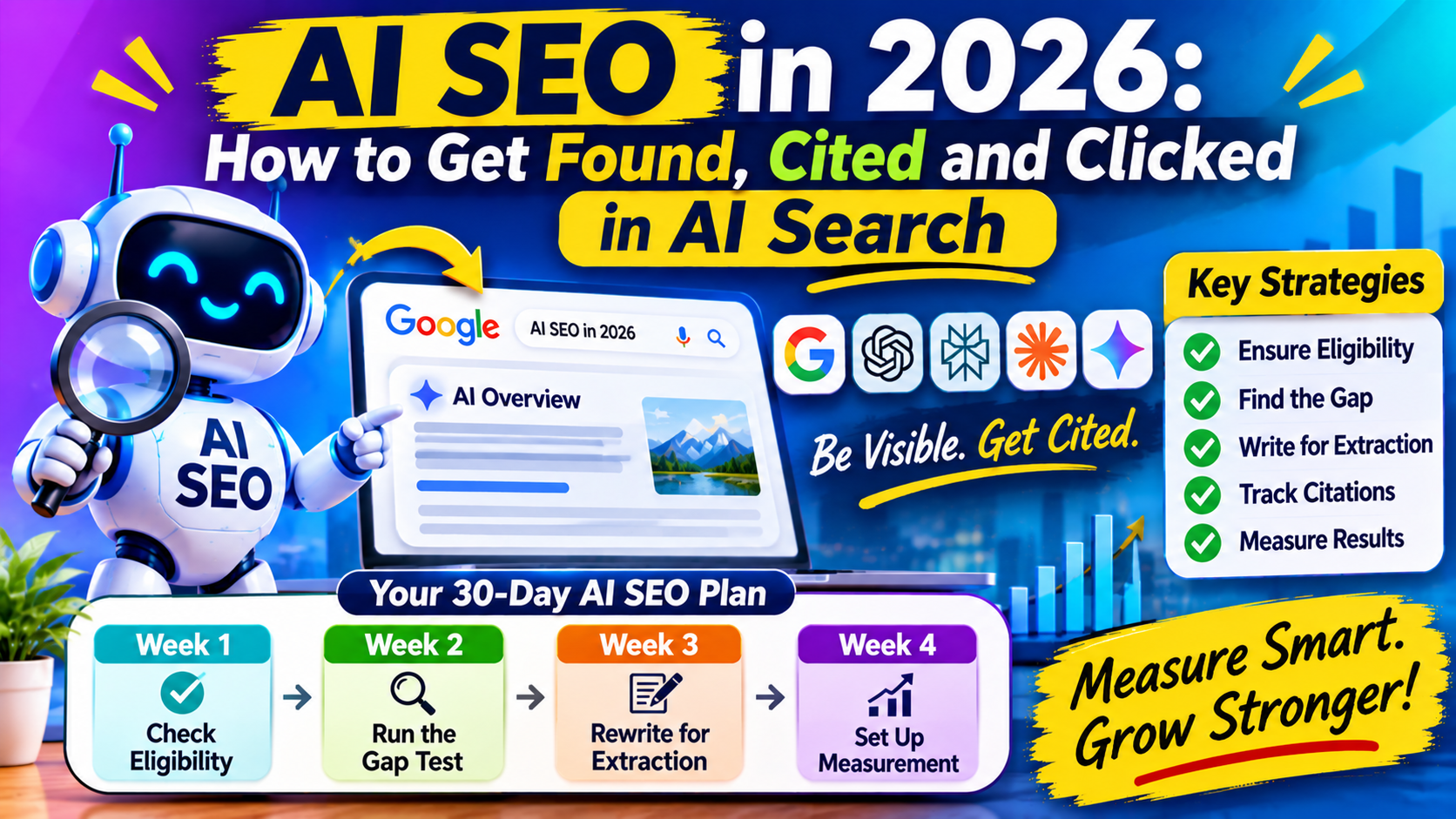
AI SEO is the practice of making your pages easy for search engines and AI answer tools to find, understand and cite. In 2026 it still rests on classic SEO foundations: crawlable, indexed, original content. What changes is how you structure answers, how you judge visibility and which numbers you trust.
At Sarkar SEO, we treat AI SEO as an upgrade to good SEO, not a replacement for it, and the current evidence backs that view.
Is AI SEO different from traditional SEO?
For Google, mostly no. On May 15, 2026, Google published its first dedicated guidance on optimizing for generative AI features in Search. Its central point is that AI Overviews and AI Mode are rooted in the same core ranking and quality systems as regular Search. There is no separate AI index. A page needs to be indexed and eligible to appear with a snippet, and that is the technical requirement.
The guide is equally useful for what it lets you skip. As reported by trade publications, there is no special schema for AI Overviews, and no need to break articles into artificial chunks for Google. What it asks for instead is unique, non-commodity content with a first-hand point of view.
One caution matters here. That guidance covers Google Search only. ChatGPT, Perplexity, Copilot and Claude run their own retrieval systems, and their inner workings are not public. Treat any claim about universal “AI ranking factors” with suspicion.
Why ranking first no longer guarantees a citation
Ahrefs data from March 2026, as reported by industry analysts, found that only 38% of pages cited in AI Overviews ranked in the top 10 for the same query. Other studies report different overlap figures, and methodology explains much of the gap, so treat any single percentage as a snapshot rather than a law.
The likely mechanism is query fan-out. AI Overviews and AI Mode can split one question into several background searches and combine what they find. A page ranking twelfth for a narrow sub-question can be cited, while a generic page ranking first for the broad keyword is passed over.
Sub-question coverage now matters almost as much as your head-keyword position.
The gap test: a simple way to create information gain
Before publishing or refreshing a page, search your target question and open the sources being cited. Then ask one thing: what does my page contain that these do not?
If the answer is nothing, rewording will not change who gets cited. Real gains usually come from:
- Original data or documented results from your own work
- First-hand experience that a generic article cannot imitate
- A narrower sub-question answered more precisely
- A format competitors lack, such as a comparison table or worked example
Write passages that survive extraction
AI systems lift passages, not whole pages, so each section should make sense on its own. A few habits help:
- Answer the section’s question in its first two sentences, with any qualification attached to the claim it modifies.
- Prefer names, dates and figures over adjectives: “updated in May 2026” beats “recently updated”.
- Put comparisons in tables with clear labels.
- Keep key facts in page text. A price inside an image or a spec locked in a gated PDF cannot be cited.
What the traffic data actually says
AI referral traffic is real but still small. SE Ranking’s 2026 study puts it at 0.32% of total website traffic, up from 0.24% in 2025 and 0.02% in 2024. In its data, ChatGPT accounts for 74.78% of AI referrals, followed by Gemini at 11.56%, Perplexity at 7.23%, Copilot at 3.51% and Claude at 2.62%.
Previsible’s study credits ChatGPT with 92.4% of trackable LLM-driven sessions. Tracking methods and site samples explain the gap, so read both as direction, not forecast: Google still sends most search traffic, and AI platforms are a fast-growing second channel with a shifting leaderboard.
How to measure AI search visibility
Search Console tracks AI Overviews and AI Mode activity, but it does not let you separate those impressions and clicks from ordinary results. You need a lightweight system of your own:
- Choose 20 to 30 priority queries that matter commercially.
- Test them monthly in Google, ChatGPT, Perplexity and Gemini, recording whether you are cited and which competitors are.
- Tag known AI referral domains in your analytics so the traffic is visible, remembering that some AI-influenced visits will still arrive untracked.
Citations shift week to week, so judge trends over months. Sarkar SEO builds this tracking sheet into audits because it turns a vague worry into a measurable baseline.
A 30-day AI SEO plan
Week 1: Check eligibility. Confirm key pages are indexed, not blocked by snippet restrictions, and keep key information in text rather than images.
Week 2: Run the gap test. Pick ten pages tied to revenue or leads and list the sub-questions competitors answer that you do not.
Week 3: Rewrite for extraction. Tighten openings into direct answers, add tables and first-hand evidence, and attribute statistics to their original sources.
Week 4: Set up measurement. Build your query list, tag AI referrals and record a baseline. This is the sequence Sarkar SEO suggests for teams new to AI SEO.
What to avoid
Do not buy guarantees of AI citations; no one outside the platforms controls them. Do not mass-produce thin pages with AI tools, since Google allows AI-assisted content only if it meets quality standards and spam policies.
